Content Editor, Dunham | 2025 ThinkAdvisor Luminaries Award Winner | 2026 Wealthies Finalist, Thought Leader of the Year | Macroeconomics, markets, geopolitics & global trends
Sectoral balances are an accounting framework that divides the economy into three sectors: government, private domestic, and foreign. Understanding sectoral balances is the key to understanding why U.S. deficits grow, what actually happens when Washington cuts spending, and why most of the mainstream deficit debate misses the point.
Key Takeaways
The U.S. economy runs on three buckets — government, private sector, and foreign. By accounting identity, they must always sum to zero. What drains from one fills another.
A government deficit fills the private sector bucket. A government surplus drains it. The math works both ways, every time.
Many major economic crises since 1980 show the same pattern — the Clinton surpluses, 2008, the 2019 near-recession, and COVID all show up clearly in the data.
The U.S. can't technically go bankrupt. It issues the currency its debt is denominated in. The real risks are inflation, debt deflation, and inequality.
Cutting the deficit isn't automatically responsible. The cost always lands somewhere. The only question is who pays it and when.
Listen to this blog here
16:56
Every few months, a new debt crisis headline drops.
The mainstream media posted everywhere about it. Deficit hawks gave their speeches. Deficit doves wanted more spending. And now one question sits at the center of every macro conversation worth having:
If the U.S. cuts - or further boosts - its deficit, what actually happens to the economy?
To answer it, we need to follow the three buckets: government, private domestic, and foreign. This follow-the-money framework was developed by contrarian British economist Wynne Godley in the 1990s and helped him see the dot-com bust, the 2008 financial crisis, and the euro crisis before most economists did.
And once you see it, there's no looking back.
What Are Sectoral Balances? The Three Bucket Rule Explained
Every dollar in the economy has to live somewhere.
Think of it as a plumbing system with three big buckets connected by pipes. Money is constantly sloshing around. And what drains from one bucket fills another (the total changes).
never
The three buckets are:
The Government — federal spending and taxes.
The Private Sector — households, businesses, corporations. You and me.
The Foreign Sector — trade, capital flows, foreign investment. The rest of the world.
And here's the one rule that governs all of it - add up the balances of all three and they must equal zero.
Always.
If one bucket gains water, at least one other has to lose it. Take money out of one pocket - it has to go somewhere else.
That is the core idea behind sectoral balances. It is not a theory. It is an accounting identity, just like debits and credits in a checking account.
Most economists knew this on paper. Almost none took it seriously as a forecasting tool.
But one man did.
Wynne Godley and the Sectoral Balances Framework: The Model That Helped Predict 2008
Back in the 1990s, a contrarian British economist named Wynne Godley2 built what's now called the Sectoral Balances framework3 - a follow-the-money model that treats the economy like the plumbing system that it actually is.
The idea was simple - every dollar one person spends is income for someone else. Nothing leaks out of the system. Nothing appears from nowhere. And the buckets must always balance.
So, while other economists focused on other models - Godley kept asking:
If the government is saving money, who is spending it? If the private sector is thriving, where is that money actually coming from?
Those questions made him pretty unpopular. But they also made him right - when almost everyone else was wrong.
In fact, his framework predicted the 1990s private debt bubble (DotCom), the 2008 financial crisis, and the post-2011 euro crisis.
Of course, nothing can fully predict markets – but understanding how it helped make correct guesses is important.
It wasn’t because he had special insight or a crystal ball. But because he followed the buckets.
How the Three Buckets Work
Here's what each bucket means in simple terms:
The Government Bucket - When the government spends more than it collects in taxes, money flows out of this bucket into the economy (a deficit). And when it collects more than it spends, money flows back in (a surplus). And that money has to come from somewhere – aka it comes from you.
The Private Sector Bucket - Every dollar the government pumps into the economy lands here first. As wages. As contracts. As Social Security checks. As savings. A government deficit fills this bucket. A government surplus drains it.
The Foreign Sector Bucket — When America buys more from the world than it sells, dollars flow out to foreign hands. That's a trade deficit. Those dollars often come back as purchases of U.S. Treasury bonds. But here's what matters: a trade deficit means money is leaving the private sector through a second drain - at the same time as whatever Washington is doing.
Figure 1: Dunham, 2026
The best part about this is that the math always backs this.
Government Balance + Private Balance + Foreign Balance = Zero.
This is an accounting fact – just like how the debits and credits in your checking account have to balance.
Godley spent decades warning that politicians talk about "balancing the books" without ever asking whose books get unbalanced as a result.
When the government tightens, something somewhere has to loosen.
How Government Deficits Create Private Sector Surpluses
Say the government runs a $1 trillion deficit this year. It's spending $1 trillion more than it's collecting in taxes. The government bucket drains - and that money flows straight into the middle bucket.
The middle bucket is you – the private sector.
A defense contractor gets paid. A retiree gets a Social Security check. A hospital gets a Medicare reimbursement. A highway gets built. Each dollar becomes someone's income which becomes savings, investment, or spending at a local business. The private sector bucket fills.
Now look at the right bucket - the foreign sector.
If America is simultaneously buying more from the world than it sells (which it has done for decades – known as a trade deficit) dollars are leaking out the other side at the same time (money is flowing abroad). Thus, the private sector bucket is filling from the left and draining some to the right. How full it stays depends on both pipes at once.
Figure 2: Dunham, 2026
Now flip the whole thing.
Let’s say the government turns that deficit into a surplus.
The left pipe shuts off. Suddenly $1 trillion less flows into the private sector. Households have less income. Businesses see fewer customers. And if the trade deficit is still running - the right pipe is still open - the private sector gets squeezed from both sides at once.
There's only one way to keep growth going - debt. Credit cards. Mortgages. Business loans. Private debt rises to fill the hole the government left.
And if people won't borrow? Well, incomes shrink and the economy contracts to match the shortfall.
Figure 3: Dunham, 2026
That's the trap most deficit-reduction program run into.
By trying to push a government surplus, it creates a debt-bubble in the private sector - which eventually leads to debt-deflation or a recession.
Then policymakers wonder why it made things worse.
Sectoral Balances in History: Four Moments That Show the Three Bucket Rule
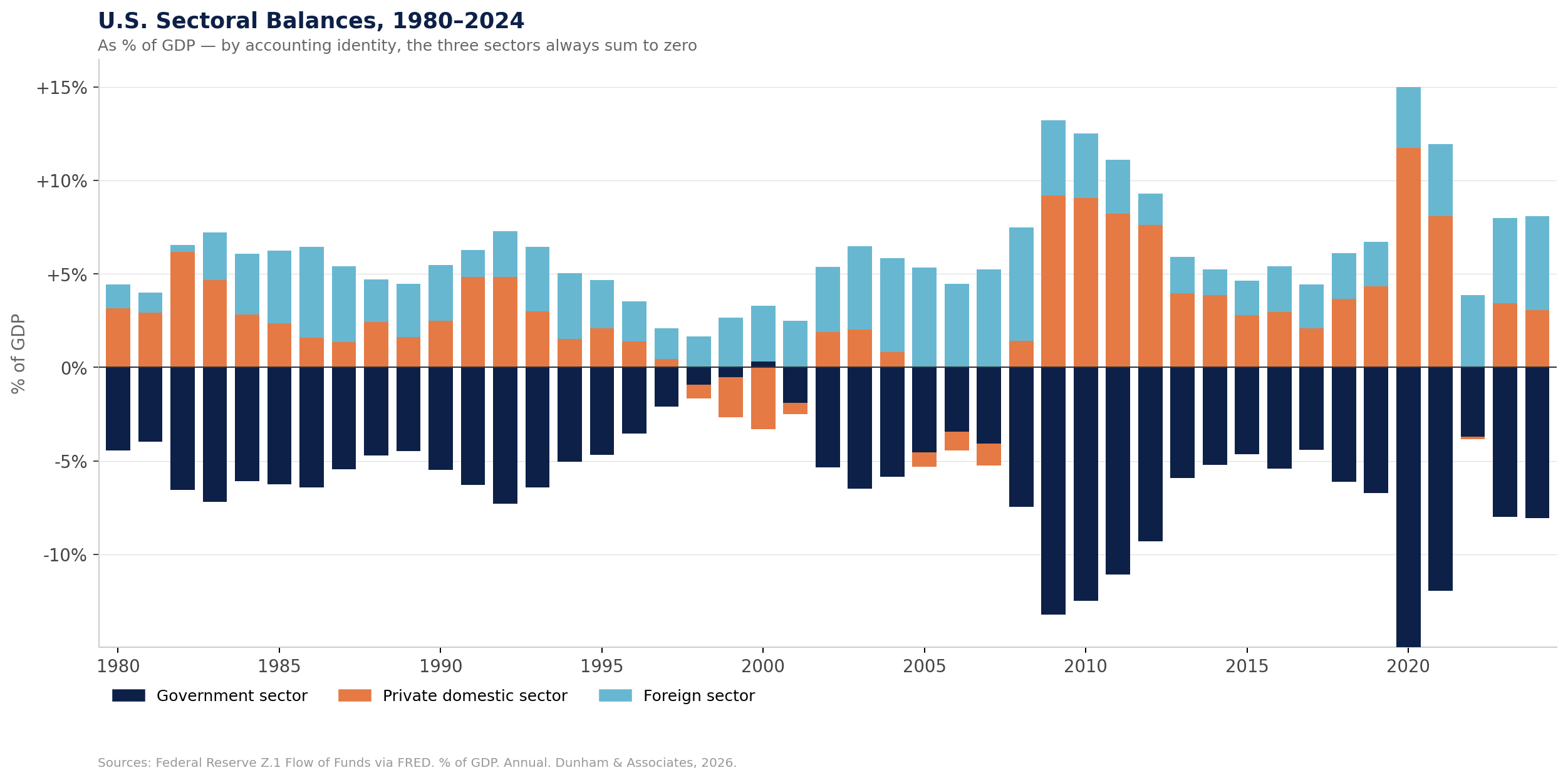
Look at the 35-year chart below.
The blue bars are the government sector. The orange bars are the private domestic sector. And the light blue bars are the foreign sector (the trade balance).
Note that the foreign sector is positive because the U.S. runs a trade deficit - aka dollars flow abroad to pay for imports, but those dollars return as foreign investment in U.S. assets like Treasury bonds. The bar shows foreigners are net lenders to America (positive = foreign borrowing).
See how they all offset one another?
That’s because as I mentioned above, they must balance - when the government deficit deepens (navy goes lower), the private sector surplus rises (orange goes higher). Vice versa the other way,
That's the Three Bucket Rule in forty-five years of data.
And four moments stand out.
Figure 4: St. Louis Federal Reserve, Dunham, April 2026
The Clinton Surpluses: When the Private Sector Took On the Debt
When the government drained its bucket by running a surplus, Americans borrowed to compensate. Look at the chart - the private sector bar actually goes negative during this period. That almost never happens. The dot-com boom ran on credit, funded heavily by foreign capital pouring into U.S. assets - which sent the dollar surging.
2008: The Financial Crisis That Proved Godley’s Point
In the years leading up to the crash, the private sector was running a deficit of its own.
Households were taking on mortgage debt at record pace. Businesses were borrowing aggressively. The government deficit had actually shrunk through 2004–2007 - meaning less money was flowing in from that side.
So where was the fuel coming from? Foreign capital.
Foreigners were pouring money into U.S. mortgage-backed securities, funding the private sector's borrowing binge from the outside (as the chart shows, the foreign sector bar is near its highest point in the entire dataset during this period).
Then the music stopped.
The private sector did what it had to — it stopped borrowing and started paying down debt. Households cut spending. Mortgage debt fell. Businesses pulled back. The private sector bucket flipped from deficit to deflating almost overnight.
Less money was flowing into the private sector. So households and businesses did what they had to — they spent down savings to keep consumption going. The private sector surplus shrank steadily through 2017. It wasn't sustainable.
At the same time, the Fed started hiking rates in 2015. Capital flooded into the U.S. chasing higher yields. The dollar strengthened. And emerging markets that had borrowed heavily in dollars during the easy-money years of 2009–2012 suddenly found those debts far more expensive to service.
Three things were running against the global economy at once. The government was draining its bucket through deficit reduction. The private sector was running thin on savings. And a surging dollar was squeezing dollar liquidity across the world.
Thus by late 2019 - before anyone had heard of COVID - the global economy was already flirting with a recession. The Three Bucket Rule was working in reverse. And the world was paying for it.
2020-2021: The Largest U.S. Deficit Since World War II
Then COVID hit and the government opened the floodgates.
The deficit exploded to 15% of GDP - the largest since WWII. The private sector surplus surged to ~12%. Asset prices soared. The stock market recovered in months, fueling the 2021 “everything” bubble8. Inflation roared as a side effect - a reminder that refilling buckets at speed has consequences.
Look at 2020 on the chart. The navy bar drops to its lowest point in forty years. The orange bar spikes to its highest.
That's The Three Bucket Rule working exactly as it should - in the most dramatic way possible.
With All These Deficits - Can the U.S. Government Go Bankrupt?
Now you may be asking yourself, if deficits fill the private sector bucket, why don't countries just run bigger deficits forever? And won't this eventually lead to a government default?
Both are great questions. And they point to the real risks of running perpetual deficits — default, inflation, and inequality. One of those risks is largely a myth. The other is extremely dangerous.
The default risk first.
The U.S. government cannot technically go bankrupt.
Think of Monopoly. The bank cannot go broke. If it runs out of bills, you write the amount on paper and keep playing. The bank doesn't have money - it is the money. Its only constraint is whether too much cash chasing too few properties makes the game unplayable.
The U.S. government works the same way.
A household can go bankrupt. A business can go bankrupt. A foreign government can (if it borrowed in a currency it doesn't control).
The U.S. is different. It issues the dollar - the very currency most global debt is denominated in.
In fact, former Fed Chair Alan Greenspan said on Meet The Press10 in 2011 that, "The United States can pay any debt it has because we can always print money to do that. So there is zero probability of default."
The point is – the U.S. government will always pay its bonds. But the dollars it pays you with might be worthless.
Now the inflation risk - and this is the main one.
Bigger deficits mean more spending and money sloshing around.
That’s inflationary - which curbs living standards and makes private sector borrowing more expensive across the board.
And as the debt pile grows, it becomes a self-feeding loop. More dollars are needed just to service it - interest payments, rollovers, repayments. If those dollars aren't there, debtors default, asset prices collapse, and you get debt deflation - the kind of crisis that turned a recession into the Great Depression in the 1930s.
That's why deficits keep growing. The economy needs the dollars to sustain itself.
Meanwhile, deficits aren't neutral – meaning they have both winners and losers. Inflation disproportionately hurts the bottom 80% of households - those who don't own assets. Their wages stagnate while the cost of living rises.
And on the other hand, asset owners watch their balance sheets swell as the flood of dollars pumps up stocks, real estate, and everything else they hold.
Put simply, the haves accumulate wealth while the have-nots fall further behind.
So no - deficits aren't a free lunch. The government may not be able to go broke. But the bill still lands somewhere. It lands in rising prices, eroding purchasing power, and a wealth gap that keeps widening with every cycle.
Why Sectoral Balances Change the Deficit Debate
Every time the deficit debate heats up, the same arguments come back. The debt is out of control. Cut spending. Balance the books.
But The Three Bucket Rule doesn’t offer a solution – only a choice.
Run large deficits and you risk inflation and inequality spiraling.
Or cut the deficit and you drain the private sector - forcing households and businesses into debt just to keep growth going. Push hard enough and you get a debt trap. Defaults. Crashing asset prices. Recession.
Pick your poison.
Keep in mind, this isn't an argument for or against deficits. Economics is never that simple - there are countless moving parts tilting things in any direction at once.
But what the buckets show is that running a surplus isn't automatically good, and running a deficit isn't automatically reckless. There's always a cost. The only question is who pays it and when.
Godley saw this tension thirty years ago. He didn't predict 2008 because he was smarter than everyone else. He just asked a question nobody else thought to ask.
If the government is saving - who exactly is losing?
Now you know the answer.
Frequently Asked Questions About Sectoral Balances
What are sectoral balances in economics? Sectoral balances measure the net lending or borrowing of three sectors: government, the domestic private sector, and the rest of the world. Their balances sum to zero when measured consistently. If one sector spends more than its income, the others collectively have an offsetting surplus. The framework connects government finances with private saving, investment, and the current account over a given period.
What is the sectoral balances equation? The sectoral balances equation is government balance plus domestic private balance plus foreign balance equals zero. Using the domestic current account instead, private net saving equals the government deficit plus the current account balance. For example, a $1 trillion government deficit and a $300 billion current account deficit imply a $700 billion domestic private surplus, assuming consistent measurement across all three sectors.
Do government deficits increase private sector savings? Government deficits correspond to an equal combined surplus across the domestic private and foreign sectors. How much goes to the domestic private sector depends on the current account balance. With a current account deficit, part of the offsetting surplus belongs abroad. The domestic private balance measures saving relative to investment, so an aggregate surplus doesn't mean every household has more money available.
What happens to private savings when the government cuts its deficit? If the current account balance stays unchanged, a smaller government deficit corresponds to a smaller domestic private financial surplus. Adjustment can involve changes in income, spending, investment, or borrowing. An improving current account can offset that decline. The accounting relationship shows which balances must adjust, but economic conditions and policy choices determine how that happens and who feels the effects.
This communication is general in nature and provided for educational and informational purposes only. It should not be considered or relied upon as legal, tax or investment advice or an investment recommendation, or as a substitute for legal or tax counsel. Any investment products or services named herein are for illustrative purposes only and should not be considered an offer to buy or sell, or an investment recommendation for, any specific security, strategy or investment product or service. Always consult a qualified professional or your own independent financial professional for personalized advice or investment recommendations tailored to your specific goals, individual situation, and risk tolerance. All examples are hypothetical and are for illustrative purposes only.
Information contained in the materials included is believed to be from reliable sources, but no representations or guarantees are made as to the accuracy or completeness of information. This document is provided for information purposes only and should not be considered as investment advice.
Dunham & Associates Investment Counsel, Inc. is a Registered Investment Adviser and Broker/Dealer. Member FINRA/SIPC. Advisory services and securities offered through Dunham & Associates Investment Counsel, Inc.
Sectoral Balances Explained: Why the U.S. Deficit Debate Misses the Point | Dunham