Content Editor, Dunham | 2025 ThinkAdvisor Luminaries Award Winner | 2026 Wealthies Finalist, Thought Leader of the Year | Macroeconomics, markets, geopolitics & global trends
A fiscal deficit occurs when government spending exceeds revenue. A trade deficit occurs when imports of goods and services exceed exports. When fiscal and external deficits occur together, economists often discuss twin deficits. This guide explains how these balances connect through saving and investment, why their effects vary, and what they can mean for debt, inflation, currencies, and investor portfolios.
Key Takeaways:
Not all deficits are the same:Fiscal deficits come from government spending more than it collects in taxes, while trade deficits reflect importing more than a country exports.
Why deficits matter:Persistent fiscal deficits can raise debt, crowd out private investment, and fuel inflation; large trade deficits can signal competitiveness issues or put pressure on the currency, even as they attract foreign capital.
The twin deficit problem:When a country runs both large fiscal and trade deficits, it becomes more reliant on foreign capital and more vulnerable to currency weakness, inflation, and policy constraints.
Why the U.S. is different — for now:As issuer of the world’s reserve currency, the U.S. can run bigger deficits for longer than most countries, but that privilege depends on continued global trust in the dollar.
Deficits as economic signals:Deficits are not inherently good or bad; they are signals about how a country spends, produces, trades, and borrows — and about potential future risks to growth and market stability.
Listen to this blog here
16:47
With headlines warning of “record deficits” and “unsustainable debt,” it’s easy to tune it all out. But now the noise is getting louder.
The result is a striking contradiction: government spending is surging while the country tries to export more and import less. One foot on the gas, the other on the brakes.
It’s a reminder that not all deficits are created equal — and they don’t always move in the same direction.
To understand what’s really at stake, let’s break down what a deficit is, why it matters, and how it affects the economy, markets, and policymakers.
What Is a Deficit?
A deficit is the gap that occurs when spending is greater than income over a given period.
And for countries, there are two major types of deficits you’ll hear about:
Fiscal Deficits: When the government’s spending outpaced its revenues.
Trade Deficits: When a country imports more goods and services than it exports.
Feature
Fiscal Deficit
Trade Deficit
Definition
Government spending exceeds revenue
Imports of goods and services exceed exports
What it measures
The government’s budget shortfall over a period
The country’s trade shortfall over a period
Calculation
Government spending minus government revenue
Imports minus exports
Common drivers
Spending increases, tax reductions, or falling revenue
Domestic demand, exchange rates, production patterns, and global trade conditions
Potential benefits
Supports demand during downturns and can fund public investment
Provides access to foreign goods, services, and productive inputs
Potential risks
Rising debt, interest costs, and reduced fiscal flexibility
Exposure to external financing conditions and adjustment pressures
Important distinction
An annual deficit adds to borrowing needs
The trade balance is one component of the current account
Keep this in mind when you hear someone say, “The deficit is exploding.”
Because the smart question is, “Which one are you talking about?”
What Is a Fiscal Deficit and Why Does It Matter?
A fiscal deficit happens when government spending exceeds total revenue during a given period. Governments typically finance the gap by borrowing through debt issuance.
Put simply, the Fiscal Deficit = Government Spending – Tax Revenue
To cover the gap - governments issue debt (bonds). And over time, that builds up into the national debt. And if that debt grows faster than the economy, it becomes a serious risk.
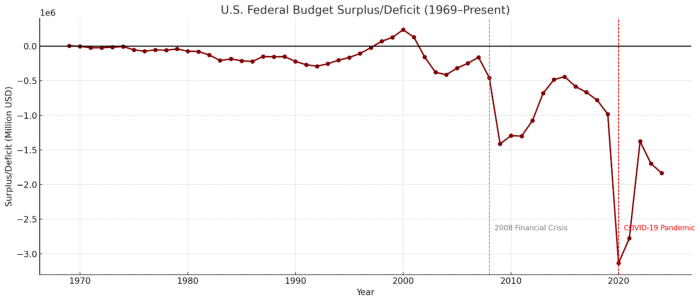
To put this into perspective - according to the Congressional Budget Office (CBO)3 – Interest alone on the debt is now the fastest-growing line item in the federal budget - projected to surpass $1 trillion annually by 2026 - and nearly $1.8 trillion by 2035.
Figure 1: St. Louis Federal Reserve, July 2025
3 Key Risks of Large Fiscal Deficits
Crowding Out Private Borrowers: When the government floods the market with bonds, investors buy. But in doing so, the government acts like a giant suction pump - pulling money out of the private sector. Thus, to compete for what’s left, the private sector has to raise interest rates to attract money towards them. But that makes it more expensive for businesses and consumers to borrow - leading to fewer business investments, slower hiring, and more expensive mortgages, car loans, and credit. Put simply, the government hogs the money pool, leaving less for everyone else
Fueling Inflation: Big deficits mean more money flowing into the economy, as the government spends more than it pulls back in through taxes. That kind of stimulus can overheat demand - especially when supply can’t keep up - because when more dollars chase the same amount of goods, prices rise. Add in the effects of currency debasement from too many dollars sloshing around, and you’ve got a recipe for persistent inflation. Sound familiar? Think back to the massive COVID-19 stimulus — trillions pumped into the economy, followed by a sharp rise in inflation4.
Ugly Market Perception: If investors start doubting a country’s ability to manage or repay its debt, they demand higher interest rates to compensate for the risk — or they pull their money out entirely. This can trigger a chain reaction where borrowing costs soar, the currency weakens as capital flees, growth sinks, and the overall debt burdens grow even more. It becomes a vicious cycle. More debt = higher interest rates = even more borrowing = repeat.
The Good, the Bad, and the Ugly of Fiscal Deficits
Now, keep in mind that not all deficits are bad. In fact, they’re often necessary during economic downturns.
See, governments aren’t households. They don’t need to balance the books each month. They can keep borrowing - and if needed, print money (you or I would go to jail for that). But sovereign nations - especially those that have a reserve currency (aka the dollar, euro, yen, etc.) - have more tools at their disposal when it comes to deficits.
So, let’s recap the good, the bad, and the ugly of fiscal deficits. . .
The Good: In a recession, deficits can act as a lifeline - jumpstarting demand, lifting employment, and supporting recovery when the private sector pulls back. This “counter-cyclical” approach often leads to higher asset prices, job creation, and economic recovery as the government pumps money into the system.
The Bad: Larger deficits mean more money flowing through the system - which can lead also to consumer inflation, especially if supply chains are tight.
This means higher grocery bills, rent, and energy costs for everyday people.
A growing deficit can also signal a weak private economy - one that’s relying more on government spending and jobs to fuel growth. Over time, this dependence can lead to a cycle where growth requires ever more borrowing or monetary expansion, increasing the risk of long-term stagnation or debt-driven instability.
This is what worries me currently, since we’re running massive "crisis level" deficits at a time when the economy is supposed to be “healthy”.
The Ugly: If debt and deficits spiral out of control, and central banks resort to printing money to plug in the gaps - thus currency collapse becomes a real risk, absolutely crushing the entire economy (since currencies are the lifeblood of trade and everyday life).
That’s why sustained, uncontrolled deficit spending is usually only seen in extreme cases - like during wars or major economic shocks. Because too much can be ruinous.
What Is a Trade Deficit and Why Does It Matter?
A trade deficit happens when a country imports more goods and services than it exports, so more money flows out to foreign producers than comes in from exports.
Put simply, the Trade Deficit = Imports – Exports
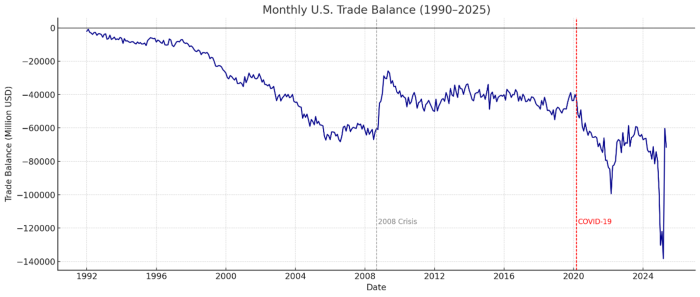
Take the U.S., for example. It consistently has one of the largest trade deficits in the world - a trend that’s persisted for more than three decades. In fact, in March 2025, the U.S. posted a record-high trade deficit of roughly $138 billion (before recovering to the post-COVID average range).
Figure 2: St. Louis Federal Reserve, July 2025
And these trade deficits come with side effects - such as:
Currency Pressure: Persistent trade deficits can weaken a country’s currency over time. Why? Because more domestic currency flows abroad to pay for imports - increasing supply and thus lowering its value.
Capital Inflows: On the flip side, countries with trade deficits often attract foreign investment to balance the books. What do I mean by “balance the books?” Well, here’s how it works: When the U.S. buys more from the world than it sells, other countries end up with U.S. dollars (aka a $100 U.S. trade deficit = a $100 global trade surplus; they have to balance out). Those dollars often flow back into the U.S. - through purchases of U.S. stocks, real estate, or government bonds. This keeps capital flowing into U.S. markets, even as we run trade deficits.
Remember: Every trade deficit is someone else’s surplus. So, while the U.S. may be “spending more abroad,” it’s another way of saying “the U.S. is the world’s biggest buyer — driving global growth.” And much of that money boomerangs back into our economy through capital inflows — into U.S. stocks, bonds, and real estate.
That’s why the U.S. can run large trade deficits and still remain a magnet for global flows(more on this below).
The Good, the Bad, and the Ugly of a Trade Deficit
And just like fiscal deficits, not all trade deficits are bad. Similarly, context is everything.
The Good: A trade deficit may signal a strong domestic economy and high consumer demand, hence we’re gobbling up even more than we produce. It can also mean we’re receiving valuable foreign investment, especially if the dollar is strong.
The Bad: A persistent deficit can point to underlying weaknesses — like loss of competitiveness, overreliance on foreign money, or shrinking manufacturing. Worse is that it can also be exploited geopolitically — as in the case of countries like China, which intentionally weaken their currencies to keep the U.S. dollar strong. This strategy makes their exports cheaper and keeps Americans consuming more of their goods — reinforcing the imbalance.
The Ugly: When a trade deficit combines with rising national debt, a weakening currency, and capital flight, it can trigger real economic instability — especially in emerging markets with fragile financial systems.
For the U.S., the risks are more structural than sudden. Over time, persistent trade imbalances can hollow out key industries as manufacturing moves overseas. Jobs are cut at home as cheap imports lead to businesses closing. To maintain living standards, households may take on more debt, borrowing to keep up their spending (which we’ve seen since the 2000s).
Meanwhile, domestic producers lose ground abroad, eroding export strength and long-term competitiveness. Left unchecked, these imbalances don’t just dent the economy — they weaken its very foundation, even in a country as large and resilient as the United States (and every major economy before it throughout history).
They also give foreign investors growing claims on U.S. assets. Each time the U.S. runs a trade deficit, dollars flow abroad - and many return to buy American stocks, bonds, real estate, and companies.
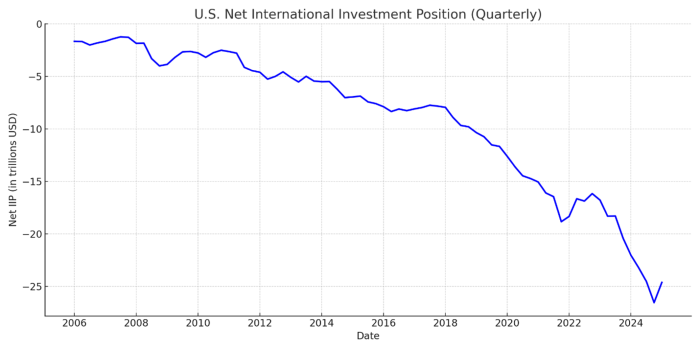
Over time, this builds up in the Net International Investment Position (NIIP) - basically a measure of what the world owns of the U.S. vs. what the U.S. owns abroad.
Figure 3: St. Louis Federal Reserve, July 2025
That balance is now deep in the red at –$24.6 trillion, reflecting decades of borrowing and selling to finance imports.
What Is the Twin Deficit Problem?
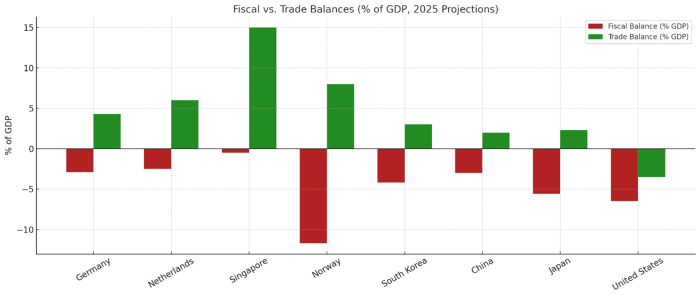
The twin deficit problem is when a country runs both a large fiscal deficit and a large trade deficit at the same time, making it more dependent on foreign capital and more exposed to currency and interest rate shocks.
See, many countries - like Germany, Japan, China, and South Korea — often run fiscal deficits while maintaining trade surpluses, thus cushioning the impact of public spending.
Their strong export sectors bring in foreign earnings, reducing reliance on external borrowing and helping to stabilize their currencies.
But what happens when both sides of the ledger are in the red?
That's the twin deficit problem - when a country is overspending at home and over-importing from abroad.
And right now, the United States is doing both.
Figure 4: CEIC, WorldBank, July 2025
Why the Twin Deficit Is a Problem
Double Dependence on Foreign Capital: Running both a fiscal and trade deficit means a country is borrowing at home to fund spending and abroad to pay for imports. Thus it relies heavily on foreign investors to plug both gaps
Vulnerability to Shocks: If investors lose confidence, capital flows can reverse — causing interest rates to spike, the currency to fall, and growth to slow. It leaves little room for policy flexibility.
Currency Weakness & Inflation: More money flowing out than in puts downward pressure on the currency. A weaker currency makes imports more expensive, fueling inflation and hurting consumers.
How Can the U.S. Run Twin Deficits?
That said, the U.S. is in a very different position than a country like Argentina or Turkey. Why? Because the U.S. dollar is the world’s reserve currency. That means governments, central banks, and investors around the world use dollars to trade, save, and invest.
So even when the U.S. runs large fiscal and trade deficits, there’s usually no shortage of buyers for U.S. debt or demand for dollar-based assets like Treasury bonds, real estate, and stocks. The world still trusts the dollar — and that trust gives the U.S. a longer leash.
That global role also creates tensions between domestic economic priorities and international demand for dollar assets - a challenge called Triffin’s Dilemma.
But emerging markets don’t get that luxury. . .
Countries like Argentina or Turkey often borrow in foreign currencies — usually dollars or euros — or run trade surpluses to earn them. But since they can’t print those currencies, they’re forced to either export more or borrow more just to stay afloat. Thus, if they’re running a twin deficit, those dollar inflows dry up and the results can be brutal – like currency crashes, debt defaults, and inflation spikes.
The U.S., by contrast, can borrow in its own currency, which gives it far more breathing room - at least for now.
Think of this this way:
The U.S. is like a popular store that can run a tab with its suppliers - and even with itself. Everyone wants their business, so it can afford to spend more than it earns and still get favorable credit terms.
Countries like Argentina or Turkey are more like street vendors. If they want dollars, they need to sell something first - and keep selling. Otherwise, they have to borrow. No sales or credit? No dollars. And if confidence fades, customers and lenders disappear, and the cash dries up fast.
Final Thoughts: Deficits Aren’t Just Numbers - They’re Signals
Whether it’s fiscal or trade, a deficit is more than a budget imbalance — it’s a signal about how a nation spends, produces, trades, and grows.
On their own, deficits can be tools. But unchecked or poorly timed, they become liabilities. And when both fiscal and trade deficits grow together - as the U.S. is seeing now - it can signal a real problem.
That’s why understanding deficits isn’t just for economists. It’s essential for investors, policymakers, manufacturers, and anyone trying to make sense of where the economy might be headed next.
Because the truth is, it’s not just about how much we owe — it’s about how long the world is willing to keep lending. Or how long the U.S. can subsidize global consumption at the expense of our own economy.
But as always, time will tell.
Frequently Asked Questions About Fiscal and Trade Deficits
What is the difference between a fiscal deficit and a trade deficit? A fiscal deficit means a government spends more than it collects in revenue. A trade deficit means a country imports more goods and services than it exports. Governments usually cover fiscal deficits by borrowing. Trade deficits are part of the broader current account, which also includes income flows and transfers between a country’s residents and the rest of the world.
What is the twin-deficit problem? The twin-deficit problem occurs when a country has both a fiscal deficit and a current account deficit. Government borrowing can reduce national saving and contribute to the external deficit, but private saving and investment also matter. When both deficits persist, changes in financing conditions or investor confidence can create pressure. The risks depend on growth, debt structure, and how borrowed money is spent.
Are fiscal and trade deficits bad for the economy? Fiscal and trade deficits aren’t always bad for the economy. Fiscal deficits can support jobs and spending during recessions or fund useful public investment. Trade deficits can reflect strong demand and access to foreign goods and services. Risks grow when borrowing becomes costly or financing becomes less reliable. A deficit’s causes, size, and duration matter when judging its effects.
Why can the U.S. run large deficits? The U.S. can finance large deficits because it borrows in its own currency, has deep financial markets, and benefits from global demand for dollar assets. These strengths help fund government borrowing and external deficits. They don’t remove the risks, though. Higher interest costs, slower growth, or weaker investor demand can put pressure on financing and the government’s ability to manage its debt.
This communication is general in nature and provided for educational and informational purposes only. It should not be considered or relied upon as legal, tax or investment advice or an investment recommendation, or as a substitute for legal or tax counsel. Any investment products or services named herein are for illustrative purposes only and should not be considered an offer to buy or sell, or an investment recommendation for, any specific security, strategy or investment product or service. Always consult a qualified professional or your own independent financial professional for personalized advice or investment recommendations tailored to your specific goals, individual situation, and risk tolerance. All examples are hypothetical and are for illustrative purposes only.
Information contained in the materials included is believed to be from reliable sources, but no representations or guarantees are made as to the accuracy or completeness of information. This document is provided for information purposes only and should not be considered as investment advice.
Dunham & Associates Investment Counsel, Inc. is a Registered Investment Adviser and Broker/Dealer. Member FINRA/SIPC. Advisory services and securities offered through Dunham & Associates Investment Counsel, Inc.