Content Editor, Dunham | 2025 ThinkAdvisor Luminaries Award Winner | 2026 Wealthies Finalist, Thought Leader of the Year | Macroeconomics, markets, geopolitics & global trends
Beijing calls yuan internationalization "irreversible," but an economic law says otherwise. The Impossible Trinity holds that no country can have free capital flows, a fixed exchange rate, and an independent monetary policy all at once. Every country must choose two. History shows what happens to countries that try to force all three anyway: reserves drain, the currency breaks, and the system collapses. That's the constraint Beijing runs into, whether it admits it or not.
Key Takeaways:
The Impossible Trinity proves no country can maintain free capital flow, a fixed exchange rate, and independent monetary policy simultaneously.
The U.S. chooses capital mobility and monetary independence — giving it a floating dollar and reserve currency status.
China's yuan relies on a shadow peg and capital controls — making it unfit for a global reserve role.
The 1997 Asian Financial Crisis shows the real cost of defying the trilemma.
Until China opens capital flows, the yuan cannot realistically challenge the dollar's dominance..
Listen to this blog here
10:52
What Is the Impossible Trinity?
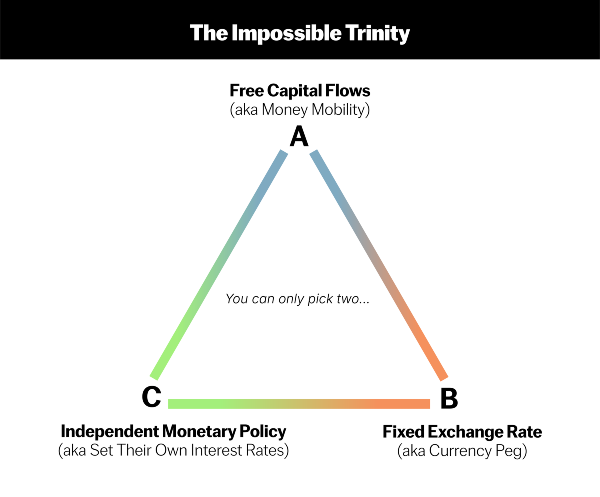
The Impossible Trinity – or known as the policy trilemma1 - is an economic principle that says a country cannot have all three of the following at the same time:
Free Capital Flow – Money can move in and out of the country without any red tape or controls (aka an open capital account).
Fixed Exchange Rate – The country’s currency stays tied to another currency or basket of currencies (aka a currency peg).
Independent Monetary Policy – The central bank acts independently and sets interest rates and monetary policy to control inflation and growth (aka independent central bank policy).
Figure 1: Dunham, 2025
If a country goes for all three, it'll risk chaos in its economy.
So, the deal is simple – . Trying to have it all? Well, that’s when things begin to break.
China directly controls how money moves in and out of the country – unlike both the U.S. and Hong Kong. This is known as a “closed capital account” – think of it like having gates around their money to stop people from sending large amounts of it abroad or letting too much foreign money come in.
a country must pick two and stick with it
This may seem complex, so let’s look at some real-life examples. . .
How Major Economies Apply the Impossible Trinity
Economy
Free Capital Flows
Fixed Exchange Rate
Independent Monetary Policy
Main Trade-Off
United States
Yes
No
Yes
The dollar floats, so its value can rise or fall with market conditions.
Hong Kong
Yes
Yes
No
Interest-rate policy largely follows the United States to maintain the Hong Kong dollar peg.
China
No, capital controls remain
Managed exchange rate
Yes
Capital controls help China manage the yuan and retain greater monetary-policy control.
1. The United States - Dominance Through Free Capital Flows
The U.S. made its pick in the Impossible Trinity game. It decided on two things:
The U.S. chose free capital flow and an independent monetary policy. That means the Federal Reserve sets rates on its own terms — and anyone in the world can buy or sell dollars freely, at any time.
But here’s the trade-off. . .
The U.S. doesn’t (and can’t) have a Fixed Exchange Rate. This means the value of the U.S. dollar can go up or down, depending on what’s happening around the world.
For example, there are no policymakers pegging the dollar to the euro or yen to manage it’s relative value.
Critics rightly argue that the U.S.’s large chronic deficits should cause a much weakerdollar. Yet, a glut of foreign money easily parked in the U.S. keeps it strong, making U.S. exports more expensive and less competitive globally. Meanwhile, this dynamic allows these countries to export more to the U.S., fueling America’s trade deficit so that they can boost their own growth.
This is the price the U.S. pays for playing the Impossible Trinity game.
2. Hong Kong - Stability Over Control
Hong Kong chose a fixed exchange rate and free capital flows. Since 2005, the Hong Kong dollar has been pegged between $7.75 and $7.85 to 1 USD. Capital moves freely in and out - which makes Hong Kong a premier hub for international trade and finance.
But here’s the catch then: Hong Kong can’t set its own Independent Monetary Policy.
Instead, the Hong Kong Monetary Authority (aka the HKMA, the central bank) has to follow whatever the U.S. does with interest rates.
Why? If the U.S. raises its interest rates, the U.S. dollar becomes stronger. Hong Kong then has to raise its rates too, to keep the HKD tied to the USD. And vice versa if the Fed cuts interest rates.
But this can cause problems.
For instance, imagine if the U.S. raises rates to slow things down because they’re worried about inflation, but Hong Kong is in a recession. Hong Kong would have to raise rates too, which could make their economy even worse.
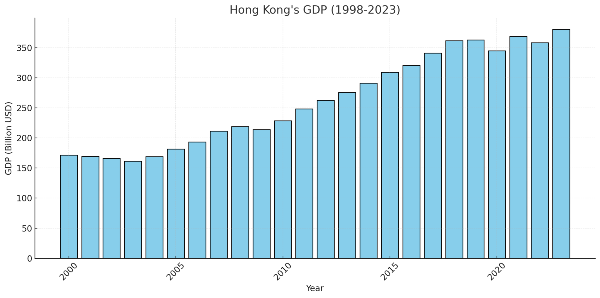
This is exactly what’s happened ever since the Fed began tightening interest rates in December 2015. Since then, Hong Kong’s economy has been struggling under the weight of following the Fed into tightening. As the chart below shows, it’s been roughly stagnant for the last 8 years (once the Fed began tightening for the first time since the 2008 financial crisis).
Figure 2: St. Louis Federal Reserve, Dunham, January 2025
Or, if Hong Kong is booming and needs to cool down, but the U.S. is lowering rates, Hong Kong might end upoverheatingand spurring more and more inflation.
That’s the price Hong Kong pays for choosing these two policies.
Note: Saudi Arabia follows this exact model that Hong Kong does, maintaining a hard peg to the U.S. dollar.
3. China - Prioritizing Control Over Global Influence
China, on the other hand, has taken a distinctly different approach.
China chose a fixed exchange rate and an independent monetary policy. The People's Bank of China doesn't explicitly peg the yuan to the dollar, but it heavily manages it - a so-called 'shadow peg.' This keeps Chinese exports cheap and supports a heavily subsidized manufacturing economy.
But here’s the catch:
No Free Capital Flow:
Why does China do this?
Because if people could move money freely, it would greatly influence the yuan’s value. For example, if China lowers interest rates to help its economy, investors might prefer to send their money to the U.S., where interest rates are higher. That would cause the yuan’s value to drop because too many people are selling yuan to buy U.S. dollars. This could break their shadow peg.
Thus, by controlling money flows, China can keep its system stable.
Note: China actually operates two versions of its currency - the onshore yuan (CNY) and the offshore yuan (CNH). This dual system lets China manage the currency domestically while allowing limited use abroad.
What Happens When a Country Defies the Impossible Trinity?
Fixed Exchange Rate – They pegged the baht to the U.S. dollar to attract investment and make the currency stable.
Free Capital Flow – They also allowed money to move freely in and out of the country.
Independent Monetary Policy – Policy makers at the Bank of Thailand wanted to set interest rates (specifically to cut interest rates).
What went wrong?
The Crux Of The Demise: Long story short, Thailand had pegged the baht to the U.S. dollar for years. Thus, as the U.S. dollar strengthened in the late 1990s, so did the baht, making Thailand’s exports uncompetitive. Meanwhile, a surging deficit and high short-term foreign-currency debt eroded confidence in its economic stability.
What happened next?
Massive Outflows: With these headwinds, domestic and global investors lost confidence in Thailand’s economy and started yanking money out.
Currency Blitz: The central bank burned through foreign reserves trying to defend the baht’s peg until they bled themselves out.
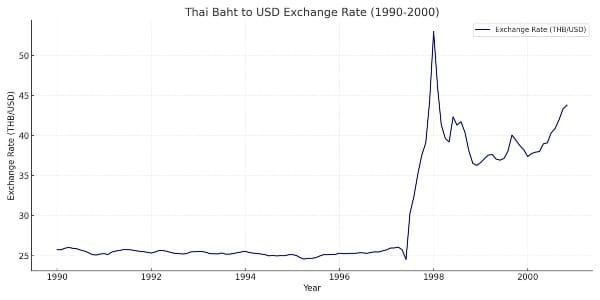
Breaking Point: Reserves ran out, and Thailand abandoned the fixed exchange rate in July 1997 and leaders were forced to let the baht plunge over 50% after over a decade of stability (see chart below showing the Baht’s collapse relative to the U.S. dollar).
Figure 3: St. Louis Federal Reserve, Dunham, January 2025
What was the fallout?
The baht lost over 50% of its value – a massive shock to the once golden goose of Asia’s economic boom.
A regional crisis then followed - impacting countries like South Korea and Indonesia.
The IMF was forced to intervene with bailout packages to try and stabilize Asia.
The Takeaway:
Thailand’s miserable failure highlights the risks of trying to "have it all" when it comes to the Impossible Trinity. At the end of the day, you’re forced to pick two.
Why the Yuan Won't Replace the Dollar (For Now)
So why does the Impossible Trinity matter for the U.S. dollar and the talk of de-dollarization?
Because China’s approach shows why the yuan won’t replace the dollar as the world’s reserve currency anytime soon, despite what you hear in the media.
China fixes its exchange rate and runs its own monetary policy. But it does this by shutting off capital flows - a major problem.
A reserve currency must allow money to move freely and quickly, without restrictions. China’s capital controls make the yuan unappealing to central banks and investors who value the U.S. dollar’s liquidity.
Moreover, if China loosened capital controls while maintaining a peg and independent monetary policy - trying to achieve all three sides of the Impossible Trinity - it would risk draining its foreign reserves. History, particularly Thailand’s 1997 collapse, shows this strategy is unsustainable.
In fact, I believe China avoids lifting capital controls because Beijing fears a massive outflow of money. Financially repressed households would likely rush to move their savings abroad into more attractive markets, putting deep pressure on the yuan’s peg.
Thus, until Beijing embraces free capital flows - which means giving up either the peg or monetary independence - the yuan can't challenge the dollar at a structural level.
Frequently Asked Questions About the Yuan as a Reserve Currency and The Impossible Trinity
Why can't China's yuan replace the U.S. dollar as the world's reserve currency? China keeps tight control over its capital account, and that's the main roadblock. A true reserve currency needs free capital flow, so investors can move money in and out with no restrictions. China won't allow that because it would mean giving up control over its exchange rate and monetary policy. As of late 2025, the yuan held under 2% of global reserves, a share that's held steady for years.
What percentage of global reserves does the yuan hold right now? The yuan held 1.95% of allocated global foreign exchange reserves in the fourth quarter of 2025, according to IMF data, edging up slightly to 1.99% in early 2026. The U.S. dollar, by comparison, held about 57% of reserves over the same stretch. Even with years of Beijing pushing yuan use abroad, that gap has barely closed since China's currency joined the IMF's reserve basket in 2016.
Is the yuan's global use growing or shrinking in 2026? It's growing, just slowly. Payment data from SWIFT shows the yuan's share of global transactions climbed from around 2.7% in late 2025 to roughly 3.1% by mid-2026, moving it up to fifth place among world payment currencies. Its reserve share ticked up too, from 1.95% to 1.99% over the same period. That's real progress, but it still leaves the yuan far behind the dollar and euro.
What is the Impossible Trinity, and how does it explain the yuan's limits? The Impossible Trinity says a country can't have free capital flow, a fixed exchange rate, and independent monetary policy at the same time. It has to pick two. The U.S. chose free capital flow and monetary independence, letting the dollar float. China chose a managed exchange rate and monetary independence, so it keeps capital controls in place. That tradeoff is why the yuan can't function as a true reserve currency yet.
This communication is general in nature and provided for educational and informational purposes only. It should not be considered or relied upon as legal, tax or investment advice or an investment recommendation, or as a substitute for legal or tax counsel. Any investment products or services named herein are for illustrative purposes only and should not be considered an offer to buy or sell, or an investment recommendation for, any specific security, strategy or investment product or service. Always consult a qualified professional or your own independent financial professional for personalized advice or investment recommendations tailored to your specific goals, individual situation, and risk tolerance. All examples are hypothetical and are for illustrative purposes only.
Information contained in the materials included is believed to be from reliable sources, but no representations or guarantees are made as to the accuracy or completeness of information. This document is provided for information purposes only and should not be considered as investment advice.
Dunham & Associates Investment Counsel, Inc. is a Registered Investment Adviser and Broker/Dealer. Member FINRA/SIPC. Advisory services and securities offered through Dunham & Associates Investment Counsel, Inc.
The Impossible Trinity: Why the Chinese Yuan Can't Replace the Dollar | Dunham