Content Editor, Dunham | 2025 ThinkAdvisor Luminaries Award Winner | 2026 Wealthies Finalist, Thought Leader of the Year | Macroeconomics, markets, geopolitics & global trends
Updated July 31, 2026:China’s stock market selloff is revealing a divide that the earlier rally concealed: equities were supported by liquidity, policy enthusiasm, and technology optimism while consumption and property remained weak. With the CSI 300 down about 8% in July 2026 alone and China’s economy slowing more than expected in Q2, the key question is whether earnings and domestic demand can catch up.
Key Takeaways
China’s stock market rally is being driven by liquidity and leverage — not strong economic growth.
Deflation, weak loan demand, and a prolonged property downturn signal continued economic stress.
China’s money supply now exceeds 230% of GDP, highlighting extreme monetary expansion.
Rising margin debt increases the risk of a volatility-driven unwind similar to 2015.
The widening gap between stock prices and economic fundamentals raises questions about sustainability.
There’s a strange battle unfolding in China right now.
A Bronze Dragon of a stock market versus a Paper Tiger economy.
If you only look at the year-over-year ticker tapes, you’d think China has entered a new Golden Age.
TheCSI 300 Index1 (China’s S&P 500) is up roughly ~20% – hitting it’s highest levels in four years.
TheShanghai Composite Index2 (China’s version of NYSE) is up ~22% - hitting its highest since the great 2015 Chinese stock bubble.
TheSSE STAR Market3 (aka STAR50; their version of the NASDAQ) is up a staggering 40%-plus.
This is what I mean by the Bronze Dragon.
It’s shiny. It’s sturdy. It’s fierce. And it’s fueled by a massive policy pivot toward high-tech "advanced manufacturing” and easy money flooding the system – pushing prices and speculative trading to records.
But markets aren’t the economy.
And that’s where the tension begins.
China’s Real Economy: Deflation, Debt, and a Property Collapse
Underneath the booming market is the real economy (aka main street). And it tells a different story.
This is the Paper Tiger.
It looks large. It looks powerful. But it’s actually flimsy and crinkled.
Rampant price wars that have firms - from autos to restaurants - undercutting each other to try and move inventory – even selling below costs to try and gain a sliver of an advantage.
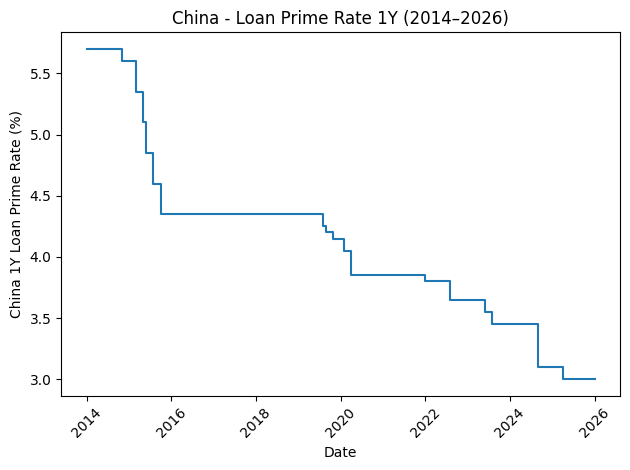
Because of this, the People’s Bank of China (PBOC) slashed interest rates - pushing the 1-Year Loan Prime Rate (LPR) – aka the benchmark for all lending - to a record low of 3.0%.
Figure 1: Bloomberg, Dunham, January 2026
Meanwhile, China’s money supply has absolutely ballooned.
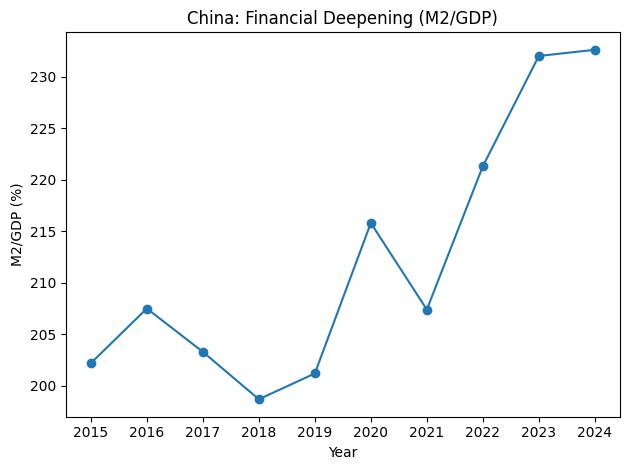
Just look at China’s M2-to-GDP ratio - sitting at a staggering 231%.
M2 is the liquid money supply = cash, deposits, the fuel sloshing around the system.
GDP is the economy = the real output.
That means China’s money supply is 2.3x larger than the entire economy.
For every dollar of economic output, there is more than two dollars of money circulating in the system.
Figure 2: World Bank, Dunham, January 2026
To put this into perspective, the U.S. sits closer to 70%.
Thus, China cut rates and pumped money into the system at an aggressive rate.
And in economic theory - cheaper money should help fund factories, home purchases, and overall demand.
It's a rare type of crisis that usually happens when a major asset bubble bursts - especially housing – and households and businesses focus on paying down debt instead of borrowing more (aka deleveraging).
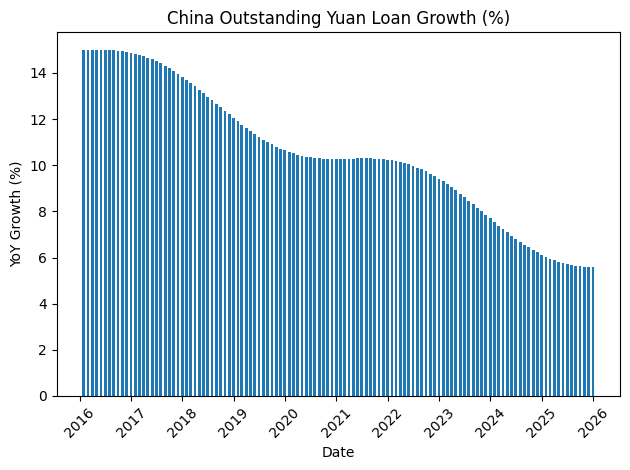
Thus, even if interest rates fall, demand for credit remains weak.
Why? Because, like the horse, you can’t force people to borrow simply because money is cheap.
And this has created a big problem for Beijing.
See, as the PBOC cuts rates to stimulate growth, bank profitability got squeezed.
Thus, desperate for any type of profit - bank lending is flowing elsewhere. . .
China’s Margin Debt Surge: Is Leverage Driving the Rally?
With limited demand in the real economy, liquidity has instead piled up and started pouring into financial markets.
Meaning – traders were borrowing this cheap money and buying stocks with it.
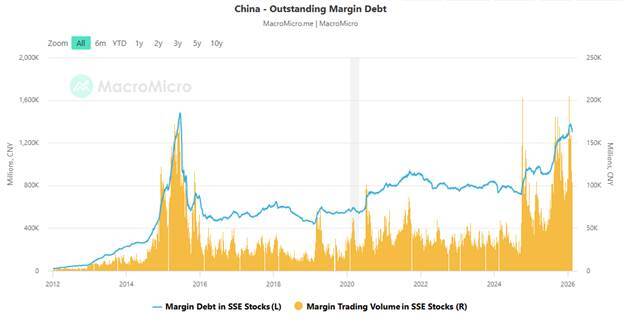
Just take a look at outstanding margin debt (aka when investors borrow money to buy more stocks). It’s surged 40% since mid-2025, returning to the same volatile levels that preceded the 2015 bubble.
Figure 4: MacroMicro.me, Dunham, 2026
Meanwhile, margintrading volumes recently just hit an all-time high.
This makes sense – because of the margin feedback loop:
The Boom: When credit is cheap, investors borrow to buy. This debt-fueled buying pushes prices higher, which boosts portfolio values. This allows traders to borrow even more. The cycle feeds itself until it’s a self-fulfilling prophecy of dizzying heights.
The Bust: But once the margin is cut off, the loop reverses. Falling prices trigger margin calls. To pay the brokers back, traders are forced to sell. This forced selling pushes prices even lower, triggering more margin calls – and feeding on it’s collapse lower.
Beijing wants organic growth – something that will endure and boost the economy.
It doesn’t want hot money-fueled booms that can get rug pulled at any moment (speculative frenzies).
Are Chinese Stocks Disconnecting From Economic Reality?
China’s stock market may continue to climb, even with tighter margins. A rising market clearly benefits Beijing to a degree as it can lift sentiment and create the perception that momentum has turned.
And liquidity can support markets longer than fundamentals suggest.
But – if in a balance sheet recession – pumping in more liquidity likely won’t fix:
Weak household consumption
Falling property prices
Deflationary pressure
A debt-heavy system
So, the Bronze Dragon may be flying.
But it’s flying with a leverage-fueled jet pack and above fragile ground.
At some point, equity valuations must snap back with earnings, income growth, and real demand.
And if the underlying economy remains weak, the gap between market prices and economic reality may become harder to sustain.
Final Thoughts
Yes. China’s stock rally is impressive. And investors have enjoyed this.
But rallies built on cheap money and leverage tend to be fragile.
Don’t forget that the Paper Tiger still faces:
Deflation
A property downturn
Slowing loan growth
High leverage
So, the question isn’t whether liquidity can push markets higher in the short term.
It’s whether the real economy can eventually justify those valuations.
Maybe it will. Maybe it won’t.
As always, this is just food for thought.
FAQ
What is driving China’s stock market rally? China’s stock market rally has been supported by easy money, policy support for advanced manufacturing, and rising speculative activity. Margin debt also climbed sharply, allowing traders to borrow more money to buy stocks and push prices higher.
Are Chinese stocks rising because China’s economy is strong? China’s stock market has risen even as the broader economy faces deflationary pressure, weak loan demand, falling home prices, and high debt levels. That disconnect is the central risk: market prices may be moving faster than underlying demand, profits, and household confidence.
What is a balance sheet recession? A balance sheet recession happens after a major asset bubble bursts and households and businesses focus on paying down debt instead of borrowing and spending. In China, falling property values have made consumers and companies more cautious, limiting the impact of lower interest rates.
Why does margin debt matter for Chinese stocks? Margin debt allows investors to borrow money to buy more stocks, which can accelerate gains during a rally. It can also amplify losses: falling prices can trigger margin calls and forced selling, creating a feedback loop similar to the one seen during China’s 2015 stock-market bubble.
Can China’s liquidity solve its economic problems? More liquidity can support financial markets in the short term, but it cannot by itself restore property values, household confidence, or private-sector demand. Sustainable growth would likely require stronger consumption, healthier credit demand, and a more durable recovery in the real economy.
This communication is general in nature and provided for educational and informational purposes only. It should not be considered or relied upon as legal, tax or investment advice or an investment recommendation, or as a substitute for legal or tax counsel. Any investment products or services named herein are for illustrative purposes only and should not be considered an offer to buy or sell, or an investment recommendation for, any specific security, strategy or investment product or service. Always consult a qualified professional or your own independent financial professional for personalized advice or investment recommendations tailored to your specific goals, individual situation, and risk tolerance. All examples are hypothetical and are for illustrative purposes only.
Information contained in the materials included is believed to be from reliable sources, but no representations or guarantees are made as to the accuracy or completeness of information.
Dunham &Associates Investment Counsel, Inc. is a Registered Investment Adviser and Broker/Dealer. Member FINRA / SIPC. Advisory services and securities offered through Dunham & Associates Investment Counsel, Inc.
Is China’s Stock Market Rally Forming a Bubble Amid Economic Weakness? | Dunham