Content Editor, Dunham | 2025 ThinkAdvisor Luminaries Award Winner | 2026 Wealthies Finalist, Thought Leader of the Year | Macroeconomics, markets, geopolitics & global trends
The natural rate of interest is the neutral, unobservable benchmark rate — implied by growth, inflation expectations, and returns on capital — against which every central bank rate decision is effectively measured. First theorized by Swedish economist Knut Wicksell in his 1898 book Interest and Prices, the concept explains why gaps between policy rates and this hidden rate (the Wicksellian Differential) drive boom-and-bust cycles. Natural rates have trended structurally lower since the 1980s due to aging demographics, weak productivity, and excess debt, making central banks increasingly prone to overtightening whenever they try to normalize policy.
Key Takeaways
The natural rate of interest is the neutral rate where the economy neither overheats nor slows down.
Wicksell’s theory shows how divergences between market rates and natural rates drive business cycles.
Global natural rates have been trending lower since the 1980s due to demographics, debt, and weak productivity.
Central banks are more likely to overtighten in the future because of structurally lower natural rates.
Investors should watch natural rate trends to anticipate monetary policy shifts and bond market moves.
Why Watch the Fed?
As investors, we all watch the Fed.
Why? Because they control the credit cycle — loosening or tightening liquidity.
There’s an old line on Wall Street: “Don’t fight the Fed.”
If they’re tightening, risk assets usually suffer. If they’re easing, liquidity flows and markets like it.
Simple enough.
But here’s the thing… sometimes the bond market fights back.
That’s what an inverted yield curve really means. The Fed hikes short-term rates, expecting growth and inflation. The long end of the curve disagrees — it prices in a slowdown and deflation instead.
And history shows this: every U.S. recession in the last 50 years was preceded by an inverted yield curve.
So here’s the question no one seems to ask:
“When the Fed hikes or cuts rates, what are they actually hiking or cutting against?”
Enter the Natural Rate of Interest
This is where the natural rate of interest comes in.
Put simply, it’s the “invisible” benchmark — the interest rate justified by economic fundamentals like growth, inflation expectations, and returns on capital.
Think of it as the neutral gear for the economy.
If the Fed sets policy the natural rate = too much credit, bubbles, and inflation.
If the Fed sets policy above the natural rate = credit tightens, growth slows, and recession risk rises.
The difference between the Fed’s short-term rate and this hidden natural rate? That’s called the Wicksellian Differential. And it’s often the spark behind the boom-and-bust cycle.
Wicksell’s Big Idea: The Natural Rate of Interest
This all comes from Knut Wicksell, a Swedish economist writing in the late 1800s.
In his book Interest and Prices (1898), he argued that as long as policy rates line up with the natural rate, the economy holds steady. But when they diverge — trouble follows.
Wicksell was onto something. His ideas still shape how the Fed thinks about monetary policy today.
What Do Natural Rates of Interest Tell Us About Global Yields and Monetary Policy?
Now, you may be wondering, “How can we calculate the natural rate of interest to know if market rates are stimulating or constricting?”
Well, that’s the tricky part. Because it technically can’t be directly observed as a market interest rate (aka the rates that institutions or consumers lend and borrow at).
However, there are models that use a variety of economic fundamentals to try and estimate the natural rate. From demographics and productivity to fiscal policy and investment returns.
Most show that natural rates have steadily declined globally since the 1980s on the back of too much debt, too little growth, relative deflation, diminishing returns, and poor demographic trends.
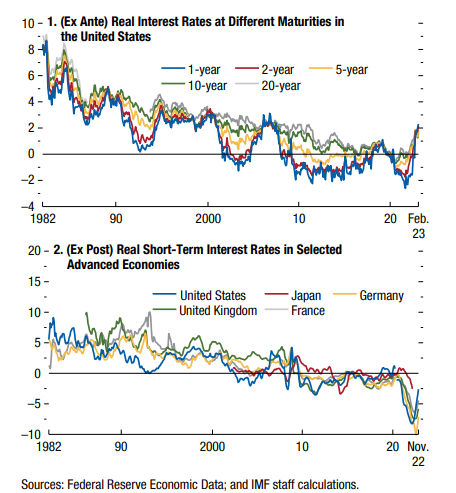
To put this into perspective – according to an International Monetary Fund (IMF) paper4 from April 2023 – ‘real’ (adjusted for inflation) interest rates have trended lower for decades across advanced economies. And even remained chronically negative after 2008 as the natural rate kept declining.
The only thing to meaningfully push up real interest rates over the last 18 months is the aggressive central bank tightening and higher inflation expectations.
But this may be short-lived. . .
In the same paper, the IMF notes, “The analysis suggests that once the current inflationary episode has passed [post-pandemic], interest rates are likely to revert toward pre-pandemic levels in advanced economies.”
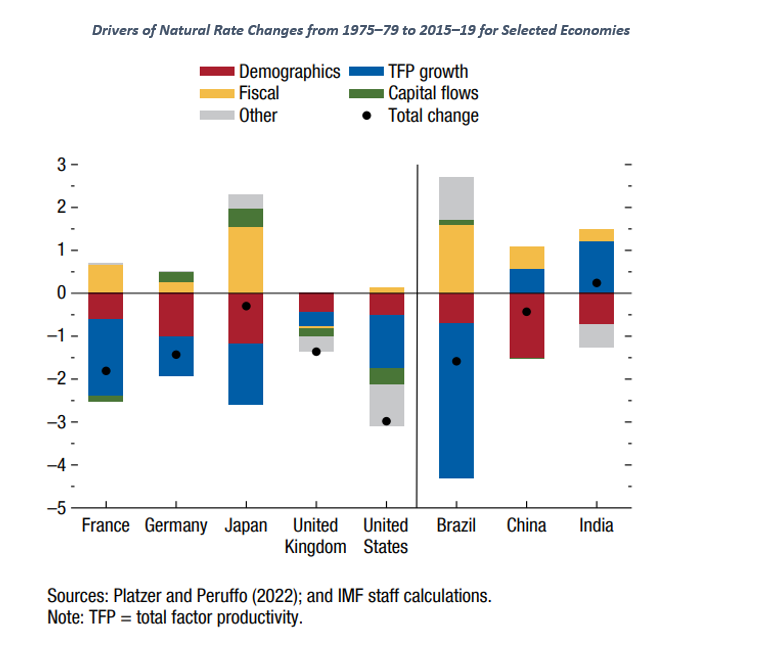
A big reason for this decline in global natural interest rates – as shown by the IMF analysis - is aging demographics and eroding total factor productivity (TFP; the total output relative to inputs and is often considered the primary contributor to GDP growth).
Why the Natural Rate of Interest Matters for Central Banks and Investors
This indicates that central banks and fiscal authorities have had to aggressively push short-term rates below market rates to keep growth going.
For instance, fiscal policy was an important offset, particularly in Japan and Brazil, as the economies required stimulus to offset declining productivity and weaker demographics.
Now, keep in mind that according to Wicksell’s concept, this chronic decline in the natural rates of interest has serious implications for global central banks.
For starters, most of these declines are structural issues that will weigh it lower and lower (such as the aging population, declining productivity, and excess debt).
Meanwhile, central bank policies are cyclical.
As mentioned above, if the natural rate is declining, then central banks must push short-term rates below it to spur growth.
So, let’s say the natural rate is 1%. That means the central bank must keep rates at 0% or even go negative (as we saw in Japan and the Euro area) to stimulate.
This is why central banks went much further with their ‘unconventional’ policies post-2008 – deploying quantitative easing (QE), negative interest rates (NIRP), and yield curve control (YCC) - to try and get things going.
But this also has serious complications when central banks want to raise interest rates in “normal” times.
Why? Because if the natural rate is chronically low, there’s a much higher chance a central bank overtightens and restricts growth, pushing them back lower than before.
This implies that the use of ever-more aggressive central bank policies will continue in the future as central bankers try and deal with structural issues weighing down natural rates.
This is something to keep an eye on because it will influence monetary policy around the world over the next decade
Summary
Global natural interest rates have been falling – on the back of structural issues – for decades and have thus pushed central banks into ever more easing.
This decline poses challenges for central bankers, as it limits their ability to spur growth through traditional means (for instance, look at Japan or Europe).
Additionally, the chronic decline in natural rates complicates the process of raising interest rates during "normal" times, as it increases the risk of overtightening, thus restricting growth, popping asset bubbles, and increasing financial instability.
So, to gain insights, we turned to the pioneering work of Knut Wicksell and his work on the natural rate of interest.
His theory suggests the interplay between central bank actions, natural interest rates, and fiscal measures that will continue to shape the financial landscape in the years to come.
But, in the face of such deep structural issues pushing natural interest rates lower, central banks may increasingly resort to even greater unconventional policies.
And as economies lean on fiscal stimulus to counteract these challenges, both the future of the bond market and monetary policy remain uncertain.
But, I believe yields long-term may continue declining globally as growth, demographic, and investment momentum fades and the monetary authorities eventually begin easing sooner rather than later to deal with these.
Just some food for thought. . .
Frequently Asked Questions About The Natural Rate of Interest
What is the natural rate of interest? It's the neutral rate where the economy runs at a steady pace, implied by growth, inflation expectations, and returns on capital. Economists can't observe it directly, but it works as the hidden benchmark every Federal Reserve decision gets measured against, whether markets notice it or not.
Who developed the natural rate theory? Swedish economist Knut Wicksell introduced the idea in his 1898 book "Interest and Prices," arguing the economy stays stable as long as policy rates track the natural rate. The gap between the Fed's rate and the natural rate, known as the Wicksellian differential, is often behind boom-and-bust cycles.
Why have natural rates fallen since the 1980s? Real interest rates have trended lower for decades across advanced economies due to aging demographics, weak productivity growth, and rising debt levels, according to an April 2023 IMF paper. Rates turned chronically negative after the 2008 financial crisis, and only recent aggressive tightening has pushed them back up, though that move may not last.
Why does a falling natural rate make central banks more likely to overtighten? Natural rate declines are structural, driven by demographics and productivity, while central bank policy moves in cycles. If the natural rate falls to 1%, the Fed has to push rates to 0% or negative just to spur growth, then risks overtightening later when it tries to normalize policy, choking off growth again.
What does a declining natural rate mean for future monetary policy? Central banks are likely to lean more on unconventional tools like quantitative easing, negative rates, and yield curve control, following the path Japan and Europe already took. Yields may keep grinding lower over the long run as growth, demographics, and productivity momentum fade, pushing central bankers toward earlier and more frequent easing cycles.
This communication is general in nature and provided for educational and informational purposes only. It should not be considered or relied upon as legal, tax, or investment advice or an investment recommendation, or as a substitute for legal counsel. Any investment products or services named herein are for illustrative purposes only and should not be considered an offer to buy or sell, or an investment recommendation for, any specific security, strategy, or investment product or service. Always consult a qualified professional or your own independent financial professional for personalized advice or investment recommendations tailored to your specific goals, individual situation, and risk tolerance.