Content Editor, Dunham | 2025 ThinkAdvisor Luminaries Award Winner | 2026 Wealthies Finalist, Thought Leader of the Year | Macroeconomics, markets, geopolitics & global trends
South Korea’s KOSPI has fallen sharply from its June 2026 peak after an AI-led rally drew heavy retail borrowing into a concentrated group of chip stocks. Margin debt reached a record ₩38.6 trillion in June, and forced selling accelerated as prices declined. The immediate issue is a market deleveraging event; the larger risk is whether it begins to pressure already indebted households and consumer demand.
What You Need to Know
The KOSPI’s sharp selloff followed an AI-led rally that made Korean chip stocks one of the market’s most crowded trades.
Margin debt reached a record ₩38.6 trillion in June, leaving retail investors vulnerable to forced selling as prices fell.
High household debt and record-low young-adult homeownership could make a prolonged market reversal harder for Korean consumers to absorb.
South Korea is central to the global AI memory-chip trade—making this a warning about valuation, concentration, and leverage.
Listen to this blog here
12:00
The KOSPI – Korea’s version of the S&P 500 - has gone from market darling to crime scene in a matter of weeks.
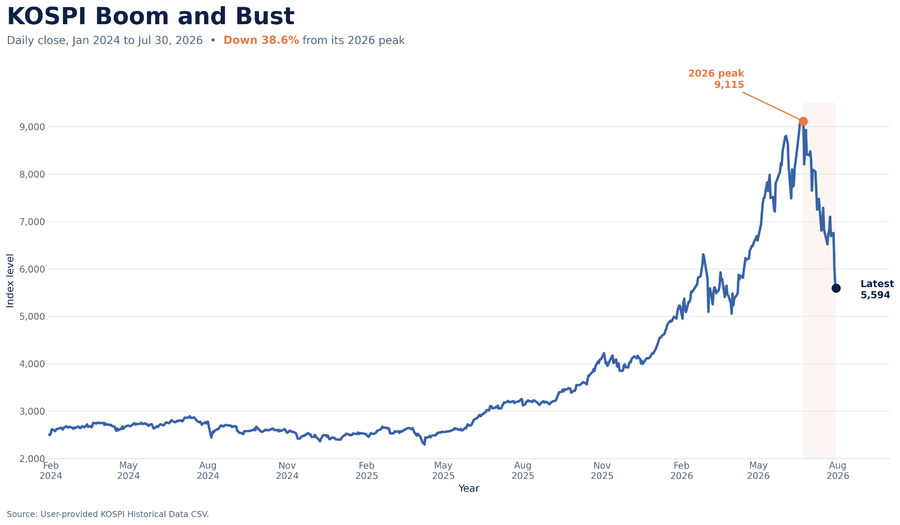
After a hot AI-led rally combined with extreme leverage and greed – which sent the index up nearly 200% between July 2025 and June 2026 - South Korea’s main stock index has fallen roughly 40%1 as of July 30th from its late-June peak (albeit still up ~30% YTD).
Figure 1: KOSPI through July 30th, 2026. Source: Investing.com/KRX, Dunham
Part of the blow-up came from fears that the AI investment boom was starting to fizzle - or at least that investors had paid too much and too fast for future chip demand.
Then South Korea’s central bank hiked rates in July for the first time since January 20232 - lifting the benchmark rate from 2.5% to 2.75%.
Falling stock prices are bad enough. But add in higher borrowing costs and that combination is what risks sucking the air out of the market.
Regardless, this is a massive drawdown in such a short span of time – one we historically don’t witness often, where an entire nation’s stock market trades like a speculative penny stock (swinging up or down double digits by the day).
So – here’s the trillion-dollar question everyone is asking.
Is this just another stock-market correction in Korea – or is this the beginning of a financial meltdown?
I think it is the beginning of something worse.
South Korea’s stock crash looks like what happens when a country with expensive housing, high household debt, rising inequality, weak birth rates, and one giant AI trade hands desperate young people leverage and calls it an opportunity, then wipes them out.
Here’s what you need to know.
When AI Hype Meets Leverage, the KOSPI Crash Was Never New
It doesn’t matter what time period or what country – the cycle is always the same.
A debt-fueled boom is followed by a violent bust.
For instance:
In Britain in 1720, the South Sea Company3 became the center of one of history’s great stock manias. Investors bid up shares – fueled by debt and on excitement - of monopoly trade, financial wizardry, and riches from the New World. Eventually, the promises never materialized, confidence faded, debt needed to be repaid, and the bubble collapsed.
In the United States in 1929, investors used borrowed money to buy stocks while broker loans ballooned. Prices rose. Confidence rose. Borrowing rose – all feeding off each other to push markets ever higher. Then borrowing costs rose, prices started falling, margin calls hit, and forced selling fed on itself – helping kick off the decade-long Great Depression.
In Japan in 1989, there was a frenzy for land and stocks. Credit expanded, asset prices ripped higher, and the Nikkei peaked near 39,000 before the bubble burst (it took 35 years for it to get back to that level). Japan then spent decades dealing with bad loans, weak demand, a sinking stock market, and private-sector debt repair.
The catalyst changes – whether railroads, real estate, dot coms, tulips, etc. - but the process is always the same.
A new frontier of technology or investment spurs excitement. An asset rises. Easy money floods in and people borrow to buy more of it. Rising prices make the borrowing look smart. Then prices dip, lenders ask for cash, and the same leverage that pushed the market up starts kicking it on the way down.
Said another way, leverage turns a campfire into a forest fire.
South Korea just got the old lesson in new packaging.
South Korea’s AI Boom Became a Leveraged Catch-Up Trade
And this time - the packaging was AI.
Korea’s AI boom not only lifted chip stocks. It gave households – especially younger generations - a way to feel like they could catch up in an increasingly unaffordable economy.
Housing looked unreachable. Private-sector debt is enormous. And wages weren’t growing much.
Thus, out of a mix of desperation and greed, Koreans turned to leverage to amplify stock bets.
To highlight this, by late June 2026, the outstanding balance of margin loans used to finance stock purchases hit a record high 38.6 trillion won (about ~$25 billion)4 - which was up 40% from 27.3 trillion won (~$17.8 billion) at end-2025.
But as we know – leverage is fueled by mood. It loves rising prices – and it panics when the screen turns red.
And boy did it turn red over the last month. . .
Margin Calls Are Turning the KOSPI Selloff Into Forced Selling
By July 165, Korea’s margin-loan balance had fallen to 33.4 trillion won, or $22.6 billion, the lowest level since April 15. That was a 13% drop from the end-June peak.
Figure 2: Bloomberg, July 2026
Many were scrambling to pay back debt as prices fell - selling stock, raising cash, cutting risk, and sending prices down further.
That’s how leverage eats its own tail.
And unfortunately, many were left choking.
Why the KOSPI Crash Is Hitting Young Koreans Hardest
Stuck between leverage and falling asset prices (a toxic combination) – Koreans are feeling the pressure.
A margin call happens when a broker says, “Put up more cash, or we'll sell your stock”. If the investor can’t meet the call, the broker liquidates everything to get their money back (and you may still owe afterwards if it wasn’t enough).
Meanwhile, between 320,000 and 360,000 accounts had already been fully liquidated by brokers.
And the damage was not evenly spread around.
For example, one news outlet citing South Korean media said more than 60% of liquidated investors were under 30.
Said another way, the younger and struggling generation was hit hardest.
South Korea’s Household Debt Makes the KOSPI Crash More Dangerous
The bigger issue is that South Korea was already carrying one of the heaviest household debt loads in the developed world – with a household debt-to-GDP ratio about 90% as of Q1-20267.
Figure 3: St. Louis Federal Reserve, Dunham, July 2026
This means that Korean households owe almost as much as the entire economy produces in a year.
That’s the fragile situation.
Because piling leveraged stock loans on top of an already huge household debt pile (mostly from mortgages) is risky enough when markets are rising.
But when those stock loans sour - and billions in paper wealth vanish in weeks - the downside gets uglier.
Meaning people aren’t just losing gains. They’re losing gains while still owing money.
And that can spill into everything else.
Less spending. More stress. Delayed purchases. More cash hoarding. A deeper sense that the future just got smaller.
And that’s where the trap begins – especially for younger generations. . .
Stock Losses Could Push Homeownership Further Out of Reach
South Korea’s young people were already falling behind in the housing market.
For instance, the homeownership rate for Koreans under 39 fell to 27.7% last year - the lowest since the data began in 20178 and down from 40.7% in 2018 and 2019.
Figure 4: The Chosun Daily, Kim Young-jae, Dunham (English translation), 2026
Thus, if you’re young, don’t own a home, and just got margin-called on the one trade that looked like a way to catch up, you didn’t just lose a significant amount of money.
You lost time.
This is how a stock crash can shove a generation that was already behind even further down the ladder.
Financial Stress Could Put More Pressure on Korea’s Birth Rate
And this is where the damage can become demographic.
South Korea already has one of the world’s lowest fertility rates. The total fertility rate fell to 0.72 births per woman in 2023 (a record low), rose to 0.75 in 2024, and reached about 0.80 in 20259- still far below the 2.1 replacement rate.
Figure 5: World Bank, Dunham, July 2026
The recovery is nice – but it’s nowhere near enough.
Worse is that if young Koreans (those needed to have more children) were already struggling to buy homes, build savings, and start families - then a leveraged-stock wipeout makes things much worse.
Put simply, this could become a generational issue.
The KOSPI Crash Could Widen Korea’s Wealth Gap and Weigh on Growth
Then comes the inequality problem.
Crashes don't hit everyone the same way. Older households with homes, pensions, and savings can usually wait it out - they have an equity buffer.
Younger households often don't.
And in South Korea, many young people were already missing the biggest wealth engine: property. If you don't own a home, you don't get the housing gains. If you don't build that asset base, starting a family gets harder. And if fewer young people start families, there are fewer future workers, spenders, and taxpayers to support the system later.
Then came the margin calls.
If younger investors borrowed near the top, got liquidated, and locked in losses, they don't get to wait for the rebound. They're out.
So if Korean stocks recover later, who benefits?
The investors with cash and assets left.
That's how inequality widens after a crash. Asset owners can wait. Leveraged catch-up traders get forced out. And that's bad for the whole economy.
Young Koreans are the future workers, spenders, borrowers, parents, and business builders. If they're broke, locked out of property, delaying families, and now scarred by margin calls - the whole economy feels it.
Remember - you can't have mass consumption if the young masses are increasingly broke.
Asia’s “Big Three” Are Fighting the Same Debt Disease
Asia’s biggest economies are already under strain.
Japan went first. A debt-fueled boom in stocks and land burst, leaving decades of weak growth, low confidence, and lingering balance-sheet damage that still hangs over the economy 30+ years later.
China is now in its own version of a 2008-esque property bust10. Households piled into real estate, developers borrowed heavily, prices fell, and confidence plunged - leaving the country stuck in a kind of liquidity trap.
Now, South Korea looks like the youth-market version of the same problems - expensive housing, high household debt, record-low young homeownership, a retail trading boom, leveraged stock products, and then a sharp crash.
That puts Asia’s Big 3 economies in an uneasy spot.
Japan is living with the long shadow of an old bubble. China is trying to work through a housing bust and cautious households. South Korea is finding out what happens when a debt-heavy society uses stock-market leverage as a release valve for young frustration.
And yes, this will have global consequences. These were supposed to be engines of global demand. Now they risk becoming drags on it.
Of course, none of this means South Korea is doomed, nor is the KOSPI going to zero. But it does mean the country has less room for mistakes than investors might assume.
You’d think history would make this obvious by now.
Speculative mania plus leverage almost always ends badly - and often leaves people worse off than before.
Unfortunately, I’d bet that South Korea won’t be the last when all this AI hype is over.
But as always, time will tell.
Frequently Asked Questions About South Korea's Stock Market Selloff
Why is South Korea’s stock market falling? South Korea's stock market is falling because cooling AI buzz is meeting heavy borrowing and crowded trades. When profit forecasts slip or investors doubt high prices, stock values drop fast. Margin calls then force traders who borrowed money to sell their shares right away. That adds fresh selling pressure to a falling market. Changing sentiment starts the drop, but debt makes the pain much worse.
How do margin calls make the KOSPI selloff worse? Margin calls make market drops worse by forcing traders to sell stocks when their accounts fall below required loan levels. If an investor cannot add cash fast, brokers can sell holdings without warning. When many accounts face this pressure at once, that forced selling drags prices down further. That drop triggers another wave of margin calls, so debt feeds on itself.
Could South Korea’s stock market crash trigger a broader economic crisis? A stock market crash does not always lead to a broad economic crisis. The danger grows if big trading losses force families to cut daily spending, or if unpaid debts hurt banks. For South Korea, the real test is whether losses stay inside brokerage accounts or spread into regular consumer spending and bank loans. Falling stock prices alone do not mean a wider crisis has begun.
What does the KOSPI selloff mean for global AI investors? The KOSPI selloff shows how heavy debt and crowded bets can magnify losses, even if global AI demand stays intact. South Korea makes vital AI memory chips, but dropping share prices do not prove chip demand is gone. Investors need to separate real business trends, like orders and earnings, from forced selling. The underlying tech can stay strong even while share prices fall.
Sources
Yahoo Finance — South Korea's Stock Market Crash Is Now Officially Worse Than 1997 and 2008 [finance.yahoo.com]
CNBC — Bank of Korea Hikes Rates, Monetary Policy and Market Reaction [cnbc.com]
Dunham — Debt Cycles, History, Bubbles, and Crashes [dunham.com]
Seoul Economic Daily — Korean Retail Investors' Margin Debt Hits Record 38 Trillion Won [en.sedaily.com]
Bloomberg — Korean Stock Traders Slash Margin Loans to Lowest Since April [bloomberg.com]
This communication is general in nature and provided for educational and informational purposes only. It should not be considered or relied upon as legal, tax or investment advice or an investment recommendation, or as a substitute for legal or tax counsel. Any investment products or services named herein are for illustrative purposes only and should not be considered an offer to buy or sell, or an investment recommendation for, any specific security, strategy or investment product or service. Always consult a qualified professional or your own independent financial professional for personalized advice or investment recommendations tailored to your specific goals, individual situation, and risk tolerance. All examples are hypothetical and are for illustrative purposes only.
Information contained in the materials included is believed to be from reliable sources, but no representations or guarantees are made as to the accuracy or completeness of information. This document is provided for information purposes only and should not be considered as investment advice.
KOPSI Composite Index - In South Korea, the main tracking index is the Korean Composite Stock Price Index, or KOSPI for short. Originally started in 1964, the index has been modified numerous times over the years, taking its current form in 1994. The KOSPI Index is comprised of 200 of the largest and most liquid issues traded on the Korean Stock Exchange. The index is market capitalization weighted, meaning that firms with the largest market value have the greatest influence on the KOSPI's returns.
Investors cannot invest directly in an index or benchmark.
Dunham & Associates Investment Counsel, Inc. is a Registered Investment Adviser and Broker/Dealer. Member FINRA/SIPC. Advisory services and securities offered through Dunham & Associates Investment Counsel, Inc.
South Korea KOSPI Selloff: AI Hype, Margin Debt and Forced Selling | Dunham