Content Editor, Dunham | 2025 ThinkAdvisor Luminaries Award Winner | 2026 Wealthies Finalist, Thought Leader of the Year | Macroeconomics, markets, geopolitics & global trends
Debt has fueled some of history’s greatest financial bubbles by allowing investors to borrow against rising asset prices, chase speculative gains, and ignore weak fundamentals. From Tulipmania to the South Sea Bubble and Railway Mania, the pattern was often the same: easy credit, rising optimism, excessive leverage, and a painful collapse.
Key Takeaways:
Debt is the accelerant. Whether tulips, South Sea stock, Latin American mines, or railroads — cheap credit turned sparks into infernos.
“This time is different” never holds. Every bubble is justified by a new story — but cash flows always win in the end.
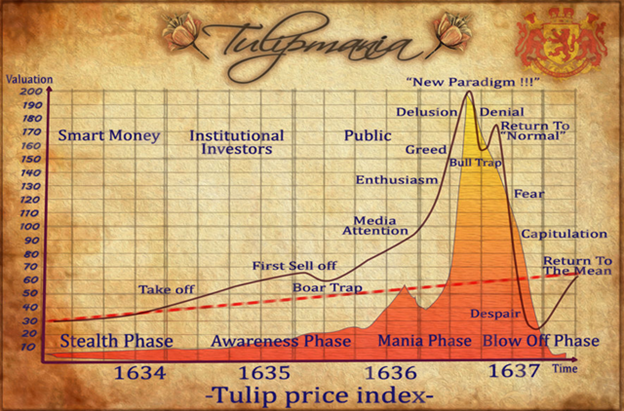
Tulipmania (1630s): Cheap credit and speculation drove tulip bulbs to house-level prices, but when confidence broke, prices plunged 80–90%.
South Sea Bubble (1720): Government-backed debt swaps and hype pushed shares sky-high until investors realized profits were illusory.
South American Mining Bubble (1820s): Easy loans and patriotic hype fueled mining speculation, but poor infrastructure and political chaos doomed projects.
Railway Mania (1860s–1880s): Railroads were transformative, but speculation and overbuilding led to bankruptcies and the Long Depression.
Lesson Across All Bubbles: Debt amplifies both booms and busts — different assets, different eras, same cycle: hype, leverage, and collapse.
Now it’s time for Debt Cycles 102 - showing how debt played a key role in some of the biggest market bubbles in history.
But instead of rehashing the usual suspects - like 2008, the Dot Com boom, or 1929 - we’re going further back.
Because the truth is, these cycles aren’t new. They’ve been playing out for centuries. Different countries. Different assets. Different stories. Same pattern.
And in every case, debt was the accelerant.
So in this piece, I’ll take you through some of the greatest manias that often get overlooked - from tulips to railroads. They may feel like distant history, but the lessons are just as relevant today.
Your Debt Cycles 102 class starts now.
What Are the Characteristics of a Financial Bubble?
The word “stock market bubble” gets thrown around often – and while it does get exaggerated, almost every real bubble has the same theme.
It starts with a spark: a new market, a new technology, or simply new money. Optimism soars, and investors convince themselves “this time is different” (often the famous last words).
Capital floods in: Banks lend freely, pamphlets (or investor presentations) promise riches, and prices climb higher and higher. Paper fortunes can multiply overnight.
Competition Spreads like fire: new “copy cat” and worthless companies that want to take advantage of the market momentum see their prices surge as speculators want in on the next big run (regardless of company fundamentals).
Greed takes the wheel: Caution disappears. Debt piles up. Skeptics are mocked. And as long as prices keep rising, no one asks questions.
Then comes the tipping point: Something eventually snaps. Maybe stretched valuations can’t match cash flows. Maybe a big bankruptcy hits. Maybe demand softens or investors just get nervous. Either way, confidence quickly erodes - and suddenly, everyone rushes for the exits.
Panic spreads. Margin calls hit. Assets that were “sure things” collapse. Banks fail. Credit dries up. Investors are left wrecked. The economy plunges - and all the feedback loops that swung things higher are now in reverse.
Keep this framework in mind as we walk through history’s great manias. I am sure you’ll notice the similarities.
Tulipmania (1630s) – Flowers of (Mis)Fortune
In 17th-century Holland, the Dutch Republic was booming. Trade flowed in from Asia (Amsterdam was the hub of the East Indies routes), the stock exchange was surging, and wealth spilled into culture and commerce. And as gold and silver poured into the Republic, interest rates fell – making debt cheap - and easy money seeped into every corner of the system.
Tulips had only recently arrived from the Ottoman Empire (modern-day Turkey). Their vivid colors and rare “broken” patterns - caused by a virus that streaked petals with flames of red and gold - were unlike anything else in Europe. They quickly became a sign of class, taste, and wealth.
At first, as usual, it was the elites - wealthy merchants and aristocrats - who paid heavily to plant them in private gardens. But soon, like every mania, the fever spread.
Prices climbed steadily. Then rapidly.
Middle-class craftsmen, shopkeepers, and sailors piled in - buying high and selling higher for a profit. Taverns turned into auction houses. A form of futures contracts (aka an early derivatives market) allowed speculators to control bulbs with only a small down payment (like buying on margin today).
Some bulbs traded hands dozens of times before they ever even touched soil.
Clearly, this wasn’t about flowers anymore. It was about paper profits. Evidence shows that people increasingly mortgaged homes, borrowed against savings, and gambled livelihoods. Pamphlets promised riches. Ordinary men became Tulip bulb day-traders. And as long as prices rose - no one asked questions.
Then - as always - came the tipping point.
In early 1637, a routine tulip auction suddenly failed when buyers balked at the sky-high prices - made worse as cheaper “copycat” bulbs flooded the market.
After that, panic set in. Within weeks, bids evaporated. Bulbs once worth fortunes now found no buyers at all.
Pricesplunged 80–90%. Panic spread, lawsuits piled up, and reputations were ruined.
Now, the Dutch economy itself survived and did relatively fine as tulips were only a corner of finance compared to global trade. But the psychological shock was immense. The richest republic in Europe had fallen for flowers.
Thus, Tulipmania revealed the anatomy of bubbles before “bubble” was even a word:
A new and unique asset captures imagination.
Easy credit and cheap debt magnify the boom.
Speculation detaches from reality.
And when confidence breaks, the collapse is violent.
In the end, the bulbs were beautiful. But beauty alone doesn’t justify rampant speculation.
Tulipmania remains the poster child of financial folly - a reminder that when speculation overtakes substance, even flowers can ruin fortunes.
Figure 1: HCM Wealth Advisors; 2019
The South Sea Bubble (1720): Lessons in Debt and Speculation
In the early 1700s, Britain had a problem. . .
There was far too much government debt from endless wars.
See, back then, raising money meant lotteries, patchwork bond issues, or paying higher and higher interest rates. It was unsustainable and increasingly carried the risk of not being able to find buyers of debt.
Basically, investors could swap their government IOUs for company shares. The government refinanced its debt at a lower rate, while the company pocketed taxpayer-funded annual payments - plus the promise of a monopoly on the slave trade with South America – freshly wrestled from Spain.
On paper, it was genius. Investors thought they were buying a slice of Britain’s South American future. The upside seemed limitless. But the profits didn’t come from trade – they came from hype and debt. South Sea shares rocketed more than 8x in a year. Nobles, politicians, merchants - even Sir Isaac Newton - piled in.
By 1720, a mania gripped the nation. “Bubble companies” sprang up promising fishing patents, machine guns, perpetual motion wheels, or vague “undertakings of great advantage” in the new territories. All nonsense – but their shares soared anyway. Everyone was speculating, borrowing, and spending like the gains would never end. And as long as prices rose, the debt didn’t look like a problem.
Then summer came, and the truth leaked out - the South Sea Company had no real business beyond issuing stock to recycle government debt. Its monopoly rights were basically worthless. Confidence soured, shares began to fall, margin calls hit, and the panic spread.
People sold at any price. Bankruptcies and even suicides followed. Banks that had lent against South Sea shares collapsed. The stock plunged 90%. Politicians were disgraced. Ordinary savers were ruined.
Britain slid into a short depression. And yet, ironically, the disaster also made Britain the father of modern banking - a structure that later helped finance its global empire.
If you want the full story of the South Sea Bubble, I highly recommend the book “Money For Nothing” by Thomas Levenson (2020).
The South American Mining Bubble (1820s) – Digging for Fools Gold
The British government lent heavily to these republics – wanting to build a foot print quickly. And on the streets of London, pamphlets promised that South America glittered with untapped treasure. Mining companies sprang up almost overnight, raising millions from investors desperate not to miss the next fortune.
Some schemes bordered on the absurd.
One company sold shares to dredge lakes for cannonballs, hoping to cash in on high iron prices.
Another promised to dive for gems in the Red Sea – though it lacked the technology to even attempt it.
No matter. Investors lined up anyway.
Historians call the fuel behind this mania the “bubble triangle”:
Parliament’s relaxed rules pushed speculation.
“Part-paid” shares let investors control stock with only a fraction down (like trading on margin today).
Low yields elsewhere pushed savers into riskier bets and banks made shoddy loans.
Add patriotic excitement about Latin America, and it became a perfect storm.
But once on the ground - dreams quickly turned to nightmares. Machinery shipped from Britain had to be strapped to mules and dragged over mountain passes (at high costs). Mining shafts were flooded, roads impassable, and the politics of these new republics proved chaotic. Thus, by 1825, resource shipments were scarce, and optimism turned to doubt.
That year, the bubble burst. Mining shares collapsed, panic spread through the London market, and the Panic of 1825 began - often called the first modern emerging-market boom-bust.
Banks were ruined. Investors were left wrecked. South America was in turmoil. And economic growth sank.
So what was the takeaway? Debt-fueled dreams of resource wealth are intoxicating, but without cash flows, the bubble collapses under its own weight.
Most European investors had never set foot in South America (it took months to even get there by boat), yet they poured money into promises on paper. Sure, minerals were there, but the infrastructure, technology, and execution weren’t.
In the end, many were left holding nothing more than empty bags (or worse, fell into bankruptcy).
There’s a great chapter (#3) about all this in the book “Boom and Bust A Global History of Financial Bubbles”by William Quinn and John D. Turner (2020)
Figure 3: Cambridge University Press, Boom and Bust A Global History of Financial Bubbles (2020)
The Railway Mania (1860s-1880s America) – The Gilded Age Implodes
After the Civil War ended in 1865, America’s investors were euphoric. The nation was reunited, industry was booming, and money - swollen by wartime finance - was sloshing around.
And railroads were the next big thing.
Steel rails promised to knit the continent together - carrying crops, coal, and people all over - and open new markets.
Politicians cheered them on as “nation-building,” and European investors (especially in London and Berlin) were desperate to get in. Pamphlets promised not just profits but massive economic progress.
Companies took off overnight. Union Pacific, Central Pacific, Northern Pacific - each laying new track with staggering speed (and at great waste).
Shares and bonds flew off the shelves. In Europe, money poured not just into U.S. rails, but into schemes across Russia, Argentina, and India. Railroads were seen as the “new technology” of the age – aka the Dot Com Boom of the 19th century.
Some ventures bordered on absurdity. . .
Competing lines built side-by-side across the same routes, each insisting demand would follow.
Insider scandals, like Crédit Mobilier (1872), revealed executives stuffing their pockets while small shareholders were left exposed.
Firms “guaranteed” riches in sparsely populated regions with little freight or passenger demand.
Historians later called the fuel behind this mania a familiar mix:
Governments showered railroads with land grants and money.
London bankers and U.S. speculators fed the fire with cheap credit.
Investors, dazzled by technological growth, treated stocks like lottery tickets.
But as usual, the bust was around the corner – just when everyone least expected it.
Why? Because:
Rails stretched into the wilderness with no traffic (oversupply).
Panic ricocheted globally – from Wall Street and London to Vienna and the Ottoman Empire. The “Long Depression10” began (aka this was the great depression before the 1930s).
The wreckage was truly immense:
In the U.S., nearly half of all railroad mileage went bankrupt in the 1870s.
Investors across Europe were wiped out as bonds defaulted and bankruptcies soared.
Trust in global finance plunged, banks failed en masse, and credit dried up for years.
The rails were real, but the cash flows weren’t there yet. Investors had chased paper promises more than realistic rail profits.
By the 1880s, fortunes had been lost, empires of steel had collapsed, and the world had learned – yet again – that when finance runs faster than fundamentals, the crash is only a station away.
A great book on this era is "Transatlantic Speculations: Globalization and the Panics of 1873"by Hanna Catherine Davies (2018)
Figure 4: Digital History Reader
Why Historic Financial Bubbles Still Matter Today
The point isn’t that tulips, mining stocks, and railroads are the same as today’s markets. It's that investor behavior often rhymes.
When cheap money meets a convincing story, prices can rise far beyond fundamentals. And when debt is involved, it's amplified - both up and down.
Final Thoughts
So now we’ve seen debt cycles in the wild - from tulips to South America to steel rails. Easy money and cheap credit fueled speculation, fortunes multiplied on paper, and then collapsed when reality couldn’t keep up. The bones were always the same - hype, debt, and the sudden loss of confidence.
Bubble
Main asset
Debt or credit fuel
What broke the cycle
Tulipmania
Tulip bulbs
Futures-style contracts and speculative borrowing
Buyers refused extreme prices
South Sea Bubble
South Sea Company shares
Debt swaps, stock issuance, and leverage
Profits failed to match the hype
South American Mining Bubble
Mining shares and bonds
Easy loans and part-paid shares
Weak infrastructure and political instability
Railway Mania
Railroad stocks and bonds
Cheap credit, subsidies, and bond financing
Overbuilding and weak cash flows
In Debt Cycles 101, we laid out the fundamentals of how debt amplifies market cycles.
And in Debt Cycles 102, we walked through history’s bubbles.
Next - in Debt Cycles 103, we’ll bring it to today - with frothy markets everywhere.
What lessons can we steal from the past to survive the next bust? That’s where we’re headed.
Until then.
Frequently Asked Questions About Debt-Fueled Financial Bubbles
How does debt actually fuel a financial bubble? Debt lets investors borrow against rising asset prices, which pumps more money into an already hot market and pushes prices even higher than fundamentals justify. This works fine while prices keep climbing, but it also means the eventual collapse hits harder, since investors owe money on assets that are now worth far less than what they paid.
What happened during Tulipmania, and why did it collapse? In 1630s Holland, cheap credit and futures-style contracts let ordinary buyers speculate on tulip bulbs using only a small down payment, pushing some bulbs to sell for the price of an Amsterdam house. The mania ended in early 1637 when buyers balked at a routine auction, and prices plunged 80% to 90% within weeks.
What caused the South Sea Bubble to form and then burst? Britain let the South Sea Company absorb government debt in exchange for stock, and hype around a South American trade monopoly sent shares up more than eightfold in a year. When investors realized the company had no real business beyond recycling debt, confidence collapsed, shares fell 90%, and banks that had lent against the stock went under.
Why did the U.S. Railway Mania end in the Long Depression? Cheap credit, government land subsidies, and eager European investors funded rapid rail construction through the 1860s and 1870s, often into areas with little actual freight or passenger demand. When Jay Cooke & Co. collapsed in 1873 because its rail bonds proved worthless, panic spread globally, nearly half of U.S. rail mileage went bankrupt, and the Long Depression followed.
What's the common pattern across all these historic bubbles? Each one followed the same sequence: a new asset or story sparks excitement, cheap credit floods in, speculation detaches from real cash flows, and confidence eventually breaks all at once. The assets were different every time, from tulips to mining stocks to railroads, but debt always turned the initial spark into a much bigger collapse.
This communication is general in nature and provided for educational and informational purposes only. It should not be considered or relied upon as legal, tax or investment advice or an investment recommendation, or as a substitute for legal or tax counsel. Any investment products or services named herein are for illustrative purposes only, and should not be considered an offer to buy or sell, or an investment recommendation for, any specific security, strategy or investment product or service. Always consult a qualified professional or your own independent financial professional for personalized advice or investment recommendations tailored to your specific goals, individual situation, and risk tolerance.
Information contained in the materials included is believed to be from reliable sources, but no representations or guarantees are made as to the accuracy or completeness of information.
Dunham & Associates Investment Counsel, Inc. is a Registered Investment Adviser and Broker/Dealer. Member FINRA/SIPC. Advisory services and securities offered through Dunham & Associates Investment Counsel, Inc.



.jpg&w=3840&q=75)
.jpg&w=3840&q=75)
.jpg&w=3840&q=75)