Content Editor, Dunham | 2025 ThinkAdvisor Luminaries Award Winner | 2026 Wealthies Finalist, Thought Leader of the Year | Macroeconomics, markets, geopolitics & global trends
Originally Published October 2025 | Updated June 2026
The China–EU trade war refers to the escalating economic conflict between China and the European Union over trade imbalances, Chinese state subsidies, and market access. Tensions center on Chinese overcapacity flooding European markets — particularly in EVs, steel, and solar — driving the EU's trade deficit with China to a record €359.9 billion in 2025. As of mid-2026, a trade war between the two seems inevitable.
Key Takeaways:
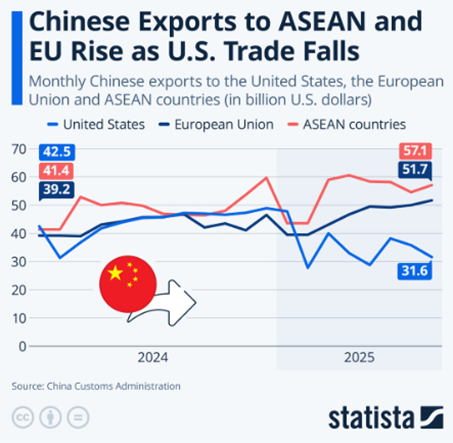
China’s exports to the E.U. jumped 14% in September 2025, the biggest rise in over three years, as goods once bound for the U.S. were redirected to Europe.
Europe’s trade deficit with China now exceeds €300 billion, putting Brussels on pace for a record shortfall as imports surge and exports fall.
Subsidized Chinese EVs, steel, and solar panels are undercutting European producers significantly, prompting new E.U. tariffs and anti-subsidy probes.
China can’t afford a two-front trade war with the U.S. and E.U.; its economy depends on exports to balance anemic consumption
Both sides are retaliating with tariffs and investigations, raising the risk that this largely ignored tension becomes the next major global trade front.
The world is watching Washington and Beijing trade blows again.
You know the kind I’m talking about - tariffs, export controls, and threats. All the familiar noise.
Keep in mind China mines roughly 70% of the world’s rare earths and processes over 90% of the global supply. Thus, these aren’t just minerals - they’re an ace up the sleeve.
Because of this, the next day, President Trump threatened a 100% tariff on all Chinese goods.
But while everyone braces for another round of U.S.–China dog fighting - a different front is forming - one that’s been building under the radar.
I’m talking about China vs. the European Union (E.U.).
It’s a trade war most aren’t watching yet - but it looks like it’s coming. And it could be bigger than many realize.
How Europe Became Collateral Damage in the U.S.–China Trade War
In truth, both sides want to export more and import less. But the math can’t work that way (for someone to sell more, someone must buy more).
Thus, neither side wants to give an inch - because doing so would negatively affect their economies.
If China lets the yuan rise and allows more U.S. imports, its trade surplus - a major cash source - shrinks. That would hurt its manufacturing base and deepen its deflation problem.
And if the U.S. caves and lowers tariffs, it risks a new flood of Chinese goods, surging deficits, and more domestic job losses.
There’s no easy win here. But the trade war results are already showing.
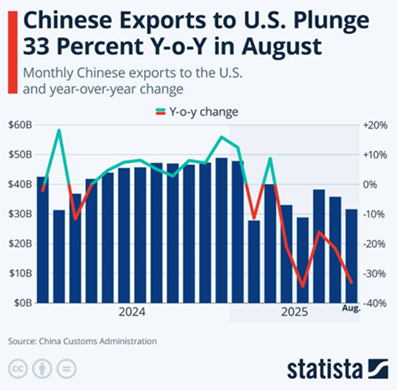
For instance. U.S. imports from China have fallen roughly 30% year over year in September - marking the sixth straight month of double-digit declines after a 33% drop in August.
Figure 1: Statista, September 2025
Europe Becomes China’s New Export Dumping Ground
So, where does Europe fit into all this?
Well, as I mentioned above, China isn’t going to sit back and watch its economy slow.
So, the goods it’s losing in the U.S. are now heading to Europe - flooding E.U. markets and forcing Brussels to absorb the imbalance (basically creating the same dynamic that irritated the U.S.).
Why the E.U. Is Losing Patience with China’s Trade Practices
The frustration in Brussels isn’t just about cheap electric cars competing with their own global auto output.
It’s about something bigger - a flood of Chinese goods revamping Europe’s industrial core.
For years, Europe saw China as a growth engine. German automakers, French luxury brands, and machinery exporters all leaned on Chinese demand to fuel profits.
But that equation has flipped.
Now, China is exporting its economic slowdown. Factories built to feed an endless domestic boom are now producing far more than China can consume - and those excess goods are being dumped abroad.
And this flood of Chinese exports has upset the E.U. economy – for instance:
It’s hard to compete when your rival’s balance sheet gets significant direct support through the government.
That’s why the European Commission has launched waves of investigations - from anti-subsidy probes on Chinese EVs to new carbon border taxes aimed at leveling the playing field.
Still, for all the frustration, Europe’s hands are tied. It depends on China for more than it wants to admit - batteries, rare earths, pharmaceuticals, and components critical to its green transition.
And that’s the paradox - Europe needs China’s supply chain to build the very industries China is taking over.
Ironically, Beijing’s new rare earth export restrictions didn’t just rattle Washington - they hit Brussels too. The E.U. is now working with the U.S. and G7 partners to coordinate a response (alienating China further).
The E.U. vs. China: A Trade War in the Making (and Why It Matters)
Clearly, the E.U. doesn’t want to keep absorbing all these Chinese imports – specifically electric vehicles (since Germany is a massive auto producer, it doesn’t want competition).
But that’s not the only problem.
China is buying less from Europe - hurting European firms that once depended on Chinese demand.
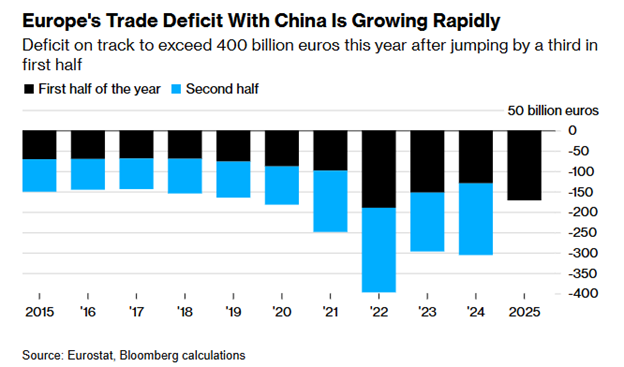
Because of this, the E.U.’s trade deficit with China has ballooned past €300 billion and - at the current pace - is on track to hit a record high in 2025.
Figure 3: Bloomberg, July 2025
It’s gotten serious enough that back in July, European Commission President Ursula von der Leyen publicly accused Beijing of “flooding global markets with cheap, subsidized goods," warning that entire Western industries are bending under the pressure.
She further told the European parliament that, “If our partnership [with China] is to move forward, we need a genuine rebalancing: fewer market distortions, less overcapacity exported from China, and fair, reciprocal access for European businesses in China.”
According to the May survey by the E.U. Chamber of Commerce in China, 73% of respondents said doing business there is becoming harder year after year, with confidence now at rock bottom.
Meanwhile, E.U. and Chinese leaders met in Beijing shortly after she said this to try and cool tensions. But with how wide apart they are on trade, the summit produced little.
If this all sounds familiar, it should. Because the U.S. did and said the same things before its trade war erupted.
Well, it’s been months later, and China still hasn’t given Europe a single inch. If anything, they took another foot (as I detailed above with the exports to E.U. hitting a three-year high).
China’s Response to Europe’s Tariffs and Investigations
Now, of course, just like any trade war – it’s not one-sided.
Just as the E.U. is now mounting a defense against China – China isn’t sitting still.
Pork tariffs: China imposed anti-dumping duties of up to 62% on European pork, widely viewed as retaliation for the E.U.’s tariffs on Chinese electric vehicles.
Medical devices: China banned European medical device firms from government tenders over 45 million yuan ($6.3 million) in retaliation for E.U. trade curbs, exempting only those that produce locally in China.
WTO complaint: China filed a WTO (World Trade Organization) dispute and denounced the E.U.’s anti-subsidy probe into Chinese EVs as protectionism disguised as “fair competition” (which is ironic).
China’s message is the same one it’s sending Washington - if you throw a punch, expect one back.
But so far, Beijing’s hits have been light – more like jabs than haymakers.
It knows it can’t afford a two-front trade war with its two biggest customers, the U.S. and the E.U.
Put simply, it can’t export its way out of a slowdown if both markets shut it out.
This isn’t a smaller economy like Turkey or Brazil that can ramp up exports and the world barely notices - because there’s room for that to be absorbed.
But when China does it, it’s too big for the system to handle. It floods global markets without truly fixing its own slowdown.
Think of it like this. A sink can handle a glass of water, but not a firehose.
What’s Next: Europe’s Trade Dilemma and Global Impact
I believe the most important thing to watch now is trade flows. They move geopolitics, currencies, and markets long before the headlines do.
For decades, China relied on the U.S. as its main export hub. That relationship is broken.
Now, by flooding Europe with goods, Beijing risks repeating the same mistake — and igniting another trade war.
The problem is, China doesn’t have many options.
Until its domestic economy stabilizes and consumption recovers, it needs global demand to keep factories open.
Without it, Beijing faces layoffs, bankruptcies, deflation, and unrest.
But the E.U. can’t save China without sacrificing itself.
Europe’s leaders won’t hollow out their manufacturing base just to keep Beijing’s afloat.
And that’s the divide.
So who’s better off - the buyer with more demand (Europe) or the seller with excess supply (China)?
Well, history suggests it’s the surplus economies, not the deficit ones, that suffer most when trade contracts.
Imagine you’re the shop owner. You can’t pay your bills when no one’s buying. But if you’re the customer, deciding not to shop doesn’t hurt you nearly as much.
That’s why, when trade dries up, it’s the sellers - notthe buyers - who feel the real pain. And this is what China is worried about.
But regardless, no one truly wins a trade war. They’re a race to the bottom - retaliation meets retaliation until both sides bleed market share.
We’ve seen this before. In the 1930s, tit-for-tat tariffs didn’t fix the global economy - they only amplified the Great Depression.
So while the media replays the U.S.–China feud, keep an eye on the next front - China vs. Europe.
Because all it takes is one spark - one tariff, one retaliation - to turn this ignored tension into a full-blown confrontation.
But as always, just some food for thought.
Update — June 2026:
The numbers have only gotten worse. The EU's trade deficit with China closed 2025 at a record €359.9 billion — up from the €300 billion figure cited when this piece was first published. In the first four months of 2026 alone, Beijing ran a $113 billion surplus with the EU-27, up $22 billion year-over-year. The EU doubled steel tariffs and approved new import quotas in April. China hit back with dairy levies of up to 42.7%. The European Commission has also signaled it will introduce additional tools by September 2026 to protect EU industry from unfair trade policies Euronews — a sign Brussels is done being patient. The two-front thesis is playing out exactly as outlined.
Frequently Asked Questions About China's Two-Front Trade War
Why can't China afford a two-front trade war with the U.S. and the EU? China depends on export revenue to offset weak domestic consumption after its housing bust. Fighting the U.S. and EU at the same time would close off both of its largest markets simultaneously, leaving no outlet to absorb its manufacturing overcapacity. That's why Beijing's retaliation against Europe has stayed limited to targeted tariffs rather than a full trade break.
What is the "sink versus firehose" problem with China's export overcapacity? Smaller export economies like Turkey or Brazil can ramp up shipments without disrupting global markets, since the world can absorb the extra volume. China's economy is too large for that. When Beijing redirects its excess manufacturing abroad, it floods entire industries at once rather than adding a manageable trickle.
How many European companies say doing business in China has gotten harder? A May 2026 survey by the European Chamber of Commerce in China found that 73% of member companies said doing business there is becoming harder year over year, with business confidence now at its lowest point on record, reflecting deepening frustration with market access and state-subsidized competition.
Is the EU-China trade war following the same path as the U.S.-China trade war? Largely yes, but delayed. The EU is now imposing EV, steel, and solar tariffs the U.S. rolled out years earlier, and facing the same Chinese retaliation playbook: agricultural tariffs, procurement bans, and WTO complaints. The main difference is timing. Brussels is fighting a fight Washington already started.
This communication is general in nature and provided for educational and informational purposes only. It should not be considered or relied upon as legal, tax or investment advice or an investment recommendation, or as a substitute for legal or tax counsel. Any investment products or services named herein are for illustrative purposes only, and should not be considered an offer to buy or sell, or an investment recommendation for, any specific security, strategy or investment product or service. Always consult a qualified professional or your own independent financial professional for personalized advice or investment recommendations tailored to your specific goals, individual situation, and risk tolerance.
Information contained in the materials included is believed to be from reliable sources, but no representations or guarantees are made as to the accuracy or completeness of information.
Dunham & Associates Investment Counsel, Inc. is a Registered Investment Adviser and Broker/Dealer. Member FINRA/SIPC. Advisory services and securities offered through Dunham & Associates Investment Counsel, Inc.