Content Editor, Dunham | 2025 ThinkAdvisor Luminaries Award Winner | 2026 Wealthies Finalist, Thought Leader of the Year | Macroeconomics, markets, geopolitics & global trends
The Smoot-Hawley Tariff Act of 1930 shows how tariffs can spiral into global retaliation and deepen a recession. Trade tensions today follow a similar pattern, with rising tariffs and counter-tariffs between major economies. History suggests these cycles escalate faster than expected. Here's what the 1930s can teach investors and advisors navigating today's trade environment.
Author's Update — July 2026: The trade war has moved through several phases since this post was first written. In February 2026, the Supreme Court ruled Trump's sweeping IEEPA-based tariffs illegal, and the administration replaced them within days with a flat 10% global tariff. By June, USTR proposed new Section 301 tariffs of up to 12.5% on 60 trading partners — including China, the EU, Mexico, and Canada — citing forced labor concerns, with a public hearing held July 7. Meanwhile, a U.S.-China truce reached in late 2025 paused some retaliatory measures, but China still taxes U.S. crude oil at 20%, LNG at 25%, and beef up to 77%. The Yale Budget Lab now puts the effective U.S. tariff rate at its highest level since the 1940s. The pattern I flagged two years ago - protectionism triggering counter-protectionism - hasn't slowed. It's compounding.
Key Takeaways:
Nations worldwide are increasingly imposing import taxes to block China's export surge — echoing patterns from the 1930s.
History shows how trade wars and “beggar-thy-neighbor” currency tactics worsened the Great Depression — raising caution today.
The Smoot-Hawley Tariff Act of 1930 offers a case study in how protectionism can spiral into global economic decline.
Financial advisors should watch for policy escalations and portfolio impacts — from inflation to supply chain shocks.
The Rise of Tariffs and Trade Wars — and What History Tells Us
Over the last few weeks, I've written to you about one of the potentially biggest themes in the coming years. I'm talking about escalating global trade wars - particularly involving China.
Long story short, China is trying to export its way out of an economic slowdown. But as I've argued, China is far too big to do so without flooding the world with excess goods – leading to lower prices, crushed profit margins, and unemployment.
This isn't Brazil we're talking about (a ~$2 trillion economy). But a roughly $18 trillion economy with China. For China to focus more on manufacturing exports, its scale is massive for the rest of the world to absorb.
Simply put, a trade war occurs when countries impose tariffs or other trade barriers on one another in retaliation, often spiraling into broader economic conflict that disrupts global trade, supply chains, and growth.Trade wars rarely stay contained. Once retaliation begins, they tend to compound, pulling more countries, industries, and currencies into the conflict.That's what makes them dangerous.
How Countries Are Responding to China's Export Surge
Since writing you: here are some developments of countries trying to raise tariffs (import taxes) and other limits on Chinese goods.
U.S. solar panel makers are seeking additional tariffs1 on imports from China to “stay competitive”.
President Biden is looking to triple tariffs on Chinese steel and aluminum imports2 (which is currently 7.5%).
Brazil is now setting to impose3 a quota system on 11 types of products. And any imported volumes exceeding these quotas will face a 25% tax (which was sparked due to Chinese goods flooding in). The Brazilian government says it’s committed to combating “unfair trade”.
The European Union (EU) is now initiating several investigations4 against Chinese imports and is expected to slap tariffs on Chinese electric vehicle (EV) imports by this summer. The EU is very annoyed with Beijing over-subsidizing its manufacturing sector (which is creating excess competition for EU firms).
Mexico decided to increase tariffs on certain products from countries it doesn't have a free trade agreement with, like China. This saw about 90% of Chinese exports5 to Mexico being impacted. These tariffs started on August 16 and continue to increase and will stay in place until July 2025.
President Donald Trump hinted6 at the possibility of imposing a tariff exceeding 60% on Chinese goods if he were re-elected, indicating a more aggressive stance towards China (which is the primary source of U.S. imports).
The point here is that countries around the world are trying to deflect the glut of Chinese exports.
And while these tariffs are a double-edged sword – such as helping domestic producers and employers but causing higher prices for consumers – it's worrying how it may escalate.
Meaning I doubt China won't look to place retaliatory tariffs on these countries at this rate. . .
Now, the question remains, "What if China does retaliate with tariffs?"
Well, that's the big theme here. Because as the second-largest economy in the world, any tariffs China places on imports will affect many countries.
But what worries me is the potential escalation in a trade war that could happen at a time when the global economy is fighting sticky inflation, slowing growth, and higher interest rates.
So, let's look at history to highlight how a trade war can truly escalate into a whole new beast. . .
A Historical Warning: The Great Depression’s Trade Spiral
To understand what could happen, let’s go back nearly a century.
In the 1920s, the world economy was recovering from WWI. The U.S. was an export powerhouse, much like China today. Currency devaluations spread, as countries tried to make their goods cheaper abroad—a trend known as “beggar-thy-neighbor” policies.
This led to a currency war, with each country trying to gain an edge through devaluation. The result? Rising trade imbalances and tension.
Why? Because when a country is suffering from high unemployment or wishes to pursue a policy of export-led growth, a lower exchange rate can be seen as advantageous (although conversely, it can cause domestic inflation and a lower standard of living as it makes imports pricier)
Imagine you and your friend both have lemonade stands. Your lemonade costs $1 per cup, and your friend's costs €1 (euro) per cup. One day, your friend decides to lower their price to €0.80 per cup to attract more customers. Suddenly, everyone starts buying lemonade from your friend because it's cheaper. To compete, you decide to lower your price to $0.80 per cup. This makes your lemonade more attractive to customers again. Now, imagine countries doing the same thing with their currencies. When a country wants to boost its economy, it may devalue its currency. This means they lower the value of their currency compared to others. It makes their exports cheaper for other countries to buy, so more people buy their products. It's like your friend lowering the price of lemonade.
But it got worse.
But other countries might not like this. They might devalue their own currencies to compete, starting a "currency war." It can lead to a cycle of devaluations where each country tries to make its products the cheapest.
In the end, devaluations can make exports cheaper and boost a country's economy temporarily. But if every country does it, it can lead to instability.
There’s so much more on this that I would love to write about, but in short, a currency war was breaking out – aka “beggar thy neighbor” policies of devaluing currencies against one another.
This was a fascinating time in history – and a great book about this is “Lords of Finance: The Bankers Who Broke The World (2009)” by Liaquat Ahamed – a compelling and easy read on the post-WWI years and how major central banks did all sorts of things that helped lead to the Great Depression.
Now, while a currency war helped lead to the destructive Great Depression policies, there’s a lesser-known thing that contributed to making the Depression “Great”.
And that was the escalating trade wars. . .
The Smoot-Hawley Tariff Act: How Protectionism Backfired
By 1930, demand and asset prices worldwide were collapsing, and unemployment was surging. Thus, countries were desperately trying to devalue their currencies, export their excess abroad to eke out some growth, and curb imports (to protect jobs at home).
This led to the Smoot-Hawley Act – named after Senator Reed Smoot of Utah and Congressman Willis Hawley of Oregon – which was a hefty import tax that the U.S. signed into law on June 17, 1930.
The Smoot-Hawley Act added about 20% to the United States' already high7 import duties on thousands of foreign agricultural products and manufactured goods.
The idea was to protect U.S. businesses – especially farmers – against foreign countries trying to export their way out of the early stages of the great depression.
However, its unintended consequences were profound. . .
Within two years, some two dozen countries adopted similar "beggar-thy-neighbor" trade tariffs and duties, exacerbating an already beleaguered world economy and reducing global trade.
As I’ve shared with you before about the Prisoner’s Dilemma – a game theory model of how people cooperate or undercut each other - no one wants to sit idly by while others take their lunch money.
To highlight what the Smoot-Hawley Act triggered, both U.S. imports and exports to Europe fell8 by some two-thirds (66%) between 1929 and 1932, while overall global trade declined by similar levels during the four years that the legislation was in effect.
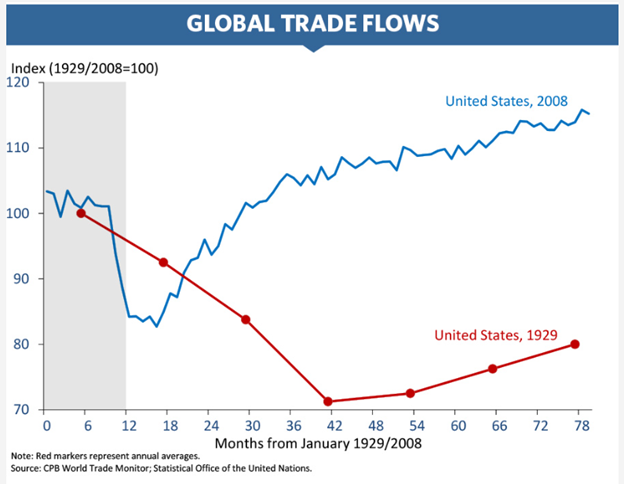
For example, here’s a chart9 showing 78 months of global trade flows after 1929 and 2008 began. As you can see, while post-2008 saw a sharp decline (for good reason), it recovered within three-odd years. Meanwhile, 78 months after 1929 kicked off, it was still roughly -20%below.
Figure 1: CPB World Trade Monitor, 2015
Thus, this “tit-for-tat” retaliation exacerbated the global economic crisis and symbolized a shift towards isolationist trade policies.
Long story short, the Smoot-Hawley Act serves as a cautionary tale about the risks of protectionism (tariffs) sparking a trade war that leaves everyone worse off
Final Thought: History Doesn’t Repeat, But It Rhymes
The Smoot-Hawley era teaches us that economic policy is often reactive, especially during uncertainty.
What starts as “protecting domestic jobs” can quickly spiral into something much bigger—and far more damaging.
As I’ve written before:
“Bad politics often trumps good economics.”
Let’s hope this time is different. But if not, history may offer a roadmap of what to expect.
FAQ:
What was the Smoot-Hawley Tariff Act? The Smoot-Hawley Tariff Act of 1930 raised U.S. tariffs on thousands of imported goods, aiming to protect domestic industries but triggering global retaliation and worsening the Great Depression.
Why are countries imposing new tariffs in 2025? Nations are raising import taxes to block China's export surge, protect domestic industries, and respond to rising trade imbalances — echoing past protectionist patterns.
How do trade wars impact the global economy? Trade wars can reduce global trade volumes, increase prices, disrupt supply chains, and raise inflation — all while dampening investor confidence and economic growth.
Could the current U.S.-China tariff escalation lead to a global recession? While not guaranteed, historical precedent suggests that prolonged tariff escalations — especially among major economies — can significantly weaken global trade and increase recession risk.
What should financial advisors be watching for? Advisors should monitor trade policy headlines, inflation signals, and sector-specific impacts (e.g., tech, agriculture, manufacturing), while helping clients remain diversified amid potential volatility.
This communication is general in nature and provided for educational and informational purposes only. It should not be considered or relied upon as legal, tax or investment advice or an investment recommendation, or as a substitute for legal or tax counsel. Any investment products or services named herein are for illustrative purposes only and should not be considered an offer to buy or sell, or an investment recommendation for, any specific security, strategy or investment product or service. Always consult a qualified professional or your own independent financial professional for personalized advice or investment recommendations tailored to your specific goals, individual situation, and risk tolerance. All examples are hypothetical and are for illustrative purposes only.
Information contained in the materials included is believed to be from reliable sources, but no representations or guarantees are made as to the accuracy or completeness of information. This document is provided for information purposes only and should not be considered as investment advice.
Dunham & Associates Investment Counsel, Inc. is a Registered Investment Adviser and Broker/Dealer. Member FINRA/SIPC. Advisory services and securities offered through Dunham & Associates Investment Counsel, Inc.
Trade Wars & Tariffs: What the Great Depression Teaches Us | Dunham