Content Editor, Dunham | 2025 ThinkAdvisor Luminaries Award Winner | 2026 Wealthies Finalist, Thought Leader of the Year | Macroeconomics, markets, geopolitics & global trends
Listen to this blog here
11:20
The $1.2 Trillion Annual Wealth Transfer Nobody's Talking About
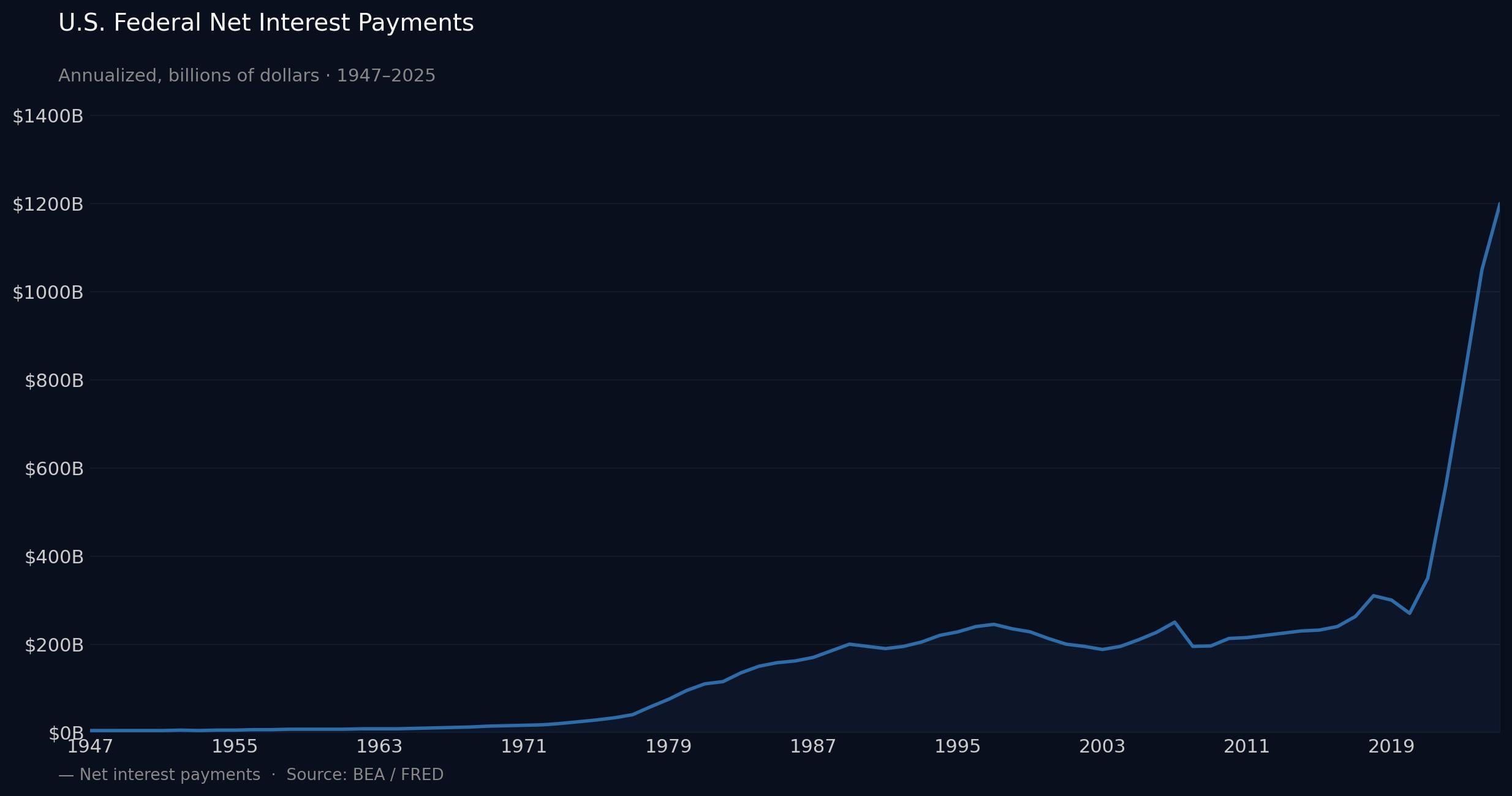
U.S. net interest payments have surpassed $1.2 trillion annualized — pumping deficit-financed liquidity directly into private balance sheets and feeding a wealth effect and inflation.
The bulk of that transfer flows to the top 20% of households who hold bonds, while the deficits funding it will eventually be paid back by everyone.
Why it matters: Every dollar the government pays in interest goes directly into a private sector bank account - injecting liquidity and feeding inflation. And since the U.S. is running a deficit, those interest payments aren't being offset by taxes coming back in and it’s increasing the money supply. Thus, the bigger the deficit and the higher the interest bill, the larger the wealth transfer. It's one of the least-discussed tailwinds running beneath U.S. financial markets right now.
The Deep Dive: Most people see the national debt clock ticking and assume it's bad. And from a long-run fiscal point, they're probably right.
But there's another dynamic almost nobody talks about.
When the government pays interest on its debt, that money goes somewhere - it flows into the accounts of whoever holds U.S. Treasuries (like pension funds, insurance companies, sovereign wealth funds, wealthy households).
For instance, if the government pays $1 in liabilities, someone on the other end receives $1 in assets. That's a wealth transfer - and an increasingly large one.
Here's how it works.
In a balanced budget, interest payments are roughly a wash. Like I mentioned above, if the government pays out $1 in interest to person A, but raises $1 in taxes from person B. No new money enters the system.
But that's not where we are - nor have been for decades.
The U.S. is running chronic deficits – meaning interest payments going out aren't being offset by taxes coming back in. Thus, the government is borrowing new debt to pay old bondholders - and the gap between what it spends and what it collects is a net injection of liquidity into the private economy.
Raises $1 but pays out $2 = New money sloshing into private balance sheets.
And the bigger the deficit, the bigger the injection.
Right now, that figure surpasses $1 trillion annually.
That’s a big problem for a system that’s trying to rein in inflation. . .
Now - who's on the receiving end?
Not everyone equally. Foreign central banks hold roughly $8.5 trillion in Treasuries, so a meaningful chunk of those interest payments leaves the country entirely. But what stays domestic doesn't distribute evenly either - it flows predominantly toward the top 20% of households, who own a disproportionate share of bonds.
And that's where things get murky.
Because the wealth gap widens from both ends.
At the top, bond portfolios compound on government-funded coupon payments.
At the bottom, the bill eventually comes due - through higher taxes, reduced government services, or both – which is spread across a much broader base of people who never held a bond in the first place.
Meanwhile, the deficits driving those payments are themselves inflationary - eroding purchasing power for everyday consumers while asset holders get paid.
This is a serious structural imbalance for the global economy.
But it does have a bright side.
All these interest payments pumping money into the system have to go somewhere – and it’s helping push asset prices and growth higher.
The bad news is it's not a boon everyone gets to ride.
Figure 1: St. Louis Federal Reserve,, Dunham April 2026
Japan Spent 30 Years Wishing for Inflation. Now It Has It — and It's Backfiring
Why it matters: For three decades, the Bank of Japan (BOJ) fought to spark inflation, betting it would break Japan's deflationary spiral, spur borrowing, and jumpstart consumer spending. Now inflation has arrived - and Japanese households are doing the opposite of what the academics predicted. They're pulling back. Thus, what the BOJ wanted most may be doing the least good.
The Deep Dive: Japan's consumer has never been the engine of growth that the American consumer is.
Since the "Lost Decade" of the 1990s3 (when Japan's economy spectacularly imploded), households have carried a deflationary mindset — meaning if prices fall tomorrow, why spend today? That psychology became endemic. And the BOJ spent thirty years trying to break it (since deflation is viewed as the economic boogeyman).
The prescription was a dose of forced inflation.
Get prices rising - the thinking went - and consumers would start spending before things got more expensive. Borrow more. Invest more. The whole engine would finally purr.
For decades - and trillions in debt and yen pumped into the system - nothing worked.
Then COVID came. And for a brief moment, it looked like it might.
But here's what actually happened. . .
Inflation ran above the BOJ's 2% target for four straight years - driven by import costs, a weak yen, and energy prices.
This isn't the "good kind" of inflation. No. It's the kind that drains purchasing power without making anyone feel wealthy enough to actually spend. So Japanese households did what they historically do under pressure - they saved more.
Thus, household spending fell faster in February - down 1.8% year-over-year, well below the 0.8% drop analysts had expected and marks the third month straight in negative territory.
It's not complicated. Four years of rising prices pushed up the cost of necessities - like food, energy, utilities. Households covered those increases by cutting everything else. A couple of months of higher wages won’t undo four years of erosion.
And more pain is coming. Food and beverage companies are raising prices on nearly 2,800 items this month - the most since October - with higher wages as the primary driver.
Inflation may now be feeding on itself.
This is the Pandora's box the BOJ never fully reckoned with.
Inflation was the tool. But inflation driven by supply shocks (like oil doubling) – and not genuine demand - doesn't spark the confidence loop the textbook teaches. It just makes things more expensive.
And when things get more expensive without a sense of prosperity to match – people tend to pull back (or borrow more, making things worse).
Japan may now be stuck in the worst of both worlds - too much inflation to ease policy, not enough growth to justify it.
The BOJ finally got what it wished for.
But it just didn't come with the bells and whistles it wanted.
Figure 2: Bloomberg, April 2026
Trade Imbalances Are Widening Again — Because Nobody Wants to Fix the Real Problem
The U.S. trade deficit isn't an American policy failure. It's the price of being the world's consumer of last resort — and the IMF says tariffs won't fix it.
Global current account imbalances are widening again. History says that's where financial instability, capital flow reversals, and trade wars are born.
What you need to know: Global current account imbalances are widening again - reversing a decade of post-financial crisis narrowing - as US deficits balloon and Chinese and European surpluses hold firm.
Why this matters: Widening trade imbalances don't just show up in trade data. History says they breed financial instability, capital flow reversals, trade wars, and the kind of economic dislocations that tip into crises. And with tariffs already flying and trust between major economies at a low, the window for an orderly adjustment is narrowing fast.
The Deep Dive: Trade balances. Current accounts. Surplus economies. I know - it sounds like a graduate seminar. But this is one of the most important things to understand right now.
Why? Because if you don't understand the plumbing, the tariff wars, the dollar decline, and the EM stress all look like separate problems.But they're not.
For starters, most people hear "trade deficit" and assume the deficit country is the problem. But they may have it backwards.
Think of the global economy like a neighborhood. One household - say China - refuses to spend locally. It saves aggressively, produces constantly, ships the excess out. Another household - the US - has to keep buying to keep the neighborhood from grinding to a halt. Over time, the US runs up a tab. China builds up savings. And the whole system depends on one household's willingness to keep spending on credit.
From that view, it's not a trade problem. It's a demand problem.
That's why this IMF piece matters – because it covers a theme I've written about before (here and here).
The gist being that a current account surplus is synonymous with weak domestic demand.
When a country produces more than it consumes, the excess flows outward - as exports, as capital, as someone else's problem.
China, Germany, and Japan all share this trait. Which means someone else picks up the slack. That someone is usually the U.S. (and the U.K.)
So the US trade deficit isn't purely a domestic policy failure. It's partly the price of being the global economy's consumer of last resort - what economists call Triffin's Dilemma.
“What about tariffs? Can’t that fix trade?”
Not in the long term.
They tend to have small and unreliable effects. Meanwhile, when trading partners retaliate, saving behavior barely changes. The imbalance stays intact. And all you've done is raise prices and lower output. They also lead to currency wars - which are far more scary.
The real fix is straightforward - and politically almost impossible.
Surplus economies need to spend more at home. Stronger safety nets in China. Higher wages in Germany. But export-led growth models are deeply embedded.
I liken it to killing the garden when tearing out weeds. The damage can be substantial.
So the imbalances keep widening. Deficit nations grow resentful. Trade barriers go up. And each round of tariffs deepens the distortions without touching the root cause - because the root cause was never the tariff. It’s the demand gap that created the whole imbalance in the first place.
This is how trade conflicts spiral in a system where incentives point in the wrong direction for everyone simultaneously (everyone wants a surplus, but not everyone can have a surplus at the same time).
The math eventually forces a reckoning. It always does.
The point is, as these imbalances keep widening – expect further trade wars.
Figure 3: IMF.org, April 2026
Anyway, who knows how this will all play out?
This is just some food for thought as we watch how these trends develop.
We’ll be keeping a close eye on things. Enjoy the rest of your weekend.
This communication is general in nature and provided for educational and informational purposes only. It should not be considered or relied upon as legal, tax or investment advice or an investment recommendation, or as a substitute for legal or tax counsel. Any investment products or services named herein are for illustrative purposes only and should not be considered an offer to buy or sell, or an investment recommendation for, any specific security, strategy or investment product or service. Always consult a qualified professional or your own independent financial professional for personalized advice or investment recommendations tailored to your specific goals, individual situation, and risk tolerance. All examples are hypothetical and are for illustrative purposes only.
Information contained in the materials included is believed to be from reliable sources, but no representations or guarantees are made as to the accuracy or completeness of information. This document is provided for information purposes only and should not be considered as investment advice.
Dunham & Associates Investment Counsel, Inc. is a Registered Investment Adviser and Broker/Dealer. Member FINRA/SIPC. Advisory services and securities offered through Dunham & Associates Investment Counsel, Inc.