Content Editor, Dunham | 2025 ThinkAdvisor Luminaries Award Winner | 2026 Wealthies Finalist, Thought Leader of the Year | Macroeconomics, markets, geopolitics & global trends
Most headlines focus on slowing jobs, rising delinquencies, and recession risk. But beneath it all, the U.S. economy may be drifting toward the opposite problem: overheating. Rapid money supply growth, surging AI-related investment, and a powerful wealth effect are all pushing in the same direction, even as the labor market and the bottom 80% of households look weak.
Key Takeaways:
The U.S. economy may be at greater risk of overheating than slowing, despite weak labor data and persistent recession fears.
Rapid money supply growth (M2) is returning as bank lending accelerates and liquidity builds, even after a period of Federal Reserve tightening.
Surging productivity, driven in part by AI adoption, is lowering labor costs and delaying inflation — but not eliminating the risk of overheating.
The wealth effect is sustaining demand, as rising asset prices allow high-income households to drive nearly half of consumer spending.
Weak labor markets do not guarantee economic slack, especially when liquidity, productivity gains, and asset-driven demand are all rising at the same time.
Over the past year, the economy has continued the slide that began in late 2022.
Remember, markets and policymakers have a habit of extrapolating recent trends too far.
For example, in 2022, many experts thought a recession was all but guaranteed. But it never came. In 2023, a “soft landing” became consensus even though growth kept fading. And in 2025, tariffs were supposed to reignite inflation and stall the economy. And that didn’t really happen either.
Long-term readers know that I tilt more to the pessimistic side (for now, at least). But I have to step back and ask myself.
“What if the U.S. economy is setting up for an upside surprise? What if the real risk isn’t weakness, but overheating?”
So let’s look at the monetary, supply, and demand sides to better understand where that overheating risk may be coming from.
The Money Is Moving Again: Why Rising M2 Raises Overheating Risk
Usually, the money supply doesn’t grab headlines. Most people just assume it rises steadily in the background.
What does get attention are the side effects – inflation and asset bubbles.
So, when the money supply starts growing this fast - it really does matter.
Think of M2 as money that’s ready to be used. It includes cash, checking accounts, savings deposits, and money market funds. In other words, it’s the economy’s liquid money - close to spending, lending, or investing.
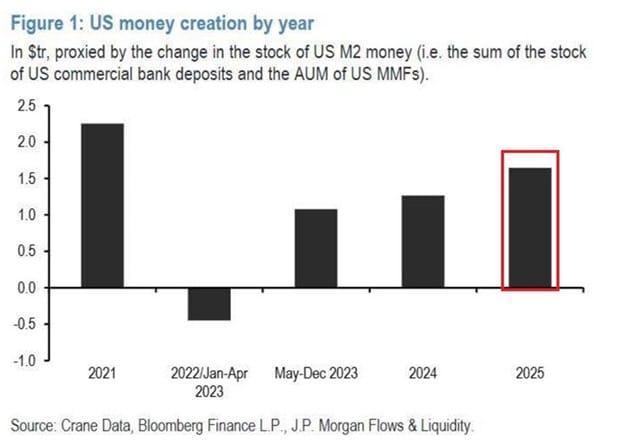
This marks the largest annual increase since 2021 - at the peak of COVID-era spending - and the third straight year of gains.
And since mid-2023, M2 has risen by nearly $3.7 trillion - about $116 billion per month.
Figure 1: Kobeissi Letter, January 2026
At this point, you may be wondering:
“Wait. Wasn’t the Fed tightening? How’s there even more money sloshing around?
That’s because the Fed – contrary to what many believe – doesn’t really control the money supply. Banks and government deficits do.
I’ve written about this before in, “Debt Cycles 101: Why Credit Is the Beating Heart of Economic Growth”– but the gist isthat when banks extend new loans, they create new money. And when the government runs deficits, it injects new spending power into the economy. Thus, if more new debt is created than old debt is repaid, the money supply grows.
Fed policy can certainly influence that process, but it isn’t the direct liquidity spigot.
From early 2022 through early 2023, M2 was shrinking as tighter policy as higher interest rates slowed growth, risk assets struggled, and credit tightened (taken altogether, banks lent less).
But once activity began to stabilize and recover - banks started lending again. Thus, money creation resumed - even as policy remained tight.
Now it’s shifting into a higher gear. . .
As I noted two weeks ago, U.S. banks are expanding loan books at the fastest pace since 2008. Surging lending - combined with heavy inflows into money market funds - is expanding the money supply at a rapid pace.
So why does this matter?
Because if the money supply was rising even while the Fed was tightening and the economy faced trade uncertainty - just imagine how much higher it could go as the Fed cuts rates and fiscal policy turns more stimulative.
That raises the odds that spending, lending, investment - and inflation - will re-accelerate.
This is where overheating enters the conversation.
If money supply keeps expanding while rates fall and growth stabilizes, the economy doesn’t need a surge in demand to run hotter. It just needs money to move faster.
And there’s a lot more of it in the system than there was two years ago.
Surging U.S. Productivity: Disinflation Today, Overheating Tomorrow?
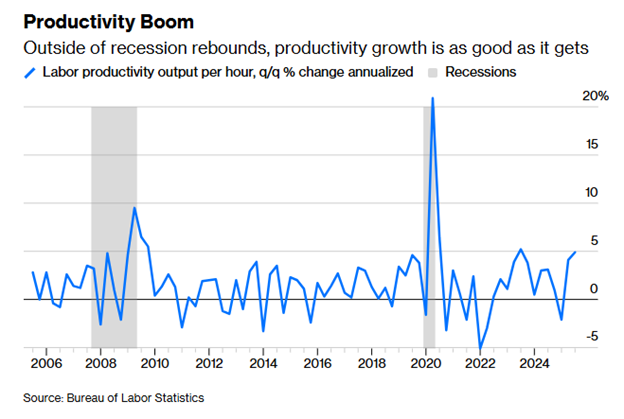
The U.S. economy appears to be entering one of its strongest productivity bursts in decades.
Adoption of AI and other technologies is pushing output higher - even as hiring slows.
The result has been a sharp jump in productivity metrics.
Seriously, take a look at labor productivity - aka output per hour in the nonfarm sector.
At the same time, unit labor costs fell for a second straight quarter - dropping 1.9% after a revised 2.9% decline earlier in the year.
And that combination, higher productivity + lower labor costs, is very anti-inflationary.
As Milton Friedman – one of world’s most famous economists - famously argued3, when productivity and supply grow faster than money creation, prices tend to fall (think mid-1950s to 60s). And when money grows faster than output (think post-COVID), inflation follows. Put another way, rising productivity carries a disinflationary bias as excess supply can counter money printing.
But there’s a catch. . .
Part of this productivity surge is coming from a less palatable source - layoffs4.
Thus, when companies maintain or increase output while employing fewer workers, productivity rises by definition (aka doing more with less).
So, how could this lead to overheating? Well. . .
Higher productivity and anemic labor demand can keep both inflation low and unemployment elevated. That combination makes for easier Fed policy. And if the Fed leans too hard into rate cuts, it risks amplifying asset bubbles and adding more fuel to an already growing pool of liquidity.
Strong productivity gains can trigger a surge in capital spending as firms invest to stay competitive. While productivity lowers costs over time, the buildout phase is inflationary - spending rises first, efficiency comes later. Think companies scrambling for copper, power, and concrete, bidding up prices to secure supply for data centers or to retrofit existing infrastructure. In other words, productivity can cool prices in the long run while heating demand in the short run.
Thus, productivity looks to be rising, but when it collides with expanding money supply and easier policy, efficiency stops being a brake and could instead become fuel.
So, the question is: will productivity growth be enough to offset money supply growth? Or will it become a feedback loop where more productivity leads to more money supply?
Time will tell.
The Wealth Effect Is Carrying the Load — and Fueling Demand
This is where household wealth enters the overheating picture.
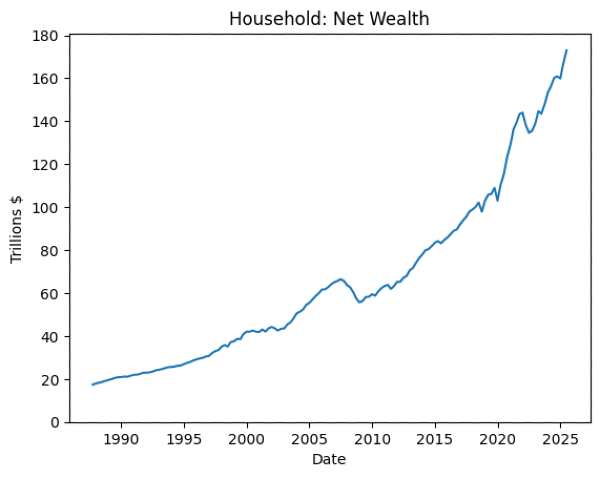
U.S. household net worth just hit a record high - over $180 trillion - driven by an AI-fueled stock rally and continued gains in home prices.
Figure 3: St. Louis Federal Reserve, January 2026
But that wealth is not evenly distributed. And that distribution matters.
For starters, it’s coming from asset prices – not wages.
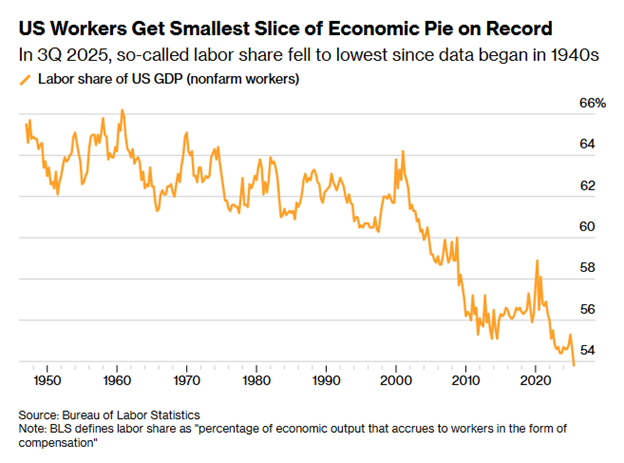
To highlight this, labor’s share of GDP has fallen to roughly 54%, the lowest level since tracking began in 1947.
Figure 4: Bloomberg, January 2026
Since the early 2000s, workers’ slice of the economic pie has dropped more than ten percentage points - while corporate profit margins have climbed near historic highs (I wrote more about this wage vs. productivity gap recently – you can read here)
Put simply, productivity gains haven’t flowed into wages. They’ve flowed into profits and asset prices.
That creates an imbalanced (split) economy – between the haves and the have-nots.
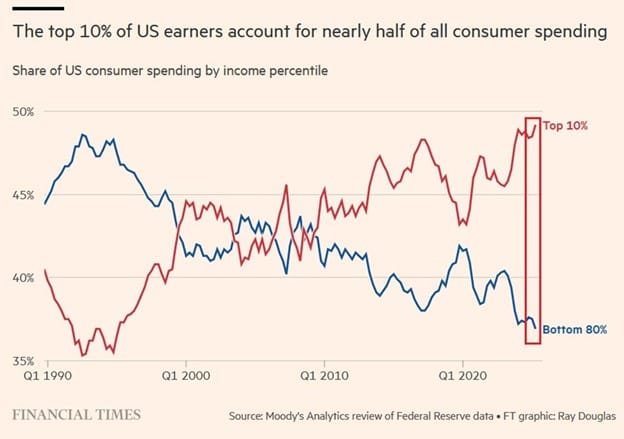
In that environment, higher stock prices don’t just lift net wealth - they sustain consumption.
Figure 5: Financial Times, January 2026
That’s how an economy can look fragile on the surface and still run hot underneath.
Because a vicious feedback loop takes hold:
Rising money supply supports asset prices, keeping pace with inflation (hopefully).
Higher asset prices reinforce the “wealth effect” – aka when asset prices rise, those who own them feel richer and tend to spend more than they otherwise would’ve.
And that wealth effect sustains demand in the economy because the top-10% make up 50% of consumer spending now.
But there’s a limit to this. . .
An economy can’t rely on an increasingly narrow slice of consumers to carry demand. And it can't depend on ever-rising debt for the bottom-90% to continue spending.
But before that limit is reached, policy usually responds to imbalance with more - you guessed it – liquidity and debt (aka make financing costs cheaper through lower interest rates).
And that’s the risk.
An economy powered by expanding money supply, rising productivity, and concentrated wealth doesn’t need a strong labor market to overheat.
It just needs asset prices to keep rising and for the wealthy to keep feeling that wealth effect.
That’s a possibility many may still underestimate.
Why an Economic Cooldown Can Still Lead to U.S. Overheating
Ironically, today’s economic weakness may be laying the groundwork for tomorrow’s overheating.
Remember, economic cycles tend to work like a pendulum - momentum builds on the way down, then overshoots on the way back up until it swings back down. There is no “middle ground” – just steady swings. A soft landing is rarely an endpoint. It’s usually a transition towards. And a depression is the precursor to a boom.
Contrary to what many may say, the U.S. economy doesn’t need a strong labor market to overheat.
It just needs expanding liquidity, early-cycle capital spending, and asset prices that keep people spending through the wealth effect.
All three – monetary, supply, and demand - are already in place.
That combination raises the risk that inflation and market volatility spurt higher just as policymakers move toward easier Fed policy.
Thus, the danger isn’t collapse. It’s mistaking visible weakness for slack - and easing into an economy already primed to run hot.
But as always, this is just some food for thought.
This communication is general in nature and provided for educational and informational purposes only. It should not be considered or relied upon as legal, tax or investment advice or an investment recommendation, or as a substitute for legal or tax counsel. Any investment products or services named herein are for illustrative purposes only, and should not be considered an offer to buy or sell, or an investment recommendation for, any specific security, strategy or investment product or service. Always consult a qualified professional or your own independent financial professional for personalized advice or investment recommendations tailored to your specific goals, individual situation, and risk tolerance.
Information contained in the materials included is believed to be from reliable sources, but no representations or guarantees are made as to the accuracy or completeness of information.
Dunham & Associates Investment Counsel, Inc. is a Registered Investment Adviser and Broker/Dealer. Member FINRA/SIPC. Advisory services and securities offered through Dunham & Associates Investment Counsel, Inc.