Content Editor, Dunham | 2025 ThinkAdvisor Luminaries Award Winner | 2026 Wealthies Finalist, Thought Leader of the Year | Macroeconomics, markets, geopolitics & global trends
Triffin’s Dilemma explains the tension faced by the issuer of the world’s leading reserve currency. Under Bretton Woods, the United States had to supply dollars for global trade and reserves, yet an expanding dollar supply could weaken confidence in the dollar’s gold backing. Today, the dollar remains central to global finance, and the conflict between domestic U.S. priorities and global demand for dollar assets still shapes debates over deficits, trade, debt, and de-dollarization.
Key Takeaways:
Triffin's Dilemma explains the paradox of being the world's reserve currency issuer — the U.S. is damned if it runs deficits and damned if it doesn't.
The U.S. must run deficits to supply global dollar liquidity, which hollows out manufacturing, builds debt, and exports inflation.
If the U.S. cuts deficits, global trade suffers from a dollar shortage — slowing growth for every country that depends on dollar inflows.
Despite years of de-dollarization rhetoric, no country — not China, not Russia — is willing to absorb the structural costs of replacing the dollar.
The dilemma that Robert Triffin identified in 1960 collapsed Bretton Woods in 1971. It still governs the global monetary system today.
Yet, this debate often overlooks a deeper paradox: the burdens of being a reserve currency issuer, famously captured by "Triffin’s Dilemma".
Let’s break down this dilemma and see how it's shaped the global economy and why no country - not even China or Russia - seems eager to replace the dollar.
What Is Triffin's Dilemma?
Now, this is a brief look back inhistory, but it’s very important to go over. So, bear with me.
Triffin’s Dilemma – named after economist Robert Triffin – is a term showing the paradox between having a global reserve currencyand domestic deficits/surpluses.
See, Triffin’s original issue was with Bretton Woods (aka the post-World War Two dollar-gold monetary system) and how it exposed a in the international monetary system.
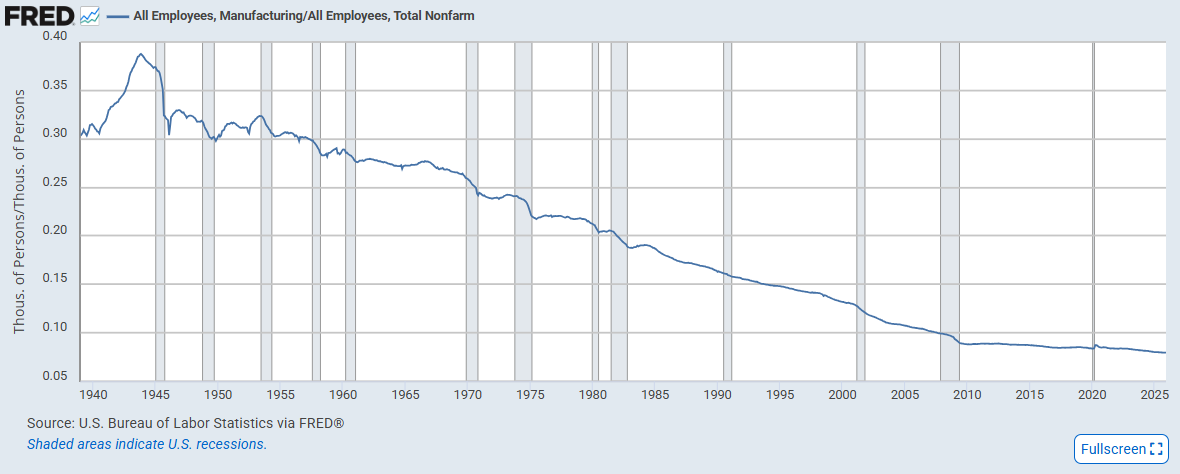
Continuous trade deficits have weakened the domestic industrial base - foreign goods are cheaper, crowding out American production and
In summary: Triffin testified2 to Congress in 1960 that the U.S. was stuck in a ‘Catch-22’ (aka a problem for which the solution is denied because of another problem).
Put simply – if the U.S. stopped running budget deficits – then the global economy would lose its main source of liquidity (aka U.S. dollars; the reserve currency). And this shortage of liquidity would increase global fragility and sink growth.
Remember: since the U.S. dollar was the reserve currency backed by gold, foreign nations needed first to gain dollars to build up their own reserves. Then later exchanged for gold if they wished. Thus the U.S. must constantly run deficits, buying more than it sells, to provide dollars globally and drive growth for foreign countries (since the U.S. was buying more of their goods).
It’s a relatively simple point that Triffin showed – but here’s where it gets interesting. . .
On the other hand – if the U.S. continued running deficits (buying more than it sells) to supply the world with dollars and thus economic growth, it would erode the confidence in the dollar. Which would lead to a run-on the U.S. gold supply (since ever-more dollars outstanding are claims on the ever-finite amounts of gold). Thus – the dollar’s value as a reserve currency would diminish, leading to further fragility, inflation, and disorder.
See the problem? It’s a “damned if do; damned if don’t” situation that Triffin noted.
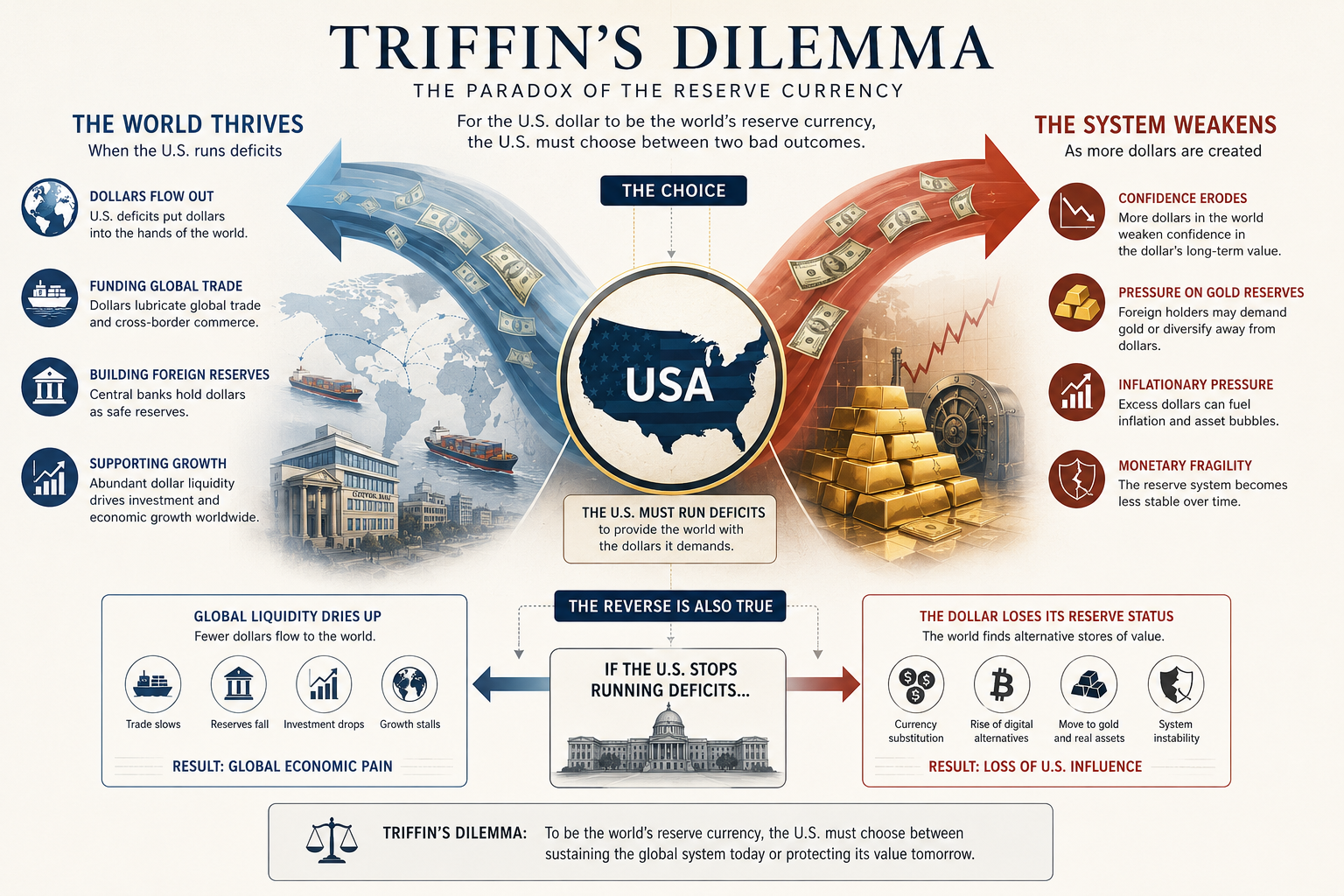
If the U.S. runs deficits: it provides the global liquidity needed for trade and growth b-ut risks eroding confidence in the dollar over time.
If the U.S. reduces deficits: it strengthens domestic stability - but creates a global dollar shortage that stifles growth and destabilizes emerging markets.
There is no version of this where the U.S. wins cleanly on both fronts simultaneously.
Figure 1: Dunham, 2026
Well, the U.S. government tried to fight this paradox for over a decade (1960-1971).
Why? Because it was enjoying the benefits of freely spending money. Thus, exporting inflation globally through huge deficits.
For example: President Johnson’s ‘Guns and Butter’3 policy for funding both the domestic ‘war on poverty’ and Vietnam were wildly expensive.
Until eventually – it was too late. . .
Thus, in 1971 – eleven years after Triffin testified – President Nixon suspended the dollar-to-gold window (effectively ending Bretton Woods) to prevent further gold outflows as inflation roared.
So, in the end – Robert Triffin’s monetary ‘dilemma’ proved accurate.
Why Triffin’s Dilemma Still Applies in the Modern Fiat Dollar System
Now – while Triffin’s-Dilemma was originally based on the dollar-gold fixed exchange system (Bretton Woods). I believeit still holds true today.
Why?
Because even in a fiat-based monetary system (aka money not backed with convertibility) – the U.S. dollar acts as paper ‘gold’.
Foreign nations still require dollars to build up their own reserves. And they do so in droves - whether it’s to buy goods from other nations or lend out the dollars.
See, most countries settle trade using dollars because they each can all accept and settle liabilities with it. They also can use dollars to maintain their own currency exchange rates, etc.
The U.S. dollar accounted for 57.13% of allocated global foreign-exchange reserves in the first quarter of 2026, according to the IMF’s COFER4data. The share remains far larger than that of any competing currency, even though it is below the dollar’s share in prior decades. data.imf
Meanwhile, Foreign investors held about $9.2 trillion of U.S. federal debt as of December 2025, or roughly 31% of publicly held federal debt, according to the Congressional Research Service. congress
Figure 2: St. Louis Federal Reserve
One thing to point out is that after the 1997 ‘Asian-Contagion’ crisis – when financial fragility spread globally throughout emerging markets in Asia – foreign nations began buying huge amounts of dollar assets. It’s likely because these foreign nations wanted a chest of dollar reserves to prevent another insolvency and currency crisis like 1997.
And don’t forget that the “Clinton surpluses” – when the U.S. ran trade surpluses between 1998 and 2001 – preceded the Asian Contagion crisis and the 2001 recession.
Meanwhile, the dollar (the nominal broad U.S. dollar index) continues rising in value relative to foreign currencies on the back of continued global demand (even as deficits have surged).
So – it appears that the U.S. dollar is still regarded as the safest and most liquid asset for global reserve holdings.
Just as gold was pre-1970s.
How the Dollar's Reserve Role Controls Global Growth
Ever notice how every time the U.S. Federal Reserve raises interest rates, other countries also do? Or vice versa? That's because of how important the U.S. dollar is in global markets.
And this is why Triffin's Dilemma is still very relevant. . .
Because even without gold, when the U.S. curbs dollar outflows through lower deficits (or running a surplus) – there's a drain on global liquidity that also weighs down growth. (And vice-versa).
This dynamic starves the world of the liquidity required for growth and debt repayment (such as dollar-denominated loans in foreign countries, how else will they get the dollars then?).
How? Because when the U.S. runs a deficit, it's buying more than it sells, thus fueling growth to whoever exports to the U.S. (such as China or Japan or etc).
And secondly, the U.S. Treasury is the only entity able to create physical dollars. So if a foreign country takes out a dollar-denominated loan, it must depend on dollar inflows (from exports) to even get the dollars to repay them. Thus, if the U.S. is importing less, that starves them of those dollars.
This is why when the U.S. sets its own budget - influencing deficits or surpluses - it can directly impact the world economy.
But this chronic deficit also comes with serious downsides
The Exorbitant Privilege — and Burden — of the Dollar
The late French Finance Minister Valéry Giscard d'Estaing famously called the dollar's reserve status America's "exorbitant privilege." The U.S. could borrow cheaply, run deficits freely, and fund its spending with foreign demand for its own currency.
But as I detailed already, there's still an "exorbitant burden" that gets less attention - such as:
2. Currency manipulation: Countries like China maintain artificially weak currencies against the dollar to sustain export competitiveness, deepening U.S. trade imbalances and making the reserve currency role structurally more costly.
3. Debt dependence: Deficits require financing. With foreign investors holding over ~$7.6 trillion in U.S. federal debt, the system only functions as long as confidence in dollar stability holds. A spiral in deficits - or a credible rival - could test that confidence.
4. Inflationary pressure: Running chronic deficits means the U.S. is constantly injecting dollars into the global system - and more dollars chasing the same goods is the textbook definition of inflation. When that dynamic combines with a weakening dollar making imports more expensive, the cost-of-living consequences reach every American household.
The privilege and the burden are inseparable. You can't have one without the other.
Why No Country Wants to Replace the Dollar
De-dollarization rhetoric has intensified in recent years - from BRICS summits to yuan-denominated oil contracts to calls for IMF Special Drawing Rights as a neutral reserve asset. Yet the dollar's share of global reserves has barely moved.
The reason is Triffin's Dilemma itself.
To replace the dollar, a country would need to:
Run persistent trade and budget deficits - supplying the world with its currency means buying more than you sell, indefinitely.
Fully open its capital account - allowing free movement of money in and out, which exposes the domestic economy to foreign shocks.
Accept the erosion of its industrial base - as the world demands your currency, imports become cheaper and manufacturing hollows out.
Subordinate domestic monetary policy to global liquidity needs - the reserve issuer's interest rates move global markets (not just domestic ones).
Russia, the eurozone, and BRICS collectively face the same structural constraint. And while the geopolitical desire to dethrone the dollar is there, the willingness to actually do what is required to replace it is not.
Put simply, the dollar's dominance isn't sustained by American power alone. It's sustained by the fact that every alternative requires accepting Triffin's burden — and no one wants it.
Triffin's Dilemma and Trump's Trade Policy
The current political moment makes this dilemma unusually visible.
Efforts to reduce the U.S. trade deficit - through tariffs, dollar weakening, or reshoring manufacturing - directly conflict with the dollar's reserve currency role. That's because the reserve currency status structurallyrequirestrade deficits.
Now, economists disagree over whether persistent deficits are a necessary cost of issuing the world’s leading reserve currency. In a 2017 BIS working paper, Michael Bordo and Robert McCauley challenge the argument that reserve status requires U.S. current-account deficits.
But my view is that the dollar’s global role helps sustain the trade imbalances Washington wants to reduce. That makes eliminating the deficit while preserving dollar dominance a much harder task than tariffs alone can address.
Thus, any attempt to eliminate the deficit while maintaining reserve currency dominance is attempting to resolve Triffin's Dilemma by willpower.
But it can't be resolved that way.
The forces driving dollar weakness in 2025 - tariff tensions, deficit expansion, and pressure on Fed independence - are all symptoms of a system straining against its own contradictions.
Triffin described this strain in 1960. And it remains unresolved today.
A Paradox That Endures
The U.S. faces the same binary Triffin identified over sixty years ago:
Run larger deficits - fuel global liquidity and growth, at the cost of domestic debt, inflation, and manufacturing decline
Cut deficits - strengthen domestic stability, at the cost of global liquidity and slower world growth
Neither choice is clean. Neither resolves the underlying contradiction. The "exorbitant privilege" of issuing the world's reserve currency is, in equal measure, an exorbitant burden.
So, the next time you hear about de-dollarization, the right question isn't whether it's possible. It's whether any nation is genuinely willing to absorb what replacing the dollar actually requires.
So far, the answer has been a hard no.
Frequently Asked Questions About Triffin’s Dilemma
What is Triffin’s dilemma in simple terms? Triffin’s dilemma is the conflict between supplying the world with a reserve currency and keeping trust in its value. Under Bretton Woods, more dollars helped support global trade and reserves. But as foreign dollar holdings grew, doubts rose about whether the United States had enough gold to exchange for those dollars.
Does Triffin’s dilemma require the U.S. to run budget deficits? No. Triffin’s original warning concerned U.S. balance-of-payments deficits under Bretton Woods, not government budget deficits. A budget deficit means the government spends more than it collects in revenue. A trade deficit means imports exceed exports. These measures describe different things, so using them as if they mean the same thing misstates the dilemma.
Did ending the gold standard solve Triffin’s dilemma? Ending the dollar’s link to gold in 1971 removed the risk that foreign governments would redeem more dollars than U.S. gold reserves could cover. It did not end every tension between U.S. policy goals and global demand for dollar assets. Economists disagree about how closely those modern tensions resemble Triffin’s original dilemma.
How did Robert Triffin propose solving the dilemma? Triffin proposed creating international reserve units that did not depend on gold or a national currency. These units would add to the funds available for global trade and growth. His goal was to let the United States reduce its balance-of-payments deficits without leaving the world short of reserves.
This communication is general in nature and provided for educational and informational purposes only. It should not be considered or relied upon as legal, tax, or investment advice or an investment recommendation, or as a substitute for legal counsel. Any investment products or services named herein are for illustrative purposes only and should not be considered an offer to buy or sell, or an investment recommendation for, any specific security, strategy, or investment product or service. Always consult a qualified professional or your own independent financial professional for personalized advice or investment recommendations tailored to your specific goals, individual situation, and risk tolerance.
Information contained in the materials included is believed to be from reliable sources, but no representations or guarantees are made as to the accuracy or completeness of information.
Dunham & Associates Investment Counsel, Inc. is a Registered Investment Adviser and Broker/Dealer. Member FINRA/SIPC. Advisory services and securities offered through Dunham & Associates Investment Counsel, Inc.



.png&w=3840&q=75)
.png&w=3840&q=75)