Content Editor, Dunham | 2025 ThinkAdvisor Luminaries Award Winner | 2026 Wealthies Finalist, Thought Leader of the Year | Macroeconomics, markets, geopolitics & global trends
Investor biases are mental shortcuts and emotional habits that can distort investment decisions. The endowment effect, information asymmetry, recency bias, and present bias can lead investors to overvalue what they own, act on incomplete information, chase recent returns, or favor immediate rewards over long-term goals. Understanding these four factors can help investors recognize what’s influencing their decisions and take steps to reduce their impact.
Key Takeaways
The endowment effect can make an investment feel more valuable simply because you own it.
Information asymmetry occurs when one party has more or better information than another.
Recency bias can make recent gains or losses seem more predictive than they are.
Present bias can lead people to favor immediate rewards over longer-term goals.
Recognizing these patterns is a first step toward helping reduce their influence on financial decisions.
Understanding the Psychology Behind Your Investment Decisions
Markets and investing are often described in terms of numbers, charts, and models - but at their core, markets are social systems driven by human behavior.
In other words, prices reflect a series of interrelationships between individuals, groups, corporations, institutions, and financial markets that together form a coherent social structure. All of these systems have one thing in common - they begin with people.
And because markets are social systems, it’s essential to understand how people influence them. Nowhere is this more evident than in behavioral finance and investor psychology, where emotions and biases show up directly in market prices.
Think of prices as the collective information of all inputs - from fear and greed to information processing and irrationality:
When people feel aggressive and greedy, prices tend to rise.
When people feel risk‑averse and fearful, prices tend to sink.
Thus it’s clear that emotions and biases are critical drivers in market prices.
The point is, It’s literally in our DNA - hence the repeated cycles of boom and bust; fear and greed.
And these persistent flaws and biases influence our decision-making, often resulting in our irrational choices.
Compounding the issue, scientific findings indicate that there are over 150 of these factors affecting us daily.
But not all hope is lost. . .
By taking the time to recognize and identify these biases, we can take the initial step in mitigating their impact on our financial decisions and potentially enhancing economic outcomes.
With that said, let’s take a closer look at the four emotional biases and cognitive flaws I believe you should look out for.
The Endowment Effect: Overvaluing What You Own in Investing
The endowment effect is the tendency to value something more highly simply because you own it. In investing, that attachment can make a holding seem more valuable than you would consider it if you were buying it today because ownership changes how you see the investment.
Everyday examples:
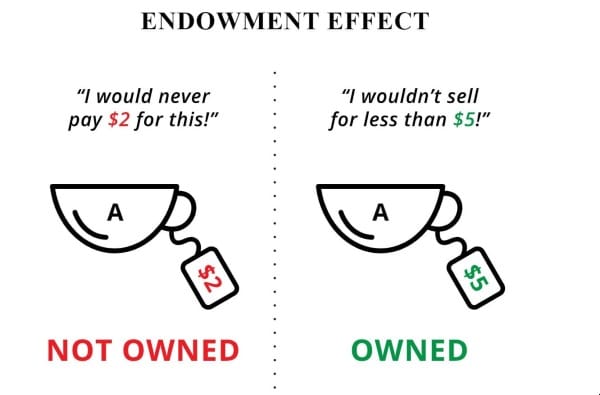
Someone would not pay 2 dollars for a new mug but refuses to sell their own mug for less than 5 dollars.
A stockholder clings to a losing investment, insisting it’s “worth more” than the market price, just because it’s already in their portfolio.
Figure 1: Dunham, 2024
Thus - in simpler terms - the endowment effect arises when there's a disparity between what a buyer is willing to pay and what a seller is willing to accept. This gap often occurs because buyers reference the lowest available price, while sellers focus on the highest prices when determining a fair value.
Now, I am sure you can see how this affects markets.
Sellers always want a higher price for their investments, and although buyers may be skeptical of paying, they will sometimes overpay for fear of missing out.
Then once they buy stock XYZ, they’ll only part with it at a higher price. And on and on.
This bias can help push prices both higher and lower than what fundamentals justify.
Thus to try avoiding this bias, you can:
Evaluate investments objectively, as if you didn’t already own them.
Ask yourself: "Would I buy this stock today at its current price?"
Consider whether your reasons for holding it still match your financial goals.
Information Asymmetry: The Risks of Unequal Knowledge in Markets
Information asymmetry occurs when one party in a transaction has more or better information than another. It’s a related investing risk rather than a psychological bias. An information gap can make it harder to assess what you’re buying, what it costs, and what could go wrong.
Here are some examples of information asymmetry:
A used car seller knows more about the vehicle’s history than the buyer.
In the stock market, insiders or institutional investors may have more detailed knowledge than retail investors.
During the 2008 financial crisis, banks packaged risky mortgages into products that were sold as “safe” to investors who lacked the granular information needed to assess the true risk.
Asymmetric information exists virtually everywhere, making win-win business agreements and transactions almost impossible to come by.
That shouldn’t come as a surprise though, right? You live in the real world. I’m sure you’ve seen this firsthand.
Well, the problem arises in economics and finance because models and theories use the assumption that all buyers and sellers have complete and instantaneous knowledge of all market prices and their utility.
Thus, if the model makes these unrealistic assumptions, then the entire model is potentially flawed.
How to help overcome it?
Diversify investments to reduce exposure to bad information.
Rely on trusted, verifiable sources before making financial decisions.
Recognize what you don’t know before committing money.
Recency Bias: Why the “Hot Hand” Can Mislead Investors
Recency bias is the tendency to give recent events too much weight when making decisions. In investing, it can lead people to assume that recent gains or losses will continue. What just happened starts to feel like the best map to what happens next.
Examples:
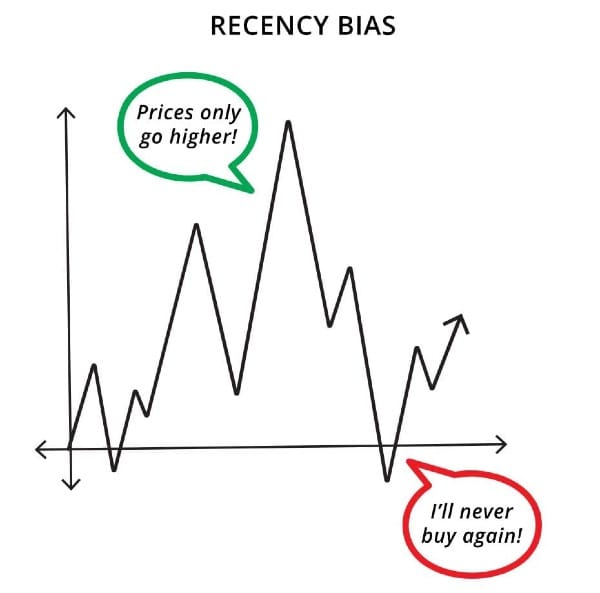
A stock market rally makes investors believe prices will keep rising.
A recent crash triggers panic selling, even if fundamentals are strong.
The "hot hand fallacy" makes people believe recent success will continue (e.g., a winning investor is "on a streak" or when a basketball player continues making shots and don't expect it to stop).
Figure 2: Dunham, 2024
This ties closely to the hot hand fallacy - the belief that a streak of recent successes means more success is likely, when in reality, short‑term streaks are often just noise.
For example, imagine observing a stock portfolio where five consecutive investments yield positive returns. The assumption might be that the investor is on a "hot streak" and will continue succeeding. This belief relies on a small sequence of random events, overlooking the chance nature of the initial gains.
Thus, the hot hand fallacy in stock markets can lead to the misconception that a short-term pattern predicts future success, neglecting a more accurate assessment.
Making matters worse, this can create false confidence in the continued streak, so individuals pile into the trade expecting further success.
That is, until it doesn’t. And things quickly unwind.
How to help overcome it?
Take a long-term view instead of reacting to short-term trends.
Stick to fundamentals rather than emotional market swings.
Review recent performance alongside a longer history.
Present Bias: Choosing Short-Term Gains Over Long-Term Success
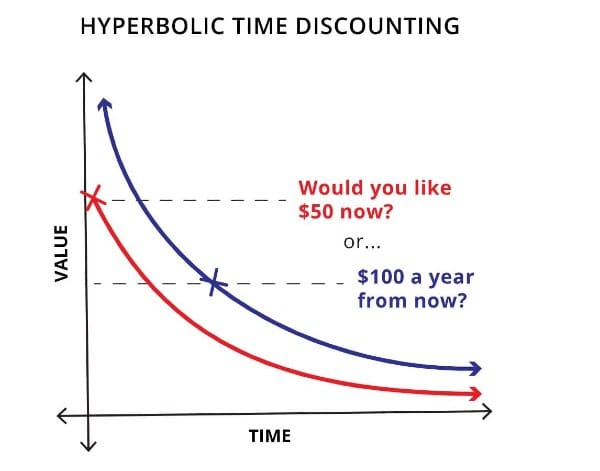
Present bias - often described in research as hyperbolic time discounting - is our tendency to favor smaller, immediate rewards over larger, delayed rewards. Meaning - “now” feels much more real than “later,” even when “later” is clearly better.
Such bias affects people at many levels - from eating and addiction to finances and risk-taking - where the immediate pleasure outweighs long-term concerns.
Figure 3: Dunham, 2024
In short, people tend to discount how they’ll feel in the future.
For example, consider having extra funds available. A prudent choice would be to invest for retirement. However, the allure of immediate gratification by buying a new video game or car today feels better.
The individual knows what the logical choice is, but that little voice in their head says, “Don’t worry, we can always save for retirement next time.”
But then next time comes, and the cycle repeats itself. . .
NBER researchhas linked present bias with lower retirement account balances, giving this everyday pattern a measurable connection to saving behavior.
Another example is how investors often grapple with the decision between pursuing high short-term yields (which come with more risk) and opting for long-term investments that typically offer lower risk and returns.
The high-flying stock offers immediate gratification, but it can also be destructive if those risks reveal themselves.
Set long-term financial goals and prioritize them over short-term moods.
So next time you feel the urge to discount your future self, think about hyperbolic time discounting (a mouthful of a word).
Final Thoughts: Recognizing Biases for Better Financial Decisions
Markets are driven by human psychology, and biases distort investment decisions.
By understanding the endowment effect, information asymmetry, recency bias, the present bias, and many many more - investors can:
Make rational choices instead of emotional ones.
Improve long-term financial outcomes.
Avoid common investing pitfalls.
Frequently Asked Questions About Investor Biases
What is the difference between the endowment effect and loss aversion in investing? The endowment effect makes an investment seem more valuable because you own it. Loss aversion makes a loss feel more painful than an equal gain feels rewarding. These biases can overlap when you resist selling because you feel attached to an investment and don't want to realize a loss.
How can financial advisors help clients stop chasing past returns? Financial advisors can help clients address performance chasing by comparing recent returns with longer market histories and the client's financial plan. Asking what changed beyond the investment's price can help reveal recency bias. Reviewing goals, time horizon, and the planned mix of investments gives clients a clearer basis for their decisions.
How does present bias affect retirement savings? Present bias can lead people to put off retirement contributions because spending today feels more rewarding than saving for later. For example, someone may plan to save a future bonus, then spend it when it arrives. Research discussed by NBER links present bias with lower retirement account balances.
Is information asymmetry a behavioral bias? No. Information asymmetry is an information gap, rather than a behavioral bias. It occurs when one party has more or better information than another. Behavioral biases involve patterns in thinking or emotion. Both can affect investment decisions, but they describe different issues: what someone knows and how they interpret or respond to it.
This communication is general in nature and provided for educational and informational purposes only. It should not be considered or relied upon as legal, tax, or investment advice or an investment recommendation, or as a substitute for legal counsel. Any investment products or services named herein are for illustrative purposes only and should not be considered an offer to buy or sell, or an investment recommendation for, any specific security, strategy, or investment product or service. Always consult a qualified professional or your own independent financial professional for personalized advice or investment recommendations tailored to your specific goals, individual situation, and risk tolerance.
Information contained in the materials included is believed to be from reliable sources, but no representations or guarantees are made as to the accuracy or completeness of information. This document is provided for information purposes only and should not be considered as investment advice
Dunham & Associates Investment Counsel, Inc. is a Registered Investment Adviser and Broker/Dealer. Member FINRA / SIPC. Advisory services and securities offered through Dunham & Associates Investment Counsel, Inc.
Investor Biases: 4 Things That Skew Investment Decisions | Dunham