Content Editor, Dunham | 2025 ThinkAdvisor Luminaries Award Winner | 2026 Wealthies Finalist, Thought Leader of the Year | Macroeconomics, markets, geopolitics & global trends
The euro is the world's second-largest reserve currency, but its global share has slipped from 28% in 2009 to about 20% as of Q1 2026. As de-dollarization debates grow louder, many investors ask whether the euro could replace the U.S. dollar as the world's dominant reserve currency. Structural weaknesses in the eurozone — including Germany's export reliance, France's record debt levels near 118% of GDP, and persistent internal imbalances — suggest that outcome remains unlikely
Key Takeaways
The Euro’s Design is Its Weakness: The euro struggles as a global currency because it is trapped in a fragmented eurozone with conflicting economic priorities.
Germany and France Are Weighing Down the Eurozone: Germany's export reliance and France’s record debt are destabilizing the region's two largest economies.
Euro’s Global Influence is Declining: Once accounting for 28% of global reserves in 2009, the euro’s share has now fallen to 20%, reflecting weakening global demand.
Divergent Economies, One Currency: Southern European nations like Greece, Italy, and Spain face stagnation, while Germany’s surplus-driven model creates a dangerous imbalance.
The U.S. Dollar Remains Dominant: Unlike the euro, the U.S. dollar benefits from strong U.S. economic growth, massive deficits that fuel global liquidity, and deep, liquid markets.
Over the last few months, I’ve tackled the de-dollarization buzz surrounding the U.S. dollar.
And my question remains: Sure, the U.S. dollar might not be spotless - like a shirt with a stain in a basket of laundry. But isn’t it still the cleanest shirt in the pile?
Or said another way, if the dollar were dethroned, what could possibly take its place?
But while everyone watches BRICS, the euro lurks in the background.
It’s already the world’s second-largest reserve currency. And on paper, it could be a contender.
But in practice? It’s struggling.
So, let’s unpack why the euro is stumbling under European turmoil - and how this keeps the dollar standing strong.
Why the Euro’s Reserve Share Is Declining
After the euro launched in 1999, enthusiasm was strong. Rapid growth across Portugal, Italy, Greece, and Spain made the euro appear to be a rising challenger.
Following the 2008 financial crisis - when the U.S. dollar looked vulnerable - the euro’s reserve share climbed to 28%.
But that momentum did not last.
By 2011–2012, sovereign debt crises erupted across southern Europe. Growth slowed. Demographic challenges deepened. Political tensions intensified. And the eurozone entered a prolonged period of stagnation.
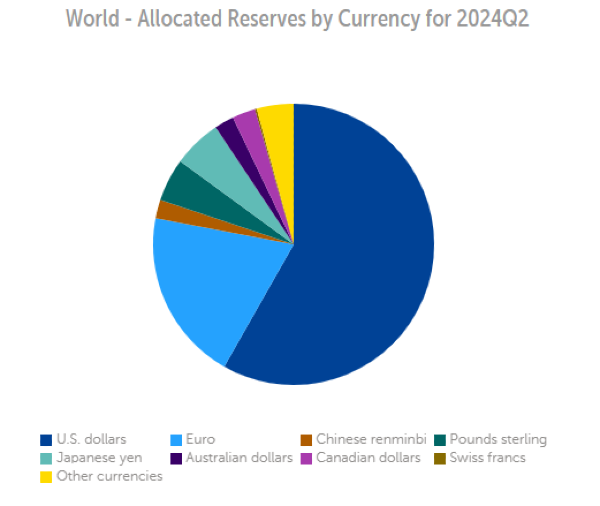
Today, the euro accounts for just 20% of global reserves.
Figure 1: IMF, Q2/2024
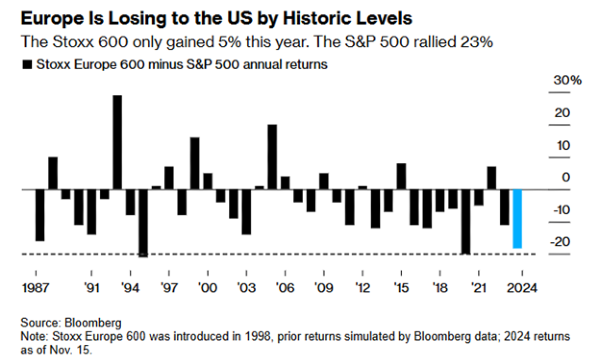
Meanwhile, the dollar remains dominant — supported by faster economic growth, deeper financial markets, and stronger equity performance.
U.S. stock values reached $63 trillion - four times the size of Europe’s markets.
Europe lacks a single public company valued at over $500 billion - while the U.S. boasts eight companies worth more than $1 trillion each (Apple and Nvidia have each surpassed the $3 trillion mark, while Microsoft have exceeded $2 trillion).
Figure 2: Bloomberg, November 2024
And as we know, capital follows growth.
And currencies follow capital.
*Note that over the last year, Euro markets have outperformed their historical averages and U.S. markets amid the "Sell America" trade as Trump pushes for a weaker U.S. dollar and rebalanced trade. Time will tell if this endures, but Europe has many structural issues it must fix.
Germany and France: The Eurozone’s Core Weakness
There’s no other way to put it - but the Eurozone is economically shaky
Why?
Because its two biggest economies - Germany and France - are stumbling. And hard.
Germany, the largest, is stuck in a rut. Factories are slowing, exports are falling, and consumer demand is weak. Some are even calling Germany the “sick man of Europe” again, a label it hasn’t carried since the early 2000s.
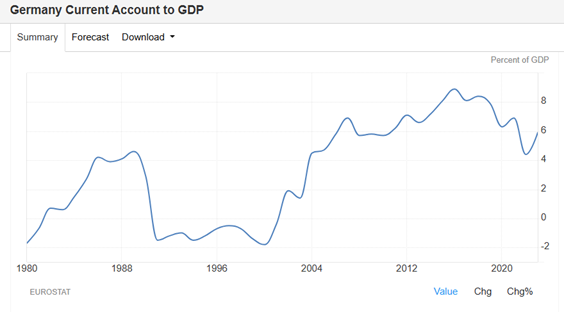
Germany’s economy heavily relies on exports, with a huge current account surplus of 6% of GDP in 2023. This dependence is risky – because if global demand drops (which it has) or tariffs rise, as Trump has said2, Germany could take another big hit.
Figure 3: Trading Economics, November 2024
Meanwhile, France – the second largest euro-zone economy - isn’t doing much better. Its finances are a mess. The government owes a lot of money, and investors are starting to worry. How bad is it? In 2023, France spent 57% of its money on government programs. That’s more than almost any other country in Europe3. And making matters worse, France's debt has reached a record €3.228 trillion - amounting to 112% of GDP. This puts a strain on the country’s finances - especially as growth prospects stay limited.
Thus, when your star players are benched, the whole team feels the squeeze.
Germany and France account for nearly 50% of the eurozone’s GDP, and no other member states can fill the gap.
Diverging Economies Stuck Under One Currency
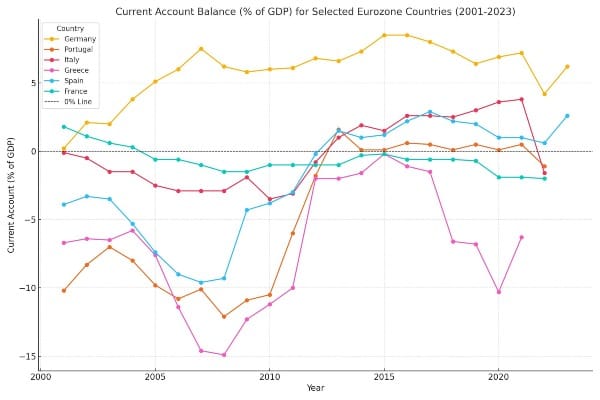
Another issue is that Germany has long relied on the eurozone to buy its massive exports. Since the euro’s creation in 1999, its trade surpluses have mirrored the deficits of France, Italy, and the PIGS nations.
But the 2008 financial crisis changed everything. And by 2011, struggling countries turned to austerity – aka cutting spending and raising taxes to slash deficits. Thus, growth suffered ever since.
Meanwhile, Germany maintained its surplus-driven model (exports), creating a deeper imbalance.
The chart below shows how Germany’s surplus contrasted sharply with the deficits of its neighbors (especially in the early 2000s). This imbalance has become a cornerstone of the eurozone’s fragile economic structure, making any rebalancing a tough sell.
Figure 5: World Bank, Eurostat, Dunham, 2024
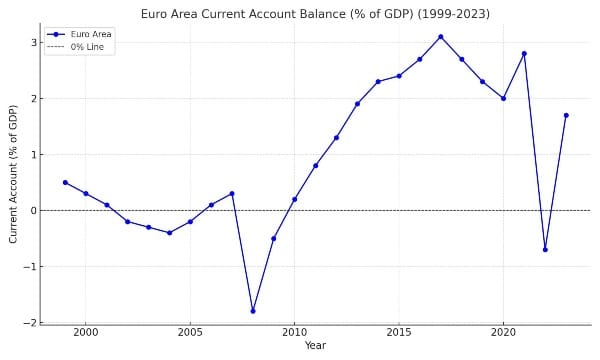
In fact, the euro area collectively runs a current account surplus (see chart below).
Put simply, the Eurozone sells much more to the world than it buys. This brings in extra foreign money and reduces the need for others to hold euros. By exporting more, the Eurozone builds up savings and lends to others, which is why it owes so little globally.
Figure 6: World Bank. Dunham 2024Now, you might ask, “Wasn't the PIGS reducing deficits a good thing?”
In many ways, yes. But those deficits fueled growth by driving extra demand.
Think of it like a credit card splurge - it’s unsustainable, but it creates a temporary consumption boost while it lasts.
To put this into context – let’s take a look at Greece 15 years since their economy began imploding.
The Greece Example: How Austerity Crushed Growth and Wages
From 2001 to 2008, Greece was a high-spending, deficit-driven economy in the European Union. Then, it all fell apart.
To secure an IMF and EU bailout, Greece slashed spending and raised taxes. These austerity measures hit businesses and households hard, wrecking the economy. The damage was unprecedented for peacetime.
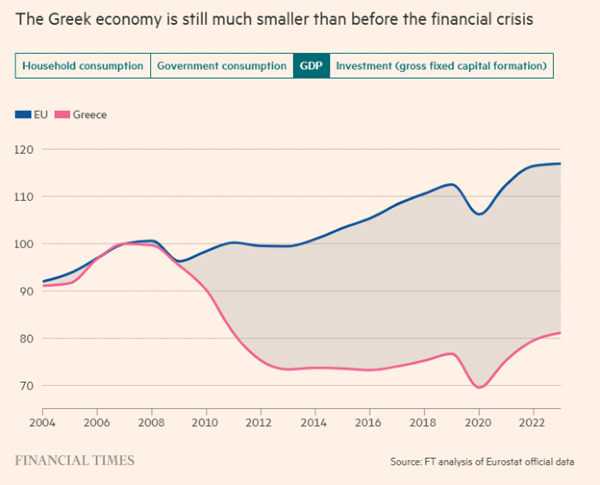
Now – over a decade later - Greece is the second poorest country in the EU7. Real wages are down 30% from pre-crisis levels, leaving it with some of the lowest average salaries among developed nations. Its economy is still 20% smaller than in 2007, while the EU’s GDP has grown by 17%.
Figure 7: Financial Times, April 2024
Austerity may have stabilized Greece’s public sector and markets, but it came at a steep cost to consumers and economic growth. The same trend hit other PIGS nations, leaving the eurozone with weak demand and risks of further stagnation – and it also negatively affected Germany’s growth.
I am not arguing that austerity is bad. It’s needed at times to purge excess and unsustainable growth. The problem is that it does come at a cost as we've seen throughout the eurozone.
And until Europe allows for much larger fiscal deficits, growth may continue stagnating.
So, Could the Euro Ever Meaningfully Challenge the Dollar Again?
It's possible - but it would require:
Fiscal integration across the eurozone
Unified "eurobonds" (like how the U.S. has a national debt as well as state debts)
Stronger growth
Large Fiscal Deficits
Deeper capital markets
Reduced structural imbalances
But those reforms would demand major political concessions.
More interestingly, though, does the eurozone actually want to do that?
For instance, even France (historically one of the strongest advocates for expanding the euro’s global role) is starting to sound cautious.
Why? Because a stronger euro could hurt exporters. Thus, if the currency appreciates meaningfully against the dollar, French and European goods become less competitive globally.
And if France - a large trade deficit nation - is worried about its exports, it's more than likely Germany is far more worried behind closed doors.
But that’s the paradox.
For the euro to rival the dollar, it would likely need to strengthen much more and become a global “safe haven.” But a stronger euro would squeeze the very export-driven economies that anchor the bloc.
France has long criticized the dollar’s “exorbitant privilege.” Yet even Paris now acknowledges that replicating that privilege is not so simple - especially for a region that runs a trade surplus (this is known as "Triffin's Dilemma" - which I've written about in depth before).
In other words, Europe wants the benefits of reserve status.
But it's less enthusiastic about the trade-offs.
And that tension runs straight through the euro’s design.
The euro was always more of a political project than an economic one.
It was built to bind Europe together.
Not to dethrone the dollar.
If it could not replace the dollar during the early 2000s - when growth was stronger and the U.S. faced crisis - it is even less likely to do so now unless major structural changes occurs.
Closing Thoughts: What Lies Ahead?
The eurozone and EU were built to bring unity and stability to post-WWII Europe. Economic integration was a means to this political goal, not the main focus. The euro brought some economic benefits, but it was rushed for political reasons. This left the region struggling to manage vastly different economies and cultures under one currency - essentially shaped by Germany.
Germany’s fiscal discipline and low inflation dominated the system, forcing “soft” currency economies like Greece, Italy, and Spain into a “hard” currency framework. Imagine a one-size-fits-all sock trying to stretch over very different feet - it doesn’t work without something tearing.
But since the euro is more of a political project, it’s likely here to stay. Still, don’t expect it to dethrone the dollar anytime soon. If it couldn’t in the early 2000s, when conditions were more favorable, it’s even less likely now.
Keep in mind there’s far more to this topic and many variables. So, I’m barely scratching the surface here.
As always, time will tell.
Frequently Asked Questions About the Euro and Global Reserve Currencies
Could the euro replace the U.S. dollar as the world's primary reserve currency? No, the euro is unlikely to replace the U.S. dollar anytime soon. It is the world's second most-held currency, but it makes up only about 20% of global reserves. The eurozone doesn't have a single treasury, a common bond market, or deep financial markets. Wealth gaps between northern nations and indebted southern members also hurt the bloc's stability during global shocks.
Why does the eurozone's trade surplus keep the euro from becoming the dominant reserve currency? A reserve currency issuer has to supply safe assets to the world. The United States does this by running trade deficits, which sends dollars abroad. The eurozone does the opposite. Because it runs a trade surplus, it takes in foreign cash instead of sending euros out. Without large deficits and cash outflows, other countries can't easily build big euro reserves.
What structural reforms would the eurozone need to challenge the U.S. dollar? The European Union would need a true fiscal union that issues shared debt, often called eurobonds. Right now, investors don't have one safe asset. Instead, they must pick between national bonds with different risks, like German Bunds or French OATs. Europe also needs united capital markets, faster growth, and an appetite for a stronger euro that could hurt exporters.
How does Germany and France's economic trouble impact the euro's international standing? Germany and France generate roughly half of the eurozone's total GDP. Germany's export factories have slowed down as world demand dropped. At the same time, French public debt tops 110% of GDP amid ongoing political fights. With both core economies facing low growth and fiscal strain, central banks see little reason to hold more euros.
This communication is general in nature and provided for educational and informational purposes only. It should not be considered or relied upon as legal, tax or investment advice or an investment recommendation, or as a substitute for legal or tax counsel. Any investment products or services named herein are for illustrative purposes only and should not be considered an offer to buy or sell, or an investment recommendation for, any specific security, strategy or investment product or service. Always consult a qualified professional or your own independent financial professional for personalized advice or investment recommendations tailored to your specific goals, individual situation, and risk tolerance. All examples are hypothetical and are for illustrative purposes only.
Information contained in the materials included is believed to be from reliable sources, but no representations or guarantees are made as to the accuracy or completeness of information. This document is provided for information purposes only and should not be considered as investment advice.
Index Definitions
S&P 500 Index - The S&P 500, or the Standard & Poor’s 500, is a stock market index based on the market capitalizations of 500 large companies having common stock listed on the NYSE or NASDAQ. The S&P 500 Index components and their weightings are determined by S&P Dow Jones Indices. It differs from other U.S. stock market indices, such as the Dow Jones Industrial Average or the Nasdaq Composite index, because of its diverse constituency and weighting methodology. It is one of the most commonly followed equity indices, and many consider it one of the best representations of the U.S. stock market, and a bellwether for the U.S. economy.
The STOXX Europe 600 Index - The STOXX Europe 600 Index is derived from the STOXX Europe Total Market Index (TMI) and is a subset of the STOXX Global 1800 Index. With a fixed number of 600 components, the STOXX Europe 600 Index represents large, mid and small capitalization companies across 17 countries of the European region.
Dunham & Associates Investment Counsel, Inc. is a Registered Investment Adviser and Broker/Dealer. Member FINRA / SIPC. Advisory services and securities offered through Dunham & Associates Investment Counsel, Inc.
Can the Euro Dethrone the USD? Why It’s Still Unlikely (For Now) | Dunham