Content Editor, Dunham | 2025 ThinkAdvisor Luminaries Award Winner | 2026 Wealthies Finalist, Thought Leader of the Year | Macroeconomics, markets, geopolitics & global trends
A weak dollar means the U.S. currency buys less foreign currency. For investors, this can lift the dollar value of unhedged international holdings while increasing import-cost pressures. The effects aren’t uniform - portfolio exposure, currency hedging, inflation, and the reasons behind the decline all matter.
Key Takeaways
A weak dollar cuts purchasing power but boosts exports and commodities.
Inflation rises as imports cost more; exporters and multinationals often benefit.
Context is key - dollar weakness can create both risks and opportunities depending on where investors are exposed.
Currency cycles are relatively common and not always catastrophic - long-term investors should focus on positioning, not panic.
How Do You Measure Dollar Weakness?
You’ve probably heard about the “debasement trade” - investors buying assets like gold because they’re worried about currencies losing purchasing power.
But there’s a key distinction.
A dollar losing purchasing power isn’t the same thing as a dollar falling against other currencies.
Said another way, when someone says the dollar is "weak" - ask: compared to what?
The euro? The yen? A broader basket of trading-partner currencies? Or are they talking about what it buys - from groceries to gold?
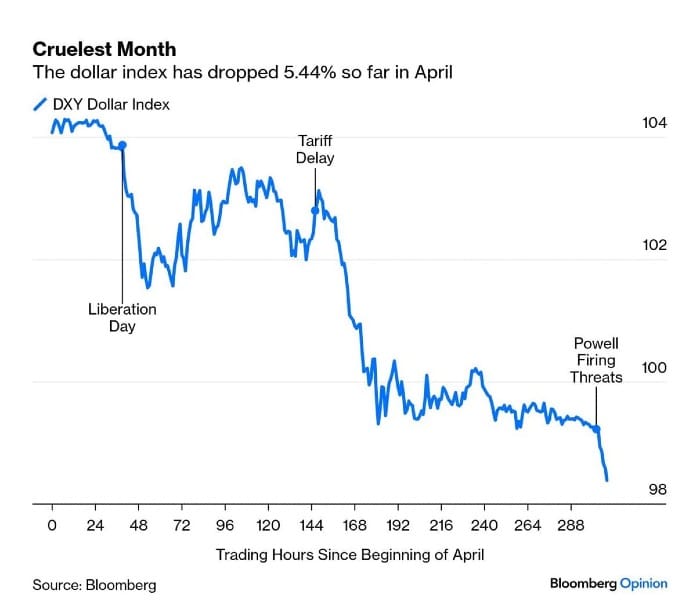
The ICE U.S. Dollar Index - commonly called $DXY - measures the dollar against six currencies. And the euro accounts for 57.6% of that basket. That makes $DXY useful - but it isn’t the whole picture of the dollar’s performance against U.S. trading partners.
For example, a decline in $DXY could be largely driven by weakness against the euro, even while the dollar strengthens against some Asian currencies. Thus, a “weak dollar” doesn’t necessarily mean it’s weak across the board.
But there is no doubt that currencies are always moving. But broader trends can take hold, with the dollar strengthening or weakening against several currencies and assets over time.
And that’s different from losing purchasing power as prices rise.
For investors, the question is how those changes flow through the economy - from the price of imports to company earnings and the investments in your portfolio.
That’s where the risks and opportunities start to look different.
Let’s break it down.
What Does a Weak Dollar Mean?
Currencies are relative - when one weakens, others strengthen. So, if the dollar is dropping, other currencies (and their local assets) are rising in value.
Put simply, a weaker dollar means it doesn’t buy as much abroad as it once did.
Last year, $1 might’ve bought €1.
Today, that same dollar might only buy €0.90.
That means your dollar buys 10% fewer euros. And buying the same €1 now costs about $1.11 instead of $1.
But riddle me this: is the euro stronger - or is the dollar just weaker? Either way, the effect is the same - your dollar buys less.
And that loss of buying power shows up everywhere - from overseas vacations to imported goods.
Why Is the Dollar Weakening?
The dollar doesn’t move for just one reason. Interest-rate expectations, trade policy, fiscal concerns, and demand for safe assets can all pull it in different directions.
The 2025 selloff offers a useful example. Tariff uncertainty and concerns about Fed independence weighed on sentiment. But the dollar later attracted safe-haven demand when the Iran conflict escalated in March 2026. Different shocks can produce different currency reactions.
The point is, think of a currency as a product in a market. If fewer people want it - or if there's too much of it - its price goes down.
It’s like walking into the grocery store and finding smaller packages—but paying the same price. You’re effectively getting less for more.
This is especially important for the U.S. economy, which is heavily dependent on imports. In 2024:
Imports of goods and services made up nearly 14% of GDP
The trade deficit (meaning imports > exports) reached a staggering $918.4 billion - a 17% increase from the year before.
Put simply, the dollar weakens = imports cost more = businesses face higher input costs = consumers pay more at checkout.
How a Weak Dollar Impacts Investments
A weaker U.S. dollar doesn’t just affect consumers and businesses - it also has ripple effects across different asset classes. Here’s how:
Portfolio Exposure
Potential Effect
What Investors Should Check
Unhedged international investments
Stronger foreign currencies can lift returns when converted into dollars.
Underlying investment performance and whether currency exposure is hedged.
U.S. exporters and multinationals
Overseas earnings can translate into more dollars, while exports may become more competitive
Foreign revenue, imported costs, and company hedging
U.S. bonds
Dollar weakness reduces home-currency returns for unhedged foreign holders.
Interest-rate changes, inflation expectations, and currency hedging
Commodities
Dollar weakness can support prices, but the relationship isn’t fixed.
Supply, demand, and the reason the dollar is weakening.
And like all things in economics, there are winners and losers.
Pros of a Weak Dollar
Boosts Exports: U.S. goods become cheaper abroad, helping manufacturers and farmers sell more.
Encourages Tourism: Travel to the U.S. becomes more affordable for foreign visitors.
Narrows the Trade Deficit: Costlier imports and stronger exports can help balance trade (aka export more and import less).
Cons of a Weak Dollar
Drives Up Inflation: A weaker dollar makes imported goods more expensive, which raises prices on everyday items. This added cost pressure can push overall inflation higher - making it harder for the Fed to lower interest rates.
Squeezes Business Margins: Companies that rely on foreign materials like commodities face rising input costs.
Reduces Consumer Power: Americans get less value abroad when converting their money (they may have to rethink their Euro-trip).
Potential Benefits
Potential Drawbacks
Helps U.S. exporters — American goods can become more affordable to foreign buyers.
Raises import-cost pressures — Imported goods can become more expensive, potentially feeding into inflation.
Supports inbound tourism — U.S. travel becomes more affordable for visitors whose currencies strengthen against the dollar.
Reduces purchasing power abroad — Americans’ dollars buy less when exchanged into those stronger currencies.
May improve the trade balance — More competitive exports and costlier imports can shift trade flows.
Pressures import-dependent businesses — Higher imported-input costs can squeeze margins if companies can’t pass them along.
What Investors Should Consider When the Dollar Weakens
A weak dollar isn't always bad. It's a rebalancing - from imports to exports, from domestic focus to international opportunity.
The key is to see dollar weakness clearly - not as automatically good or bad, but as a shift that changes where risks and opportunities may appear.
Frequently Asked Questions About a Weaker Dollar
What does a weak dollar mean for investors? A weak dollar means the U.S. currency buys less foreign currency. That can increase the dollar value of unhedged foreign investments, but it doesn’t guarantee a positive return. The underlying investment’s performance and the exchange-rate change both affect the result.
Do international investments benefit from a weaker dollar? They can. When a foreign currency strengthens against the dollar, investments denominated in that currency translate into more dollars, all else equal. Currency hedging can reduce that effect. A currency gain can also be outweighed by losses in the underlying stocks or bonds.
Does a weaker dollar always cause inflation? No. Dollar depreciation can raise import costs, but the impact on consumer prices depends on how businesses adjust prices and margins, along with other economic conditions. Federal Reserve research finds that exchange-rate changes don’t necessarily translate into equally large changes in consumer prices.
Does a weaker dollar always push commodity prices higher? No. Commodity prices have often moved inversely to the dollar, but that relationship isn’t fixed. BIS research finds that changing U.S. energy trade has altered the relationship, making a simple “dollar down, commodities up” rule unreliable.
Sources
ICE — U.S. Dollar Index Futures [ice.com]. Use for the DXY definition, composition, and euro weighting.
Federal Reserve — Exchange Rate Pass-Through and Monetary Policy [federalreserve.gov]. Use for the import-cost and inflation explanation—not as a current market forecast.
Bureau of Economic Analysis — U.S. International Trade in Goods and Services, December and Annual 2024 [bea.gov]. Use beside the historical 2024 trade figures.
U.S. Securities and Exchange Commission — International Investing [investor.gov]. Use for currency effects on international investment returns.
Bank for International Settlements — Commodity Prices and the US Dollar [bis.org]. Use for the commodity relationship and its limitations.
Disclosures
This communication is general in nature and provided for educational and informational purposes only. It should not be considered or relied upon as legal, tax or investment advice or an investment recommendation, or as a substitute for legal or tax counsel. Any investment products or services named herein are for illustrative purposes only and should not be considered an offer to buy or sell, or an investment recommendation for, any specific security, strategy or investment product or service. Always consult a qualified professional or your own independent financial professional for personalized advice or investment recommendations tailored to your specific goals, individual situation, and risk tolerance. All examples are hypothetical and are for illustrative purposes only.
Information contained in the materials included is believed to be from reliable sources, but no representations or guarantees are made as to the accuracy or completeness of information. This document is provided for information purposes only and should not be considered as investment advice.
Dunham & Associates Investment Counsel, Inc. is a Registered Investment Adviser and Broker/Dealer. Member FINRA/SIPC. Advisory services and securities offered through Dunham & Associates Investment Counsel, Inc.
What a Weak Dollar Actually Means for Investors | Dunham