Content Editor, Dunham | 2025 ThinkAdvisor Luminaries Award Winner | 2026 Wealthies Finalist, Thought Leader of the Year | Macroeconomics, markets, geopolitics & global trends
Investors often make irrational decisions because losses hurt far more than gains feel good. This cognitive bias, known as prospect theory, causes individuals to hold losing investments too long and sell winners too early. Financial advisors can improve long-term portfolio outcomes by helping clients recognize these emotional traps.
Key Takeaways
Investors feel losses more intensely than gains. Prospect theory shows that losses can feel up to 2.5x more painful than equivalent gains, leading to overly conservative or emotional decisions.
Loss aversion distorts rational risk-taking. Fear of losses often causes investors to hold losing positions too long, sell winners too early, or avoid opportunities with favorable long-term odds.
Ego can be just as dangerous as fear. Identity claiming causes investors and professionals to double down on bad decisions rather than admit mistakes.
Being right often matters less than being right big. The Babe Ruth Effect highlights that investment success depends more on the magnitude of wins than the frequency of being correct.
Advisors add value by managing behavior, not just portfolios. Helping clients recognize and reframe cognitive biases can materially improve long-term outcomes.
Investing isn’t purely rational. As humans, our brains are wired with biases and cognitive shortcuts that often cloud judgment - especially in markets.
From confirmation bias to hindsight bias, psychologists estimate there are over 180 cognitive biases influencing our decisions. The good news? Many of these aren’t conscious flaws. The bad news: ignoring them can cost investors dearly.
Two concepts stand out for financial advisors and investors alike:
Prospect Theory (loss aversion)
Identity Claiming (ego-driven bias)
Understanding these biases can make the difference between rational decisions and costly mistakes.
What Is Prospect Theory?
So, what exactly is prospect theory?
In short, it’s a theory that Daniel Kahneman and Amos Tversky – both famous behavioral economists – created in 1979 to try and explain how people irrationally process information regarding gains and losses.
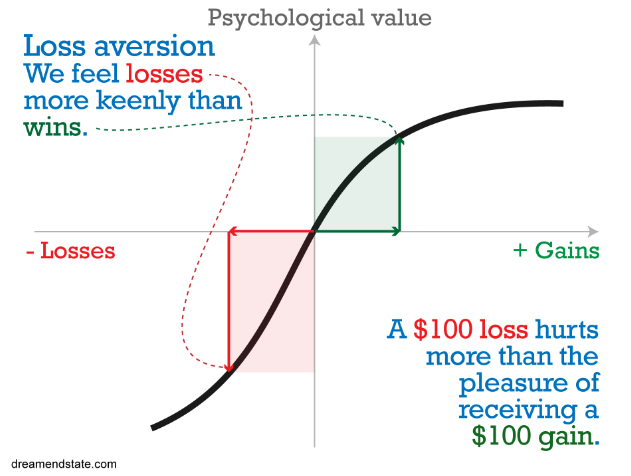
Put simply, humans value losses and gains very differently. Specifically, individuals don’t like losses – no matter how small the stakes.
really
And this may skew how investors judge risk and reward.
Imagine you have $100, and you are presented with two different scenarios:
Scenario 1: You can keep your $100 without any changes.
Scenario 2: You have the chance to gain an additional $100, doubling your money to $200, but there's a risk involved. There's a 50% chance you'll double your money to $200, and a 50% chance you'll lose $100, leaving you with only $0.
According to prospect theory, most people would feel differently about these two scenarios, even though the expected value (average outcome) is the same for both.
In Scenario 1, where you keep your $100, you are in a certain and safe position. People tend to find this option relatively more attractive because they dislike losing what they already have.
In Scenario 2, where there's a 50% chance of gaining $100 and a 50% chance of losing $100, the expected value is the same as Scenario 1 ($100).
However, many people would be risk-averse (aka shun risk) in this situation, feeling that the potential loss of $100 outweighs the gain, even though the expected value is the same.
Figure 1: Dreamendstate, 2023
This theory had compelling implications. Most notably, humans don’t view risk and reward symmetrically.
In fact, some studies3 have shown that humans feel losses two-and-a-half times (2.5x) more than equivalent gains.
Kahneman and Tversky’s work on this behavioral flaw led to other great concepts in behavioral finance.
For instance, the sunk-cost fallacy – which is the bias towards continuing a poor strategy because of the time, money, and effort already invested into it – was based on prospect theory’s findings.
Many investors may hold onto losing positions – hoping for a rebound that never comes – because selling at a loss causes emotional distress (even if it’s the better option).
Thus, because of prospect theory, conventional financial wisdom suffered a serious blow, such as the Efficient Market Hypothesis - which assumes that markets are always rational and efficient.
Once you begin realizing how flawed human minds are, and how markets are open social systems, I believe it’s clear how irrational and inefficient things may truly be.
Identity Claiming: Why We Hate Being Wrong
Another interesting cognitive flaw is that humans seem to despise being wrong.
In Kathryn Schulz’s book– ‘Being Wrong: Adventures in the Margin of Error’ (2010) – there’s some great insight into this dilemma.
She wrote, “Our love of being right is best understood as our fear of being wrong.”
Put simply, humans tend to believe they know exactly what’s happening and why, which is reinforced by trying very hard not to think about the possibility of ever being wrong.
Furthermore, researchers Caroline Bartel and Jane Dutton explained4 that in both our words and deeds, humans always express how we see ourselves –whether conscious or not - and thus how we want others to perceive us.
In finance, this concept is known as identity claiming—when investors refuse to admit mistakes because it threatens their self-image.
How This Affects Investing:
Analysts & fund managers may double down on bad calls rather than admitting error.
Top Investors may ignore contrary evidence to protect their ego.
Public figures hesitate to reverse positions, fearing reputational damage.
The Babe Ruth Effect: Magnitude Matters More Than Frequency
Most investors focus on being right often. But in reality, success comes from the size of your wins, not their frequency.
Michael Mauboussin – the head of Consilient research at Morgan Stanley - wrote this clearly in a whitepaper5 from 2002, “The frequency of correctness does not matter; it is the magnitude of correctness that matters. Say that you own four stocks and that three of the stocks go down a bit but the fourth rises substantially. The portfolio will perform well even as the majority of the stocks decline”
This is also known as the ‘Babe Ruth Effect’ - because even though Ruth struck out a lot, he was one of baseball’s greatest hitters.
This makes sense, right?
Well, the problem is that humans are hardwired to feel those losses and mistakes much more deeply. Thus, we may focus on avoiding any potential downside even when the upside is more attractive.
Putting this into perspective, Mauboussin references the book ‘Fooled by Randomness’ (2001) by Nassim Taleb.
“In a meeting with his fellow traders, a colleague asked Taleb about his view of the market. He responded that he thought there was a high probability that the market would go up slightly over the next week. Pressed further, he assigned a 70% probability to the up move.
Someone in the meeting then noted that Taleb was short a large quantity of S&P 500 futures—a bet that the market would go down—seemingly in contrast to his “bullish” outlook.”
He clarified his thought process in Babe Ruth’s terms…
Although he (and the crowd) believed the most probable outcome was for the market to rise – the low chance the market declined created an asymmetric opportunity (greater upside vs. downside risk).
Why? Because the high-probable outcome (70%) was priced in already because markets are relatively efficient.
In his eyes, there wasn’t much more to gain.
But on the off chance the market does decline (a 30% chance in this example) – the effect is dramatic as the market re-prices the news.
Figure 1: Credit Suisse, Mauboussin (2002)
Thus, in Taleb’s mind, he saw that betting on the high-probability outcome had a negative expected value.
Many were puzzled by Taleb's strategy because it implied frequent small losses. And as I noted above, humans tend to feel losses more strongly than gains. So, it didn't seem very attractive.
In fact, it must’ve appeared unnatural (thanks to human biases).
But – just like Babe Ruth – when it hit, it really hit.
Applying Prospect Theory to Investing: 3 Takeaways
Detach emotions from decisions. Fear of loss distorts rational thinking.
Don’t let sunk costs trap you. Past losses shouldn’t dictate future strategy.
Focus on magnitude, not frequency. A few big wins can outweigh many small setbacks.
Final Thoughts: Overcoming Behavioral Biases in Investing
Markets are not fully rational — they’re shaped by human psychology. Prospect theory, loss aversion, and identity claiming help show why investors often make irrational choices.
By recognizing these flaws, advisors can help clients:
Make more objective decisions.
Avoid emotional traps like sunk costs.
Focus on long-term outcomes over short-term fears.
By understanding our cognitive limitations, we can hope to become more effective and rational, even in the face of our complex and often irrational human nature.
But don’t expect it to be easy.
Frequently Asked Questions About Prospect Theory And Loss Aversion
What is prospect theory in investing? Prospect theory, developed by Daniel Kahneman and Amos Tversky in 1979, explains why people process gains and losses differently rather than treating them as mirror images of the same outcome. Investors tend to prefer a safe, certain outcome over a risky bet with the same expected value, simply because the fear of losing outweighs the appeal of gaining.
Why do losses feel worse than gains for investors? Studies show people feel losses roughly 2.5 times more intensely than equivalent gains. This imbalance pushes investors to hold onto losing positions too long, hoping for a rebound, while selling winning positions too early to lock in a good feeling. It's also the root of the sunk-cost fallacy, where past losses keep driving bad decisions.
What is identity claiming, and how does it affect investment decisions? Identity claiming is the tendency to avoid admitting mistakes because doing so feels like a threat to your self-image. In investing, this shows up as analysts doubling down on a bad call, ignoring evidence that contradicts their thesis, or hesitating to reverse a public position out of fear of looking wrong.
What is the Babe Ruth Effect in investing? It's the idea that investment success depends more on the size of your wins than how often you're right. A portfolio can do well even if most positions lose money, as long as one position gains substantially more than the others lose. The name comes from Babe Ruth, who struck out often but remains one of baseball's greatest hitters.
How can financial advisors help clients manage these behavioral biases? Advisors add value by helping clients recognize loss aversion and ego-driven decisions before they derail a portfolio. That means detaching emotion from decisions, avoiding sunk-cost thinking that keeps money in a losing position, and refocusing clients on the magnitude of long-term outcomes rather than the frequency of short-term wins or losses.
This communication is general in nature and provided for educational and informational purposes only. It should not be considered or relied upon as legal, tax, or investment advice or an investment recommendation, or as a substitute for legal counsel. Any investment products or services named herein are for illustrative purposes only and should not be considered an offer to buy or sell, or an investment recommendation for, any specific security, strategy, or investment product or service. Always consult a qualified professional or your own independent financial professional for personalized advice or investment recommendations tailored to your specific goals, individual situation, and risk tolerance.
Dunham & Associates Investment Counsel, Inc. is a Registered Investment Adviser and Broker/Dealer. Member FINRA/SIPC. Advisory services and securities offered through Dunham & Associates Investment Counsel, Inc.
Why Investors Hate Losing: Prospect Theory, Loss Aversion & Market Behavior | Dunham