Content Editor, Dunham | 2025 ThinkAdvisor Luminaries Award Winner | 2026 Wealthies Finalist, Thought Leader of the Year | Macroeconomics, markets, geopolitics & global trends
Fiscal dominance occurs when a government's deficit spending becomes so large that it overpowers the central bank's ability to control inflation through monetary policy. In the U.S., rising deficits, compounding interest costs, and political pressure on the Federal Reserve are increasingly creating the conditions for fiscal dominance — with lasting consequences for inflation and investors.
Note — June 2026: The fiscal dominance debate has moved from academic fringe to mainstream urgency. In January 2026, former Treasury Secretary Janet Yellen told the Brookings Institution that "the preconditions for fiscal dominance are clearly strengthening" — and warned that if Congress fails to address primary deficits, "the temptation to rely on inflation or financial repression to reduce the debt burden will surely grow." The 2026 federal deficit is now projected at $1.9 trillion, with the CBO projecting the U.S. will borrow an additional $25 trillion over the next decade — roughly $16 trillion of that going toward interest payments alone. Cato Institute Interest costs are on pace to hit $1 trillion this year and are projected to reach $2.1 trillion by 2036. Fortune The thesis in this piece is playing out in real time.
Key Takeaways
Persistent U.S. budget deficits are weakening the Fed’s ability to fight inflation effectively.
Treasury borrowing injects liquidity that can neutralize or reverse interest rate hikes.
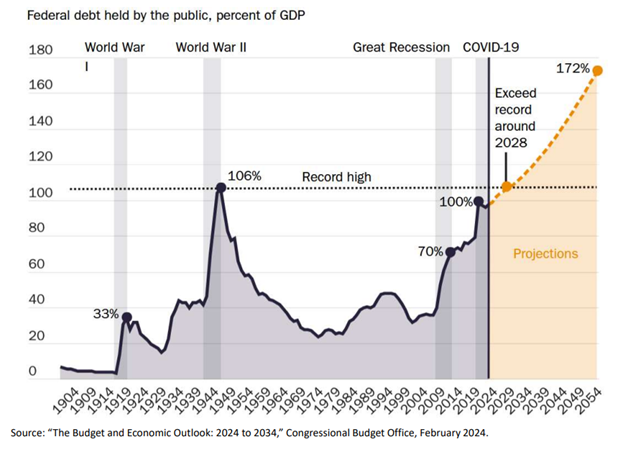
U.S. debt is projected to reach 172% of GDP by 2054, with interest payments becoming a top deficit driver.
The Fed’s traditional tools, like rate hikes, are losing power in the face of growing political spending.
Without fiscal reform, the Fed may lose independence—risking longer inflation cycles and market instability.
Listen to this blog here
12:14
Are Deficits Undermining The Fed’s Ability To Fight Inflation?
As the 2024 election looms, much of the media focuses on the candidates' policy debates. But regardless of who wins, evidence shows that the path of the U.S. deficit will continue rising in the decades to come.
The question won’t be: but rather,
A prime example is the , when the U.S. government issued substantial debt to fund reconstruction efforts - forcing the Fed to accommodate fiscal policy by keeping interest rates low.
“Who will get the budget under control?”
“Who will the deficit rise less under?”
Thus, beyond the election drama, there’s a bigger issue simmering in the background - one that could shape the U.S. economy for decades to come.
Fiscal dominance occurs when the government’s heavy borrowing and spending (via deficits) overpowers the central bank’s ability to manage inflation through monetary policy.
In simpler terms, it’s a power struggle where the Treasury’s spending habits for political purposes can handcuff the Federal Reserve’s attempts to manage inflation and employment.
In the years ahead, this tug-of-war between the Federal Reserve and the Treasury will intensify, with rising government deficits threatening to undermine the Fed’s ability to steer the economy and keep inflation subdued.
So, what does this mean for you as someone who’s simply trying to make sense of where the economy is headed?
Let’s break it down.
Treasury vs. Fed — Two Different Power Centers
The Federal Reserve and the Treasury each manage liquidity in the economy, but with different tools and timeframes.
For instance, the Fed uses cyclical measures like interest rate adjustments and quantitative programs (such as buying and selling bonds) to manage inflation and economic activity in the short term, either stimulating or cooling the economy depending on its needs.
In contrast to the Federal Reserve’s short-term, cyclical actions, the U.S. Treasury operates on a structural level, using long-term fiscal strategies such as deficit spending, taxation, and funding for social programs or infrastructure projects. These actions influence the economy over a longer time horizon. For instance, if the government spends $110 but only collects $100, the resulting $10 deficit means more money is injected into the economy, thereby increasing overall liquidity and demand.
This dual mandate dictates how the Fed sets monetary policy – by reducing interest rates if inflation falls too low (below 2%) or if unemployment rises too high. And vice versa.
But this becomes difficult when political agendas drive fiscal policy in the opposite direction. Politicians often push for large-scale fiscal measures, which may conflict with the Fed’s inflation-control goals.
This misalignment, where fiscal policy works against the Fed’s monetary goals, can weaken the Fed’s ability to meet its mandate, resulting in a scenario of fiscal dominance.
How Rising Deficits Handcuff the Fed
Now, historically, both the Fed and the Treasury would work in unison – a recession would mean the Fed would ease policy, and the Treasury would run larger deficits to stimulate growth.
But now – in the era of Fiscal Dominance - the trend of larger fiscal deficits has become a defining feature of the U.S. economy – and creates a problem for the Fed.
Debt-to-GDP: Where We Are and Where We're Headed
For instance, following the Great Recession in 2008, U.S. federal debt – held by the public – as a percentage of GDP sharply increased, rising from around 70% of GDP to 100% by 2020, largely driven by economic stimulus measures and recovery efforts. The COVID-19 pandemic in 2020 triggered another surge in government spending, maintaining the debt level at around 100% of GDP.
Please note that as of the second quarter of 2024, the Federal Reserve also holds approximately 16.6% of U.S. federal debt relative to GDP3. This percentage reflects the Federal Reserve's buying of U.S. Treasury securities as part of its efforts to manage interest rates and the money supply. Combined, the total U.S. federal debt stands at approximately 120% of GDP – which means the country owes 20% more than the total value of all goods and services it produces in a year.
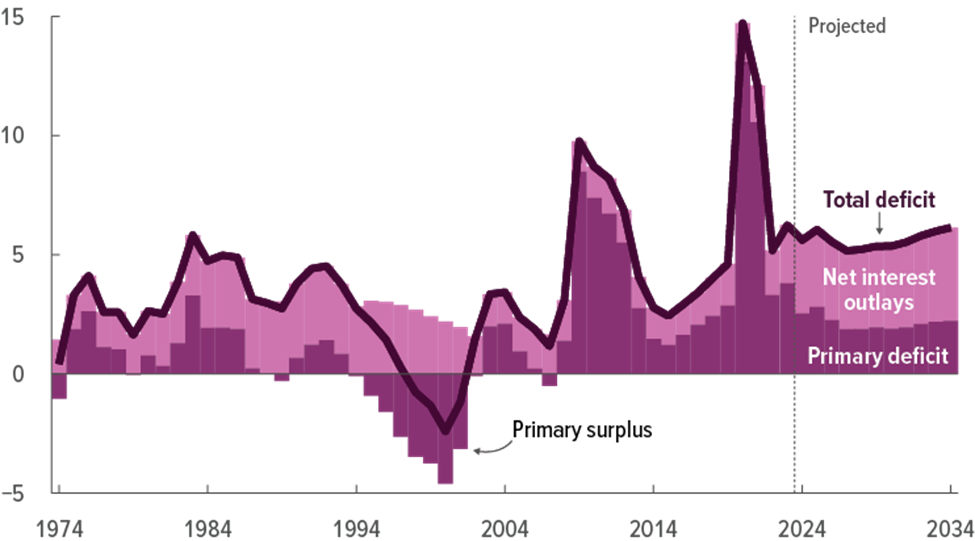
Figure 1: CBO, October 2024
When Interest Costs Become the Deficit
More troubling is that projections show federal debt continuing to rise, exceeding the previous record high of 106% (from World War 2) around 2028 and reaching 172% of GDP by 2054, driven by long-term structural deficits and rising interest costs.
Source: "The Budget and Economic Outlook: 2024 to 2034," Congressional Budget office, February 2024
This ongoing upward trend implies significant fiscal pressures in the coming decades – especially as interest payments begin compounding on an ever-rising national debt.
Meanwhile, the more the Treasury borrows, the more it adds to the national debt. This borrowing increases overall liquidity in the economy and sustains high levels of demand, putting upward pressure on prices (causing inflation).
The Federal Reserve’s ability to mitigate this is constrained by the sheer scale of government borrowing, which forces it into a position where traditional monetary tools become less effective.
The Mechanics of Fiscal Dominance in Action
As mentioned previously, fiscal dominance occurs when government spending and borrowing take precedence over the central bank's ability to execute effective monetary policy.
Why Rate Hikes Lose Their Power
In a fiscally dominant environment, the Federal Reserve’s actions - like hiking interest rates - are less impactful because fiscal policies continue to inject liquidity through bigger deficits. This creates a scenario where inflation remains elevated for longer periods, as the Fed’s efforts are undercut by fiscal expansion.
Historically, fiscal dominance has surfaced during times of high national debt and significant government intervention in the economy.
Historical Precedent: Post-World War II
post-World War II period
Today, we are seeing a similar situation. With government spending commitments on social programs, healthcare, and defense growing, the Federal Reserve faces increasing pressure to accommodate these expenditures and keep interest rates lower to service the national debt.
What's Different This Time
The risk is that the Fed could lose its autonomy, needing to prioritize government debt financing over inflation control - leading to longer periods of high inflation, which undermines the Fed’s credibility.
For example, when the Fed raises interest rates to bring down inflation, it makes borrowing more expensive for everyone, including the U.S. government. And since the government must borrow money to pay off its maturing debt, higher interest rates mean it can't refinance at lower rates like before. This increases the cost of paying back the debt, straining the federal budget and making it harder for the Fed to keep using rate hikes to control inflation.
Three Key Risks Investors Need to Watch
Prolonged Inflation: Fiscal expansion may outpace the Fed's ability to control inflation, resulting in persistently high prices.
Economic Volatility: A weakened Fed may lead to market instability, higher interest rates, and slower growth.
Recession Risk: Sustained high interest rates could trigger a recession, exacerbating fiscal and economic pressures.
Can the Fiscal-Monetary Conflict Be Resolved?
As fiscal dominance rises, the economy faces a greater risk of prolonged inflationary periods.
If inflation stays elevated, the Federal Reserve may be forced to raise rates higher or for a longer period than expected, which could slow economic growth and increase the likelihood of a recession. Markets may react negatively to the loss of confidence in the Fed’s ability to manage inflation, leading to more volatility and higher long-term interest rates.
On the other hand, the U.S. could also see a scenario where coordination between fiscal and monetary policy becomes necessary. This would require politicians to make tough decisions about reducing deficits and managing public debt - a difficult (and unlikely) ask in an environment where political pressures often favor short-term solutions over long-term fiscal discipline.
What Fiscal Dominance Could Mean Going Forward
Looking ahead, fiscal dominance suggests inflation may prove stickier than markets expect — not because the Fed lacks tools, but because fiscal policy keeps working against them.
With deficits structurally embedded and interest costs compounding, the Fed may face increasing pressure to tolerate higher inflation, cap yields, or lean more heavily on balance-sheet tools.
For investors, this change carries risks toward longer inflation cycles, higher volatility, and greater uncertainty around real returns.
Frequently Asked Questions About Fiscal Dominance
What is fiscal dominance? Fiscal dominance is what happens when government debt and deficits start dictating monetary policy instead of the other way around. The central bank gets boxed in, forced to keep rates lower than inflation calls for just to keep the government's debt payments manageable. Once that happens, price stability takes a back seat to keeping Treasury financing costs in check.
Is the US in fiscal dominance right now, in 2026? Not officially, but the pressure is rising. The CBO expects a $1.9 trillion federal deficit for fiscal year 2026, about 5.8% of GDP, with net interest costs hitting $1 trillion. Those numbers matter, but they don't prove the Fed has put inflation control second to helping Treasury finance its debt. Most economists still say we're not there yet.
What causes fiscal dominance? It usually comes down to three things stacking up together: deficits big enough to keep pumping money into the economy, interest costs growing fast enough to drive the deficit on their own, and political pressure pushing the central bank to hold rates down instead of fighting inflation. The Cato Institute projects $25 trillion in new US borrowing over the next decade, with $16 trillion going to interest alone.
How does fiscal dominance affect inflation and interest rates? It tends to make inflation stick around longer. Government spending can keep demand high faster than the Fed can cool it down. Treasury borrowing usually just shifts money from investors to the government rather than creating new money outright, but deficit-funded spending still fuels demand. If the Fed can't raise rates enough to offset that, inflation risk stays elevated.
Has fiscal dominance happened before? Yes, and the US has real experience with it. From 1942 to 1951, the Federal Reserve pegged Treasury-bill rates and capped long-term yields at 2.5% to help finance the government's debt. That arrangement ended with the 1951 Treasury-Federal Reserve Accord, which restored the Fed's independence over monetary policy. It's the clearest historical example on record.
This communication is general in nature and provided for educational and informational purposes only. It should not be considered or relied upon as legal, tax or investment advice or an investment recommendation, or as a substitute for legal or tax counsel. Any investment products or services named herein are for illustrative purposes only and should not be considered an offer to buy or sell, or an investment recommendation for, any specific security, strategy or investment product or service. Always consult a qualified professional or your own independent financial professional for personalized advice or investment recommendations tailored to your specific goals, individual situation, and risk tolerance. All examples are hypothetical and are for illustrative purposes only.
Information contained in the materials included is believed to be from reliable sources, but no representations or guarantees are made as to the accuracy or completeness of information. This document is provided for information purposes only and should not be considered as investment advice.
Dunham & Associates Investment Counsel, Inc. is a Registered Investment Adviser and Broker/Dealer. Member FINRA/SIPC. Advisory services and securities offered through Dunham & Associates Investment Counsel, Inc.
What is Fiscal Dominance? Why Rising Deficits Are Undermining the Fed | Dunham