Content Editor, Dunham | 2025 ThinkAdvisor Luminaries Award Winner | 2026 Wealthies Finalist, Thought Leader of the Year | Macroeconomics, markets, geopolitics & global trends
Petrodollar recycling is the process by which Gulf oil exporters reinvest their surplus U.S. dollar earnings into U.S. Treasuries, equities, and direct pledges. As of September 2026, Iran's closure of the Strait of Hormuz and a drone strike on Saudi Arabia's backup pipeline have cut oil-export volumes and vessel traffic to roughly 10 ships a day, versus a pre-crisis baseline of 88 to 130. Shrinking export revenue means shrinking Gulf surpluses, and that threatens the capital flow that has quietly supported U.S. asset prices for decades.
Key Takeaways:
No oil = no surplus: Gulf states run massive current account surpluses from oil exports — and recycle those dollars directly into U.S. assets.
The surplus is shrinking: With oil lanes disrupted and production curtailed, those surpluses are evaporating — and so is the capital flowing into U.S. markets.
Promised investment commitments at risk: Several Gulf states made large, specific pledges to invest in the U.S. — those commitments depend entirely on oil revenues that may no longer materialize.
The ripple hits Asia too: Countries like Japan and South Korea depend heavily on Gulf oil imports — higher costs are straining their own current accounts and limiting their ability to invest abroad.
This is already happening — and most financial media is focused entirely on the oil price headline, missing the deeper capital flow story.
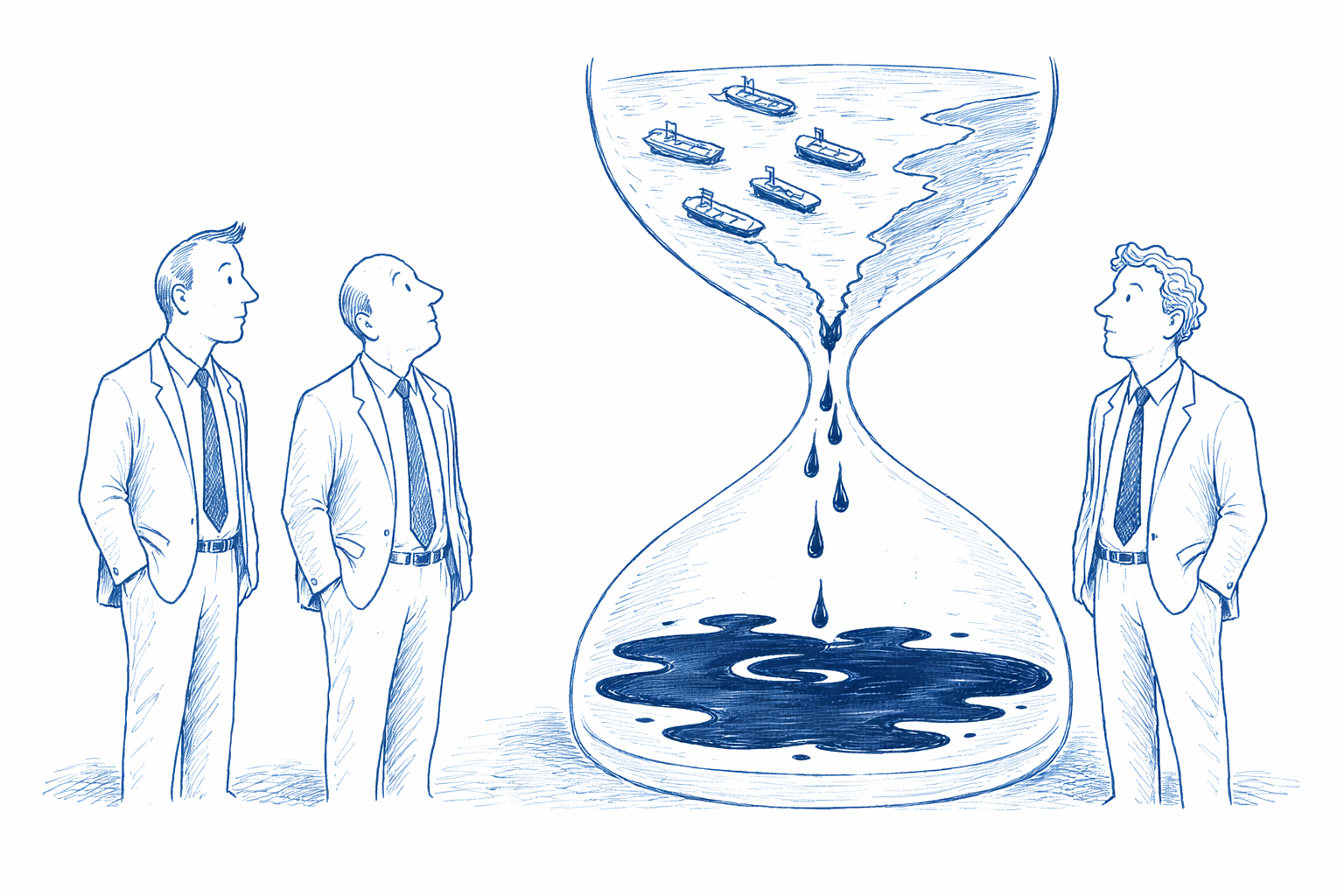
A ~25-mile stretch of water is threatening to ruin one of the most important - and least understood - capital flows in the world.
The Strait of Hormuz - the chokepoint connecting the Persian Gulf to the Arabian Sea – with roughly 25% of all global oil shipments passing through it every single day.
And right now - it's effectively shut down.
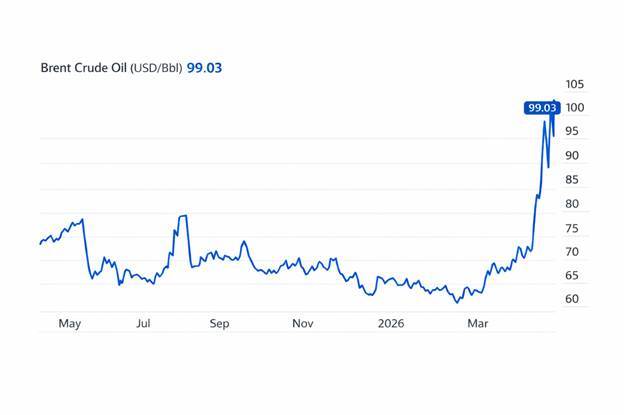
Oil prices have surged 75% since January - one of the sharpest short-term moves ever recorded.
Figure 1: Investing.com, Dunham, March 12, 2026
And while that matters - it may be the wrong thing to watch right now.
Yes, a Strait of Hormuz disruption sends energy prices higher. Yes, that hits inflation. Yes, it complicates central bank policy and squeezes consumers.
All of that is true – but all of it is being covered. Which means it's already priced in.
But there's a second-order effect that's getting almost no attention - and it's potentially more consequential for U.S. markets than the oil price move itself.
It's the collapse of petrodollar recycling.
And if you don't know what that is, you're about to understand why it matters.
What Is Petrodollar Recycling — and Why Does It Matter for U.S. Markets?
Put simply, a petrodollar is a U.S. dollar earned through the sale of oil.
Soon after, every OPEC nation agreed - locking in dollar demand from any country that needed oil (which was every country).
The dollar didn't need gold anymore. It had oil.
Thus, petrodollar recycling1 came next – aka when those dollars didn’t stay in the Gulf but flowed right back into U.S. assets.
Here's how it works. . .
When Gulf states - like Saudi Arabia, Kuwait, the UAE, Qatar - sell oil, they get paid in U.S. dollars.
These countries earn far more dollars than they can spend domestically – so they have a surplus. Saudi Arabia can't consume its entire oil revenue internally. Kuwait can't either. So what do they do with the extra cash?
They recycle it back into U.S. assets - which fuels steady demand for markets, supports asset prices, and helps keep interest rates lower than they otherwise might be.
Figure 2: Aron Groups Broker, December 2025
That’s petrodollar recycling. And it has been one of the most consistent, least discussed tailwinds for U.S. markets for decades.
Think of it as a giant, automatic capital flow. Oil gets sold. Dollars come in. Dollars go back into U.S. markets. Repeat.
Thus, the U.S. not only gets benefits from being the top reserve currency, but it also benefits from being the only place large enough and liquid enough for petrodollar surpluses to go.
The Gulf State Surplus Machine — and What's Happening to It Now
It’s no surprise that the Gulf oil producers - like Kuwait, Saudi Arabia, the UAE, Bahrain, Iraq, Oman - have historically run large current account surpluses2 as a percentage of GDP (except during weak oil price times – like the 2015-19 oil bust and post-2023 production cuts).
A current account surplus = a country exports more than it imports. Thus, they lend their savings to the rest of the world (aka they’re global creditors while deficit nations are borrowers).
Figure 3: International Monetary Fund, Dunham, 202
At times, Kuwait ran surpluses above 40% of GDP. Saudi Arabia - the world's second-largest oil producer - consistently posted double-digit surpluses during high oil price periods.
And those surpluses didn't sit idle. They flowed into sovereign wealth funds, U.S. Treasuries, Wall Street, and increasingly into direct pledges to fund U.S.
infrastructure, technology, and manufacturing.
Here's what's changing right now.
The shuttered Strait of Hormuz is simultaneously curtailing export volumes for Gulf producers, raising insurance and tanker costs, and forcing sovereign wealth funds to hold more capital in reserve at home.
Higher prices help. But they don't offset the damage when you can't reliably ship the oil in the first place.
Having $100 oil is great — if you can actually get it out and sold.
Thus, no oil exports = no cash surplus = no dollars flowing back into U.S. assets.
And that's the feedback loop the mainstream hasn't talked about yet.
The $2T Promised Investment Commitments That May Never Arrive
And the timing couldn't be worse - because those surpluses were already committed.
See, when President Trump toured the Gulf countries in May 2025, the numbers raised eyebrows.
Saudi Arabia committed $600 billion over four years - defense, AI data centers, energy infrastructure, and critical minerals. Including what was dubbed the largest defense sales agreement in history at $142 billion.
Qatar signed a $1.2 trillion economic exchange framework – with a $96 billion Boeing order (the largest widebody aircraft order in Boeing history).
UAE pledged $1.4 trillion over ten years - almost entirely focused on AI, semiconductors, and data centers built on U.S. soil.
Now, Reuters was quick to point out that only ~$730 billion of that was actually binding (less than half). The rest was non-binding memoranda, pending negotiations, congressional approval, etc.
But the point is that even the realistic portion of those commitments is an enormous, ongoing capital flow into U.S. markets.
And every single dollar of it runs through the same pipeline.
Oil revenue -> surplus -> sovereign wealth fund -> U.S. investment.
Curb the first step - and you disrupt everything downstream.
When your own house is on fire, you don't write checks to your neighbors first. You buy the fire extinguisher. You fix the roof. You make sure your family is fed.
Thus, foreign investment commitments - even the most legally binding ones - become a luxury when survival is the priority.
So, what would the U.S. get?
Any remaining leftovers.
The Asia Ripple: Japan, South Korea, and the Second Wave
And this could become another indirect ripple for the U.S.
Here’s how. . .
When oil gets more expensive or harder to source, Japan and South Korea's import bills explode. And those costs bleed through both economies.
Sony, Toyota, Samsung, etc - manufacturing costs all go up.
Trade balances deteriorate.
And the Bank of Japan and Bank of Korea face the same impossible choice as everyone else - hike rates to fight inflation and risk killing growth. Or cut rates to help consumers and risk letting inflation run hotter.
Those commitments were already shaky before this crisis. Japan made clear the money was meant to benefit Japanese companies. And neither deal was fully binding.
Now their energy bills are surging – thus that $900 billion looks even shakier.
So, like the Gulf countries - you can't invest abroad when you're bleeding at home.
That means the capital inflow from Asian investors starts to slow at exactly the samemoment Gulf petrodollar recycling is contracting.
Two tailwinds reversing simultaneously? That's the risk nobody may be modeling right now.
Why This May Matter More Than the Oil Price Headline
Let's put this all together.
The financial media is focused on oil at $X per barrel and what that means for CPI.
And while that matters - it's the first-order effect.
Think of it like a rock hitting water. The splash is big and everyone sees and reacts to it.
But the ripples are what spread outward - hitting people who never saw the rock drop in the first place. That's where the real damage may be.
Thus, right now - I'm watching the ripples. The second-order effects. Slower. Less visible. And potentially more damaging to U.S. asset prices over the medium term.
Here's what those ripples look like:
Gulf petrodollar recycling slows as surpluses shrink
Promised Gulf investment commitments get redirected domestically
Asian current accounts tighten, reducing their capacity to invest in U.S. markets
The steady inflows that have pushed U.S. stocks higher and kept interest rates lower dry up
Now keep in mind - this isn't a one-day event. It's a slow drain on the capital flows that have been supporting U.S. (and global) asset valuations for years.
And here's where it gets worse.
These nations don't just stop investing abroad. If the pressure builds long enough, they start selling their existing U.S. holdings to raise the cash they need to keep themselves afloat.
So while everyone is watching the price at the pump - the deeper damage may be happening somewhere else entirely. And the longer this drags on, the tighter the noose gets.
The point is, watch the capital flows. Not just the oil price.
Frequently Asked Questions About Strait of Hormuz Closure
How much oil actually moves through the Strait of Hormuz? Normally, roughly one-fifth of the world's oil and liquefied natural gas passes through the strait. As of mid-September 2026, daily vessel traffic has dropped to around 8 to 10 ships, down from a pre-crisis average of 85 to 130 ships a day, based on IMF PortWatch tracking.
Is the Strait of Hormuz open right now? No, it's still effectively closed to routine commercial shipping. Iran shut the strait on February 28, 2026, briefly reopened it under a June memorandum of understanding, then closed it again in July after attacks on commercial vessels. A September understanding between Iran and Oman sets the groundwork for a possible reopening, but normal traffic hasn't returned.
How does the closure affect Gulf states' investment pledges in the US? It squeezes the oil revenue that funds those pledges in the first place. Gulf sovereign wealth funds draw directly from export surpluses, and the GCC's current account surplus has fallen sharply as oil income declined. A longer closure shrinks that surplus even more, raising the chances that non-binding parts of Gulf investment commitments get delayed or scaled back.
Why are Japan and South Korea so exposed to the Hormuz crisis? Both countries depend heavily on Middle East oil, with Japan sourcing about 72% of its supply from the region and South Korea about 65%. Higher import costs strain their trade balances, leaving less capital free for their own investment commitments tied to 2025 tariff agreements.
Could Gulf states sell US assets instead of just slowing new investment? Yes, and it's a real possibility, not just a theory. Rising global borrowing costs and mounting debt pressure show how tight conditions have become. If a sovereign fund needs cash faster than oil revenue can replace it, selling existing holdings, including US Treasuries or equities, becomes the next available option.
This communication is general in nature and provided for educational and informational purposes only. It should not be considered or relied upon as legal, tax or investment advice or an investment recommendation, or as a substitute for legal or tax counsel. Any investment products or services named herein are for illustrative purposes only and should not be considered an offer to buy or sell, or an investment recommendation for, any specific security, strategy or investment product or service. Always consult a qualified professional or your own independent financial professional for personalized advice or investment recommendations tailored to your specific goals, individual situation, and risk tolerance. All examples are hypothetical and are for illustrative purposes only.
Information contained in the materials included is believed to be from reliable sources, but no representations or guarantees are made as to the accuracy or completeness of information. This document is provided for information purposes only and should not be considered as investment advice.
Dunham & Associates Investment Counsel, Inc. is a Registered Investment Adviser and Broker/Dealer. Member FINRA/SIPC. Advisory services and securities offered through Dunham & Associates Investment Counsel, Inc.
The Strait of Hormuz Crisis Is Draining Capital Flows From U.S. Markets | Dunham