Content Editor, Dunham | 2025 ThinkAdvisor Luminaries Award Winner | 2026 Wealthies Finalist, Thought Leader of the Year | Macroeconomics, markets, geopolitics & global trends
The Kelly Criterion is a position-sizing method that seeks to maximize expected long-run compound growth based on an estimated probability of success and the payoff relative to the loss. Its result is only as reliable as those inputs. Because investment probabilities are uncertain, practitioners may use fractional Kelly approaches and additional portfolio risk constraints.
Key Takeaways
The Kelly Criterion explained: It is a position-sizing framework designed to balance risk and reward — helping investors avoid ruin while maximizing long-term growth.
Sizing is everything: Many investing failures do not stem from being wrong on a thesis, but from sizing positions poorly and blowing up the portfolio.
Survival over prediction: In markets, compounding only works if you stay in the game long enough to let it happen.
Risk budgeting for advisors: Financial advisors can use the Kelly framework as a behavioral tool to prevent false diversification and over-concentration.
The Half-Kelly approach: Conservative investors often allocate exactly half of what the Kelly formula recommends to reduce volatility while preserving disciplined position sizing.
But this final piece brings us to what I believe is the most actionable tool in the box.
I’ve written before about taking advantage of fear and greed. About booms and busts. About moments when markets get emotional and an opportunity can show up.
But none of that matters if you don’t size your positions correctly.
Great investors don’t just find good ideas. They survive long enough for those ideas to work.
But it also doesn’t mean under-investing - or over-diversifying out of fear.
So how do you decide how much to invest?
That’s where the Kelly Criterion comes in.
What Is the Kelly Criterion?
The Kelly Criterion2 is a mathematical formula used by investors to calculate the optimal percentage of their capital to allocate to a single investment based on its expected win rate and payout.
Long story short, in 1956, a former Bell Labs (the research arm of AT&T) employee - John Kelly Jr. - used ‘information theory’ (basically the math of how useful a signal you have vs. how much noise you’re dealing with) to create this formula.
How Do You Calculate the Kelly Criterion?
Here is the simple version you need to know.
Edge/Odds = Optimal Fraction of Capital to Invest
An Edge is the total expected value of the bet.
The Odds are what the market’s offering if you win.
Once you estimate both, the formula tells you what percentage of your portfolio to allocate.
Thus, in the context of the Kelly formula, your "edge" is the expected value of an investment, and the "odds" are the potential payout compared to the risk.
What Is an Example of the Kelly Criterion in Practice?
Imagine walking into a casino with $1,000 and you find a coin-flip game with the following setup:
Heads: you win $2
Tails: you lose $1
Probability of winning: 50%
So even though your chance of winning is even (50/50), the payoff isn’t - you win twice as much money as you lose.
In other words, you’re risking $1 to potentially make $2.
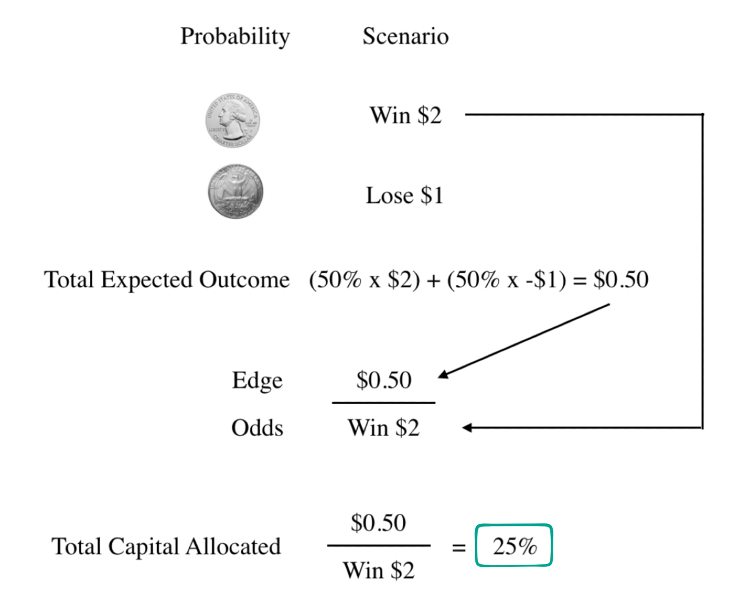
With that in mind, the expected value (your edge) of this game looks like this:
(50% × $2) + (50% × –$1) = +$0.50
Now take that edge ($0.50) and divide it by the payout ($2 if you win) = 0.25.
Thus, according to the Kelly Criterion, the optimal position size is 25% of your bankroll, or $250 in this example.
Figure 1: For Illustrative Purposes Only
The idea is that if you bet more, you risk blowing up (going broke). And if you bet less, you fail to maximize the favorable edge you’re given.
That tradeoff is exactly what the Kelly Criterion is designed to solve.
How Is the Kelly Criterion Used in Investing?
Now of course, markets aren’t casinos. The odds aren’t fixed (risk-reward constantly change), and the edge isn’t obvious (people rarely just stumble upon a huge edge without it getting priced out immediately).
But the logic of Kelly still applies to investing.
For instance, Edward O. Thorp - often considered the original “quant” - successfully applied the Kelly Criterion to Wall Street decades before modern option-pricing models existed.
Thorp’s career spanned MIT professor, professional blackjack player (where he invented card counting), and hedge fund manager. His first fund - Princeton/Newport Partners - returned 19.1% annualized over nearly two decades3. Then from 1992 to 2002, his second fund (Ridgeline) delivered 18.2% per year4. He eventually closed it not due to losses - but because growing competition from quants was eroding his edge. I recommend reading his autobiography ‘A Man of All Markets’ (2017).
As Thorpe showed - the lesson wasn’t about being aggressive. It was about position sizing and risk management to find your most favorable risk vs. reward opportunities.
What Is the Half-Kelly Strategy?
One major limitation of the Kelly Criterion is that the edge must be estimated - and estimates are rarely perfect.
That’s why many investors use:
Half-Kelly
Quarter-Kelly
For example, the Half-Kelly strategy involves investing exactly half of the capital that the Kelly Criterion formula recommends - which significantly reduces portfolio volatility while accounting for human estimation errors.
Meaning if the Kelly formula suggests allocating 20% of capital, a Half-Kelly approach would allocate 10%. And a Quarter-Kelly would be just 5%.
Using these strategies helps reduce volatility and estimation risk while preserving the long-term benefits of optimal position sizing.
How a Financial Advisor Can Actually Use the Kelly Criterion
Most financial advisors aren’t running hedge funds. And clients aren’t walking into casinos looking for coin flips.
So the Kelly Criterion isn’t meant to be plugged blindly into portfolios.
Instead, it works best as a mental framework - one that helps advisors and investors think clearly about position sizing, risk budgeting, and conviction.
Here’s how it shows up in practice:
1. As a margin of safety against oversized bets - Even the best ideas can hurt you if they’re too large and something goes wrong (which in markets, is pretty common). For advisors, this means avoiding concentrated positions that can derail a client’s long-term plan - even when conviction is high.
2. As a check on false diversification - On the flip side, Kelly highlights the cost of under-investing. Owning dozens of tiny positions may feel safe, but it can dilute returns (leaving too much money on the table). Kelly helps advisors right-size exposure when the odds are genuinely favorable.
3. As a risk-budgeting tool, not a formula - Rather than calculating a precise “Kelly percentage,” advisors can think in ranges:
When conviction is high, and the payoff is attractive, position sizes can be larger — but never unlimited.
When conviction is moderate, allocations should be smaller.
And when conviction is low, the best decision is often to do nothing (unless the risk-reward is too great, then maybe some allocation can be justified)
That mindset alone can improve decision-making
4. As a behavioral coaching tool for clients - Clients often want to go all-in at market peaks - and all-out at the bottom (buy into greed, sell into fear). Kelly provides a rational anchor in emotional moments, showing us that:
Being early doesn’t mean being wrong - positions need time to work
Being cautious doesn’t mean doing nothing - patience is still a decision
This helps keep clients invested when emotions run high.
5. As a reminder that survival comes first - Perhaps most importantly, Kelly reframes what success can mean. Said another way, it’s not about hitting home runs every year. It’s about finding favorable edge vs. odd scenarios, avoiding catastrophic mistakes, and let compounding do its job over decades.
Final Thoughts
The Mental Toolbox was always about giving financial advisors and clients a set of tools they can pull from when markets test them the most - when emotions are high, noise is loud, and mistakes are costly.
The Kelly Criterion doesn’t tell you what to buy.
It helps tell you how much to risk when you believe the odds are in your favor - and when to hold back.
Remember - most investors don’t fail because they’re wrong. They fail because they size positions poorly.
Survival isn’t passive – and sizing is critical. Betting too big can lead to ruin - because compounding only works if you’re, well, still standing.
That’s the final tool in the Mental Toolbox.
Go have some fun.
Frequently Asked Questions About Kelly Criterion Position Sizing
What is the Kelly Criterion in investing? It's a math formula that calculates the optimal percentage of your capital to put into a single investment, based on its expected edge and payout odds. Created by John Kelly Jr. at Bell Labs in 1956, it aims to help investors grow their capital over time while avoiding the kind of oversized bet that can wipe out a portfolio.
How do you actually calculate the Kelly Criterion? The formula is edge divided by odds, which gives you the optimal fraction of capital to invest. In a coin-flip example where you win $2 on heads and lose $1 on tails at 50/50 odds, the edge works out to $0.50, and dividing that by the $2 payout gives 25%. That's the portion of your bankroll the formula says to risk.
What is the Half-Kelly strategy, and why do investors use it? Half-Kelly means investing exactly half of what the Kelly formula recommends. Since your edge is always an estimate and estimates are rarely perfect, this approach cuts portfolio volatility while still keeping the discipline of sizing positions by conviction. If Kelly suggests 20% of capital, Half-Kelly puts in 10%, and Quarter-Kelly would be just 5%.
How can financial advisors use the Kelly Criterion with clients? Advisors don't need to calculate an exact Kelly percentage. Instead, it works as a mental framework for risk budgeting, helping avoid oversized concentrated bets while also flagging when a portfolio is spread so thin across tiny positions that it dilutes returns. It also gives advisors a rational anchor to keep clients invested when fear or greed pushes them toward emotional decisions.
Why does position sizing matter more than being right about an investment? Many investing failures don't come from a bad thesis. They come from sizing a position too large, so that even a correct idea can't survive a rough patch. Compounding only works if you stay in the game long enough to let it play out, which is why survival matters more than any single prediction.
This communication is general in nature and provided for educational and informational purposes only. It should not be considered or relied upon as legal, tax or investment advice or an investment recommendation, or as a substitute for legal or tax counsel. Any investment products or services named herein are for illustrative purposes only, and should not be considered an offer to buy or sell, or an investment recommendation for, any specific security, strategy or investment product or service. Always consult a qualified professional or your own independent financial professional for personalized advice or investment recommendations tailored to your specific goals, individual situation, and risk tolerance.
Information contained in the materials included is believed to be from reliable sources, but no representations or guarantees are made as to the accuracy or completeness of information.
Dunham & Associates Investment Counsel, Inc. is a Registered Investment Adviser and Broker/Dealer. Member FINRA/SIPC. Advisory services and securities offered through Dunham & Associates Investment Counsel, Inc.
Kelly Criterion Explained: A Practical Guide to Position Sizing | Dunham