Content Editor, Dunham | 2025 ThinkAdvisor Luminaries Award Winner | 2026 Wealthies Finalist, Thought Leader of the Year | Macroeconomics, markets, geopolitics & global trends
Financial instability can develop when prolonged stability encourages borrowing and greater risk-taking. Hyman Minsky’s Financial Instability Hypothesis explains how financing becomes fragile, while George Soros’ theory of reflexivity describes feedback loops between investor expectations and economic conditions. Together, these frameworks help investors understand how leverage, asset prices, and shifting confidence can amplify financial bubbles, market downturns, and credit cycle reversals.
Key Takeaways
Minsky’s Financial Instability Hypothesis explains how prolonged stability can encourage borrowing and increase financial fragility.
Hedge, speculative, and Ponzi finance describe borrowers’ growing dependence on refinancing and additional funding.
A Minsky moment is a sharp reversal that exposes fragile financing structures.
Soros’ reflexivity describes how investor expectations influence conditions that then reshape those expectations.
Leverage, refinancing dependence, and feedback loops can amplify market booms and downturns.
I’ve long believed that markets and economies trend towards disequilibrium (aka a loss of stability). And this is contrary to what we learned in economics – that a system tends towards equilibrium.
And while equilibrium may sound good in theory; it doesn’t hold up in reality.
Why?
Because markets and the economy are complex and dynamic social systems. Meaning they constantly change over time and have ripple effects.
There are eight billion people in the world – both rational and irrational – that are driven by their own biases. Thus, influencing everything around them.
Two key theories explain why markets don’t stay in balance and why boom-and-bust cycles are inevitable:
Hyman Minsky’s Financial Instability Hypothesis (a.k.a. the “Minsky Moment”)
George Soros’ Theory of Reflexivity
Let’s break down how these ideas help us understand financial bubbles, market crashes, instability, and economic crises.
So, let me explain why they’re so important. . .
The Minsky Moment: Why Stability Creates Instability
Hyman Minsky was a post-Keynesian economist who did most of his work in the mid-to-late 1900s. But more than that, he was a brilliant thinker and wrote the groundbreaking book ‘Stabilizing an Unstable Economy’ (1986) – a book I highly recommend reading.
Now, unfortunately, most of Minsky’s work was ignored by mainstream economists and he received very little recognition.In fact, very few even knew who he was.
But that all changed after the 2008 Great Financial Crisis (GFC). . .
Many dusted off Minsky’s work and realized that he may have effectively written the playbook on what would happen between 2001-2009. Hence the “Minsky Moment” was born.
Minsky wrote about the inherent instability in markets and economies through feedback loops between risk tolerance and credit (this connects to the broader debt cycle - where borrowing supports expansion before repayment pressures and tighter lending can reverse the momentum).
But most importantly, how periods of calm are the seeds for future volatility; and vice versa.
During stable times, investors become more confident and take on more debt & risk
Over time, debt levels rise too high, making the system fragile
Eventually, a trigger (external or internal) sparks panic
Investors rush to sell & deleverage, causing a market collapse
The crisis ends, stability returns - and the cycle repeats
This is the Minsky Moment - the tipping point where overconfidence turns into panic and markets collapse under their own weight.
Now, second – there are three stages of financial regimes2 in the private economy that trend towards instability all on their own.
The Three Stages of Financial Instability
Minsky outlined three financial regimes that determine how stable or fragile a market is:
Hedge Finance > Safe: borrowers can repay principal & interest
Speculative Finance > Risky: borrowers can only cover interest, not principal
Ponzi Finance > Dangerous: borrowers rely on new debt to cover old debt
When markets shift from Hedge Finance to Ponzi Finance, they become fragile and vulnerable to collapse - which is exactly what happened in 2008.
Minsky’s Three Financing Structures
Financing Structure
Cash Flow Position
Main Vulnerability
Hedge finance
Cash flow covers interest and principal payments
Falling income can weaken repayment capacity
Speculative finance
Cash flow covers interest; principal requires refinancing
Access to refinancing may tighten or disappear
Ponzi finance
Cash flow cannot cover all interest payments; additional funding or asset sales are needed
Continued access to funding and favorable asset prices becomes critical
*note: “Ponzi finance” describes a fragile financing position in Minsky’s framework. The term does not necessarily imply investment fraud.
As you can see – both parts of the financial instability hypothesis feed off each other.
Thus, according to Minsky, financial crises occur when the economy moves from the hedge finance stage to the speculative or Ponzi finance stages, as increasing levels of debt and risk tolerance lead to a buildup of financial fragility and vulnerability. When a shock or disruption occurs – such as a decline in asset prices or a slowdown in economic growth – borrowers may become unable to meet their obligations, triggering a wave of fear, defaults, and a breakdown in the financial system.
And this tipping point into collapse is the infamous “Minsky Moment”.
So, it appears from this perspective – and if history means anything (I believe it does) – that markets trend toward disequilibrium more often than not.
And that’s what makes Minsky and his financial instability hypothesis so important.
For historical examples of how debt fuels financial bubbles, consider the South Sea Bubble and Railway Mania - episodes explored in our financial bubbles article.
George Soros’ Reflexivity: Why Markets Overshoot Up & Down
George Soros (you may have heard of him) is a Hungarian-born investor who’s best known for ‘breaking the Bank of England3’ (the BoE) in 1992.
How did he do that?
In short, he believed that the British currency – the pound sterling – was too strong and strangling the economy. Making matters worse, the pound was effectively pegged to the German currency in the Exchange Rate Mechanism (ERM – which was essentially the first step in what would later become the Euro).
Thus, Soros saw an opportunity to force the BoE to devalue their currency sooner than later.
Or rather, push the BoE to fall on their face instead of limping along.
Soros made huge short bets on the pound (i.e. selling the pound), thus putting pressure on it.
As others saw what he was doing, more shorts piled in. This forced the BoE to cut interest rates and break their peg – devaluing the pound.
Soros made out like a bandit – netting over $1 billion in a single day (remember a billion was worth much more in 1992).
Now – say what you will about Soros (he’s a very divisive character) – but the thesis he used to determine this opportunity was brilliant.
He called this the Theory of Reflexivity.
How Reflexivity Creates Boom & Bust Cycles
Soros argues that market prices don’t just reflect reality - they influence it.
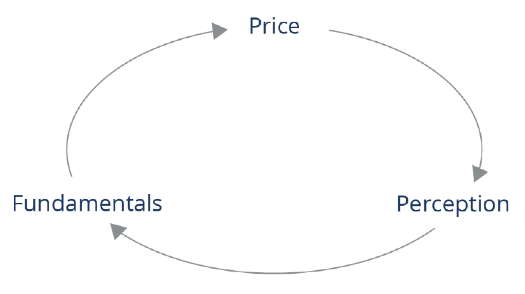
Investor sentiment & fundamentals feed off each other in a self-reinforcing loop
When markets are rising, optimism fuels more buying, pushing prices too high
When markets are falling, pessimism fuels more selling, pushing prices too low
This is how bubbles and crashes happen - not because of rational decision-making, but because of feedback loops that drive extreme market moves.
Figure 2: Dunham, 2023
And while Soros didn’t invent the term reflexivity (he got the inspiration from philosopher Karl Popper), he applied it in financial markets – or at least was the one who became famous for it.
Example: The 2000s Housing Boom-Bust
Consider a property boom.
Rising prices increase collateral values, which can support additional borrowing. More borrowing can finance more purchases, helping prices rise further.
If prices fall, collateral values shrink. Lenders may tighten credit, borrowers may need to sell, and those sales can add downward pressure.
Expectations, credit availability, and property prices influence one another throughout the cycle.
Thus, Soros showed that the reflexive process is particularly relevant in financial markets, where investors’ perceptions and actions can have a significant impact on asset prices and market conditions.
He made the point that financial bubbles and crashes aren’t caused solely by external factors – such as economic fundamentals – but also by the reflexive feedback loop between investors’ perceptions and their buying/selling actions.
Why This Matters for Investors
I believe it’s important to keep these two concepts in mind – the financial instability hypothesis and the theory of reflexivity – when navigating markets.
Gauging sentiment and understanding the causal link it has to fundamentals is critical as well as the inherent feedback loops that propel markets both irrationally high and low.
So, while many cling to equilibrium theories and rational markets, we will know better.
And next time you hear someone preaching about how investors and markets are efficient – keep Minsky and Soros in mind. . .
Frequently Asked Questions About Minsky’s Financial Instability Hypothesis
What is Minsky’s Financial Instability Hypothesis? Minsky’s Financial Instability Hypothesis explains how long periods of economic stability can encourage more borrowing and riskier financing. As confidence grows, some borrowers rely more on new loans, refinancing, or rising asset prices to meet their obligations. That leaves the system vulnerable when income falls or funding tightens. Calm markets can therefore hide growing financial risks.
What is a Minsky moment? A Minsky moment is a sharp loss of confidence that exposes heavy debt and fragile financing. Borrowers struggle to refinance or make payments, leading them to sell assets. Those sales can push prices lower and deepen the strain. The term describes a tipping point after risks have built up, but it doesn’t provide a way to predict when a crash will happen.
What are hedge, speculative, and Ponzi finance? Hedge, speculative, and Ponzi finance are Minsky’s three categories of financing, based on a borrower’s cash flow. Hedge finance covers both interest and principal payments. Speculative finance covers interest but requires refinancing to repay principal. With Ponzi finance, cash flow can’t cover all interest payments, so the borrower needs more funding or asset sales to meet obligations.
What is George Soros’ theory of reflexivity? George Soros’ theory of reflexivity explains how expectations and real-world conditions can feed into each other. In a property boom, rising prices can make borrowing easier and encourage more purchases. Those purchases can then push prices higher, reinforcing buyers’ optimism. Falling prices can reverse the process, showing how market beliefs can help shape the conditions people respond to.
This communication is general in nature and provided for educational and informational purposes only. It should not be considered or relied upon as legal, tax or investment advice or an investment recommendation, or as a substitute for legal or tax counsel. Any investment products or services named herein are for illustrative purposes only and should not be considered an offer to buy or sell, or an investment recommendation for, any specific security, strategy or investment product or service. Always consult a qualified professional or your own independent financial professional for personalized advice or investment recommendations tailored to your specific goals, individual situation, and risk tolerance. All examples are hypothetical and are for illustrative purposes only.
Information contained in the materials included is believed to be from reliable sources, but no representations or guarantees are made as to the accuracy or completeness of information.
Dunham &Associates Investment Counsel, Inc. is a Registered Investment Adviser and Broker/Dealer. Member FINRA / SIPC. Advisory services and securities offered through Dunham & Associates Investment Counsel, Inc.