Content Editor, Dunham | 2025 ThinkAdvisor Luminaries Award Winner | 2026 Wealthies Finalist, Thought Leader of the Year | Macroeconomics, markets, geopolitics & global trends
Europe cannot realistically dump its $10 trillion in U.S. assets at scale without hurting itself. Selling would push down prices on its own holdings, damage pensions and balance sheets, and force capital into markets that lack the size or liquidity to absorb it. More importantly, the global financial system runs on dollars, making true exit structurally difficult, not just politically unlikely.
Listen to this blog here
18:07
Key Takeaways:
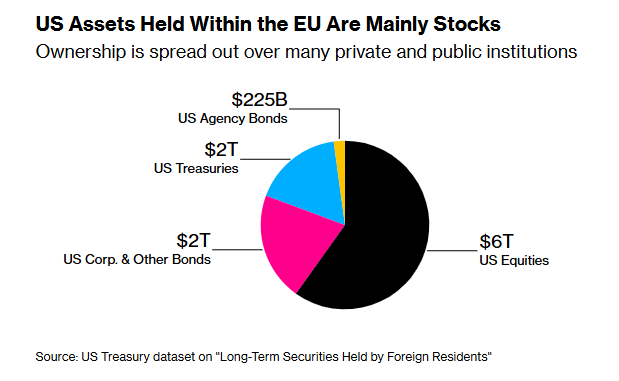
Europe holds ~$10 trillion in U.S. assets — about 40% of all foreign Treasury holdings including the U.K., Norway, and Switzerland.
Selling at scale would backfire — Europe would crash prices on its own holdings, weakening pensions and insurance balance sheets in the process.
There's nowhere else to put the money — European bond markets are fragmented and emerging markets can't absorb trillions without destabilizing.
The Eurodollar system makes dollar dependency structural — global trade and lending run on dollars even when no American is involved.
The euro can't replace the dollar yet — persistent surpluses and no unified bond market make it structurally unable to serve as the world's reserve currency.
The global monetary order will eventually reset — but like every reserve currency shift before it, the transition won't be sudden or painless for anyone involved.
A few weeks ago, I wrote about some of the headlines coming out of the U.S.–Greenland saga. And I got a number of subscribers writing back asking for more.
So I thought - while the media is consumed with everything else happening right now - why not revisit a topic that's being swept under the rug?
I’m talking about the idea that Europe could dump the trillions in U.S. assets it owns as retaliation.
It sounds dramatic. It gets attention. And every few months, someone floats it as though it's a real strategy.
But here's what most of those pundits won’t tell you - and it applies not just to Europe, but to any country that holds large amounts of U.S. assets.
The ability to sell and the ability to actually exit are two very different things.
Think of it like owning 40% of a stock. You can sell - but if you try to sell all at once, you become the price. Every time you unload, it pushes the value lower on what you still hold.
So, could Europe (or China, Japan, Saudi Arabia, etc) do the same today?
Yes - they certainly could.
But not without severely hurting themselves. . .
How Much Does Europe Own in U.S. Assets?
To understand why this matters, you need some context.
That amount is why the idea of "weaponizing capital" sounds intimidating.
But here's the problem - selling is only half the transaction.
Why Would Selling U.S. Assets Hurt Europe More Than the U.S.?
If European pension funds, insurers, or sovereign investors were to meaningfully reduce U.S. exposure, they wouldn't be moving to cash indefinitely. They'd have to buy something else, right?.
You can’t just sell U.S. assets in the trillions and park that balance under a mattress.
So, where would $10 trillion go?
Back into European equities that have lagged for over a decade (minus the 2025 surge)?
Into government bonds with limited yield upside and growing fiscal risk?
Into emerging markets that aren't remotely large enough to absorb trillions without destabilizing their own currencies and markets?
None of those options are realistic on that kind of scale.
And there's a second problem that doesn't get talked about enough. . .
Europe would be pushing prices down on itself while trying to exit.
Large-scale selling would pressure U.S. equity prices and push Treasury yields higher - at least initially. But European investors would be locking in losses on their own holdings in the process, weakening pension systems, insurance balance sheets, and long-term returns.
Think about it this way. If you own 100 shares of a stock and want to sell, you find a buyer and move on. But if you are the market - if your selling is the price move - then every share you sell pushes the price lower on the shares you haven't sold yet. You're not just exiting a position. You're essentially collapsing it on yourself.
And if Europe did decide to sell? Domestic U.S. buyers or non-European foreign investors could step in to buy discounted assets.
Thus, Europe sells low. Others buy the dip.
That’s not a great strategy.
Why Europe Is Trapped in the Dollar System
Here's the truth.
Europe has spent years criticizing U.S. financial dominance - the outsized role of the dollar, the reach of American capital markets, the influence Washington wields through the financial system. The rhetoric is familiar and justified in many ways.
But the irony is that Europe's own pension funds, insurers, and sovereign wealth vehicles have spent those same years building one of the deepest dependencies on U.S. markets in history.
You can't credibly threaten to sell $10 trillion in assets you needed to buy in the first place.
The reason European institutions poured capital into U.S. markets in the first place wasn't ideological.
It was because U.S. markets delivered returns that European markets simply couldn't match.
U.S. Treasuries offered liquidity that European government bonds - fragmented across 27 sovereign issuers with wildly different credit profiles - couldn't replicate at scale. And the dollar provided the kind of stability that a currency union without a unified fiscal policy never quite managed to offer.
That's not a criticism of Europe. It's just capital going where capital goes - toward scale, liquidity, and growth.
But it does mean that Europe's $10 trillion exposure isn't only a war chest. It's also a predicament.
And nowhere is that predicament more visible - or more misunderstood - than in the Eurodollar market2.
What Are Eurodollars and Why Do They Matter?
Despite the name, Eurodollars have nothing to do with the euro currency.
The term basically refers to U.S. dollars held and traded outside the United States - in foreign banks, offshore accounts, and international financial institutions.
Think of it as a vast, parallel dollar economy that exists entirely beyond U.S. borders but is denominated entirely in U.S. dollars.
The Eurodollar market is estimated to be in the tens of trillions of dollars - larger than the entire U.S. money supply by some measures - and it's the foundation of global trade, international lending, and cross-border transactions.
When a Brazilian company borrows to buy machinery from a German manufacturer, that deal is almost certainly priced and settled in dollars.
When an Asian bank lends to a Southeast Asian infrastructure project, the loan is likely dollar-denominated.
That’s because the world doesn't run on euros, yuan, or yen. It runs (so far) on dollars - even when neither party in the transaction is American.
Here's an example of how it works in practice:
A French bank takes dollar deposits from a French manufacturer and lends those funds to a Turkish company that needs dollars to buy oil. That loan is denominated in dollars. And the Turkish company earns revenue in lira - but now owes dollars. Thus, the French bank holds dollar-denominated assets on its books - but operates entirely outside the United States. No American or U.S. soil involved. And no U.S. banking regulations or FDIC.
Now multiply that by millions of similar transactions happening every day across every continent.
That's the Eurodollar market. And that's why Europe - or any country - can't simply walk away from dollar dependency. Because the literal pipes of global finance are built in dollars whether they like it or not.
That's the dependency trap in its purest form. Europe didn't just invest in U.S. markets. It built its entire international financial architecture on a dollar foundation.
Thus, threatening to sell U.S. assets while simultaneously depending on dollar-denominated markets for trade, lending, and liquidity isn't a strategy. It's a long-term risk.
Why Dollar Shortages Prove the World Can’t Exit the Dollar
And the proof shows up every time the world hits a crisis - in the form of a dollar shortage.
Here's how it works. Because so much global debt, trade, and lending is denominated in dollars, countries and institutions around the world constantly need a fresh supply of them to service that debt, fund imports, and keep their financial systems running.
Put simply, it's a structural, ongoing demand for dollars that never goes away.
Remember the Turkish company from my example above? It borrowed dollars from the French bank. So to repay that dollar debt, Turkey must export goods to earn dollars. It can't just print them. It can't pay in lira. It needs dollars - and it always will until that debt is gone.
Thus, when the Federal Reserve tightens monetary policy – like raising rates - the rest of the world doesn't just feel it. It gets starved of the currency it needs.
Dollar liquidity dries up globally
Countries with dollar-denominated debts find it harder and more expensive to refinance
Currencies weaken against the dollar (making it harder to get dollars)
Capital flees back to the U.S. - the one place that can actually produce the dollars the world needs
We've seen this play out repeatedly. The 2013 Taper Tantrum3. The 2018 emerging market crisis4. The March 2020 dollar crunch5 - when even the world's most sophisticated financial institutions were scrambling for dollar liquidity so desperately that the Fed had to open emergency swap lines with foreign central banks just to prevent a global dollar freeze.
Think of swap lines as an emergency dollar ATM - where the Fed lends dollars directly to foreign central banks so they can pump liquidity into their own financial systems when the supply runs dry.
That's not the behavior of a world that's ready to walk away from the dollar. That's the behavior of a world that's addicted to it.
And that's the deepest irony of Europe's position. The threat to sell U.S. assets assumes a world where Europe can operate independently of dollar liquidity.
But the Eurodollar market - and the dollar shortage dynamic it creates - proves that no such independence exists. The dollar isn't just America's currency. It's the world's financing mechanism.
And until something replaces it, that dependency isn't going anywhere.
Why the Euro Still Can’t Replace the Dollar
And this brings us to the deeper issue.
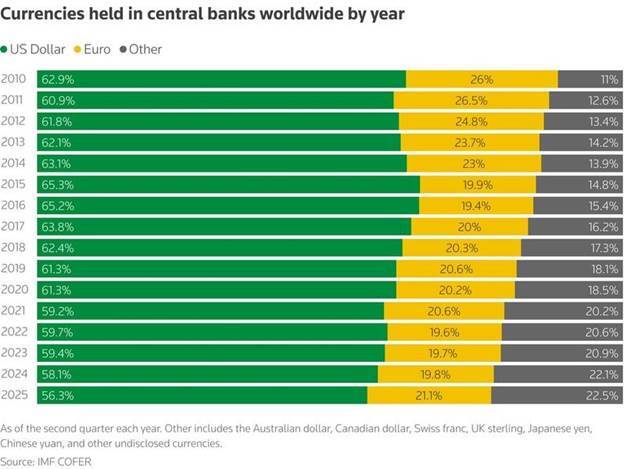
For Europe to credibly threaten U.S. financial dominance - let alone execute a meaningful selloff of U.S. assets - it'd need somewhere credible to put the money. That means a reserve currency and capital market capable of absorbing trillions in reallocated capital.
And that gap has barely moved in two decades despite repeated predictions of dollar decline. Why? Because a reserve currency isn't just about monetary policy.
It requires deep, liquid bond markets. It requires political stability and fiscal credibility. It requires that the world's commodity markets - like oil, gold, agricultural products - price themselves in your currency.
None of those conditions fully exist for the euro today.
The European bond market remains fragmented.
German bunds are safe but scarce. Italian bonds are abundant but carry real credit risk.
Thus, there's no European equivalent of the U.S. Treasury market - a single, deep, unified pool of sovereign debt that the world can park trillions in without a second thought.
But even if Europe wanted to build a credible dollar alternative, its own economic structure makes that essentially impossible.
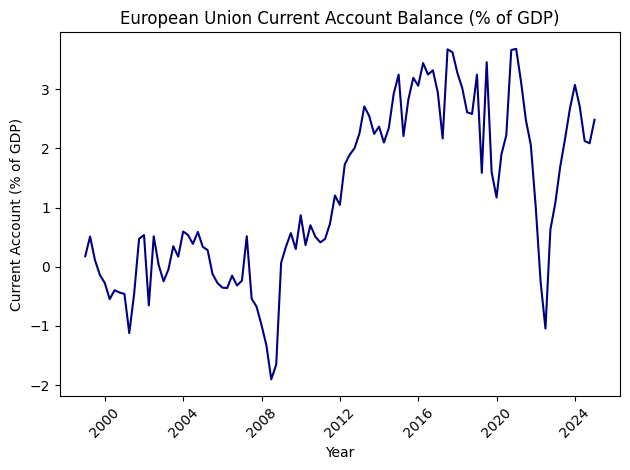
Put simply, Europe sells more to the world than it buys from it – making it an export-driven bloc that hoards foreign currency rather than spending it back out into the global system.
Figure 3: OECD, Dunham, 2026
That might sound like a good thing. And it is.
But in reserve currency terms, it's actually a liability.
Here's why.
For a currency to become the world's reserve currency, the country behind it needs to be willing to run deficits - to consistently spend more than it earns, pushing its currency out into the global economy so other countries can actually get their hands on it.
The U.S. has done exactly that for decades – like the British did before WW2.
The American consumer buys goods from the world, they pay in dollars, and the world gets the currency it needs to trade, borrow, and hold in reserve.
Europe since the 2000’s largely does the opposite. The eurozone saves more than it spends, runs surpluses, and pulls currency inward rather than pushing it outward.
Said another way, it's a creditor to the world, not a debtor.
And you can't fuel a global financial system on a currency that its own issuer hoards.
So, until that changes - and it'd require a level of European fiscal integration that's been politically impossible for decades - the dollar's dominance isn't a choice the world is making.
It's a constraint the world is operating under.
Europe can talk about reducing dollar dependency. It's been talking about it since the euro launched in 1999. But talking isn't the same as having a credible alternative.
And without one, the threat of capital weaponization is exactly that - a threat.
Why No Country Can Actually Dump U.S. Assets at Scale
Europe is the example I’ve been using. But the same logic applies to any large holder of U.S. assets - like Japan, China, Saudi Arabia, or anyone else.
The reason is simple - size can work against you.
When you hold trillions in U.S. stocks and bonds, you're not a trader. You're a market. And markets can't exit themselves without destroying the value of what they're trying to sell.
That's the reality facing any country that tries to weaponize U.S. asset holdings at scale.
The U.S. Treasury market is the deepest and most liquid in the world - but even it has limits. Japan tried to quietly reduce its Treasury holdings over several years and still moved markets. China's Treasury exposure has been slowly declining for a decade - a slow, careful, years-long process precisely because doing it fast would crater the value of what they're selling.
And beyond the mechanics - there's the retaliation risk. Any country that publicly dumps U.S. assets as a geopolitical weapon invites an immediate response. The U.S. has tools too - sanctions, trade restrictions, dollar swap line exclusions, and the ability to freeze foreign-held assets in extreme scenarios. The financial system is not a one-way weapon.
Final Thoughts
So the next time you read a headline about China, Europe, or anyone else threatening to sell their U.S. holdings en masse - remember this.
Because in the end, everyone's massive exposure to U.S. markets looks less like a weapon and more like a constraint.
Capital flowed to the U.S. because of scale, liquidity, and growth. Until those fundamentals change - or someone offers a credible alternative - rebalancing away from U.S. assets will remain far easier to talk about than to execute.
This communication is general in nature and provided for educational and informational purposes only. It should not be considered or relied upon as legal, tax or investment advice or an investment recommendation, or as a substitute for legal or tax counsel. Any investment products or services named herein are for illustrative purposes only and should not be considered an offer to buy or sell, or an investment recommendation for, any specific security, strategy or investment product or service. Always consult a qualified professional or your own independent financial professional for personalized advice or investment recommendations tailored to your specific goals, individual situation, and risk tolerance. All examples are hypothetical and are for illustrative purposes only.
Information contained in the materials included is believed to be from reliable sources, but no representations or guarantees are made as to the accuracy or completeness of information. This document is provided for information purposes only and should not be considered as investment advice.
Dunham & Associates Investment Counsel, Inc. is a Registered Investment Adviser and Broker/Dealer. Member FINRA/SIPC. Advisory services and securities offered through Dunham & Associates Investment Counsel, Inc.
Can Europe Dump $10 Trillion in U.S. Assets? Here’s Why It Can’t | Dunham