Content Editor, Dunham | 2025 ThinkAdvisor Luminaries Award Winner | 2026 Wealthies Finalist, Thought Leader of the Year | Macroeconomics, markets, geopolitics & global trends
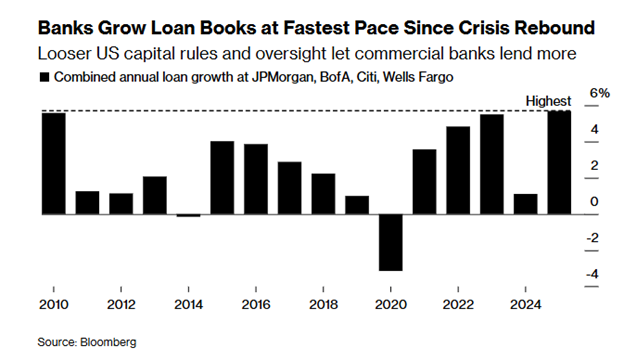
U.S. Banks Are Expanding Loan Books at the Fastest Pace Since 2008
After a decade on the sidelines, U.S. banks are lending aggressively again as deregulation picks up - reclaiming ground lost to private credit.
With private credit under pressure and banks taking on more risk, the pendulum in U.S. lending is swinging fast - and not without consequences
Why it matters: For more than a decade after 2008, banks were heavily constrained as policymakers tried to make sure another crisis never happened. That vacuum allowed private credit to flourish while banks stepped back. Now, with deregulation picking up and private credit showing stress, banks are stepping back into the arena - and potentially taking on more risk just as the economic backdrop weakens.
Now the Deep Dive: If 2025 were a movie, it might be called “No Country for Weak Banks”as U.S. banks boom.
Since the financial crisis, banks have been effectively muzzled. Higher capital requirements, stress tests, and asset caps were designed to try to prevent another 2008 - but they also pushed banks out of some of the most lucrative lending businesses.
That opened the door for private credit.
Top dealmakers walked out of traditional banks - and the biggest loans went with them. Banks then spent almost two decades watching from the sidelines as private capital ate their lunch.
But things are now changing. . .
President Trump has pushed to ease lending and capital standards, and regulators have followed suit. Thus, large banks are once again expanding their loan books - at the fastest pace since the financial crisis.
Thus, what used to be a popular positioning - long private credit and short U.S. banks - is now unwinding.
Banks are back in the game. With fewer constraints, they’re moving quickly to reclaim market share lost over the last decade.
And investors have rewarded that rotation.
For instance, this year alone, the six largest U.S. banks - JPMorgan, Bank of America, Citigroup, Wells Fargo, Goldman Sachs, and Morgan Stanley - have added roughly $600 billion in market value. And several banks are trading at or near record highs.
JPMorgan is within reach of the most profitable year in U.S. banking history.
Wells Fargo finally had its asset cap lifted after seven years (aka allowed to expand its loan book).
Banks are re-entering riskier lending just as the economy looks increasingly fragile - with record credit-card balances, rising auto-loan delinquencies (especially among subprime borrowers), a decelerating labor market, and student-loan payments straining millions.
And the implications go beyond bank earnings and credit risk.
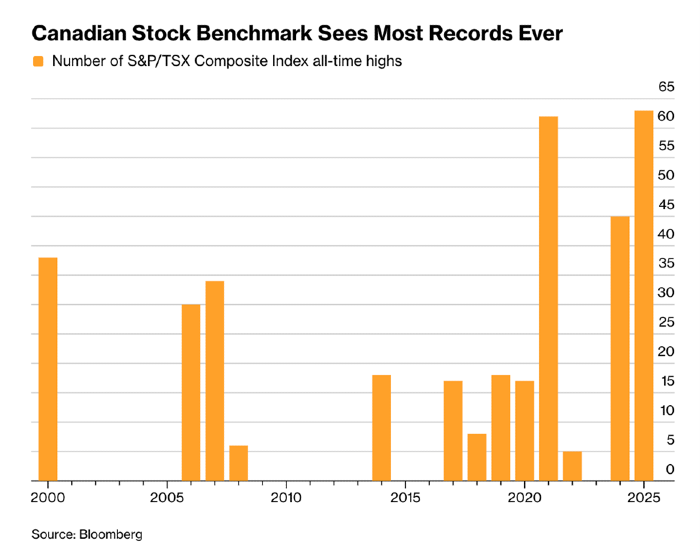
Why it matters: Despite a trade war (Canada is one of the only major countries that hasn’t signed a trade deal with the U.S. yet), political turmoil, and a highly indebted consumer, Canada’s stock market surged - a reminder that markets don’t move in lockstep with the economy, and sometimes thrive on chaos.
Now the Deep Dive: If someone told you eight months ago that Canada’s stock market would deliver one of its strongest years in decades, you probably would’ve laughed.
“Canada? No chance.”
And to be fair, the setup looked ugly:
President Trump had imposed some of the steepest tariffs Canada has seen since the Great Depression.
In fact, the materials sub-index nearly doubled - driven by surging prices in gold, silver, copper, and palladium. (If you want more context on why gold and uranium have boomed, I wrote about that last year in The Capital Cycle: How Supply Drives Markets.)
Canadian banks also played a big role - and they’ve been on a tear.
But this is where things get interesting. . .
Bank valuations have expanded just as the Canadian economy appears to be feeling the strain of higher tariffs and weak household demand.
Meanwhile, gold and silver are largely unaffected by GDP growth. And if anything, economic uncertainty tends to help them.
So yes - Canadian equity investors got the last laugh in 2025.
But the question now is whether that laughter carries into 2026. Or turns into something else.
Figure 2: Bloomberg, December 2025
Nearly Every Rich Country Is Now Below Replacement Birth Rates
Falling fertility across nearly every developed economy is at dangerous levels, putting pressure on demand, growth, and inflation - thus creating a long-term drag that central banks can’t rate-cut away.
Aging, shrinking populations help explain why growth feels harder to generate, interest rates keep drifting lower, and many economies are sliding toward Japan-style stagnation
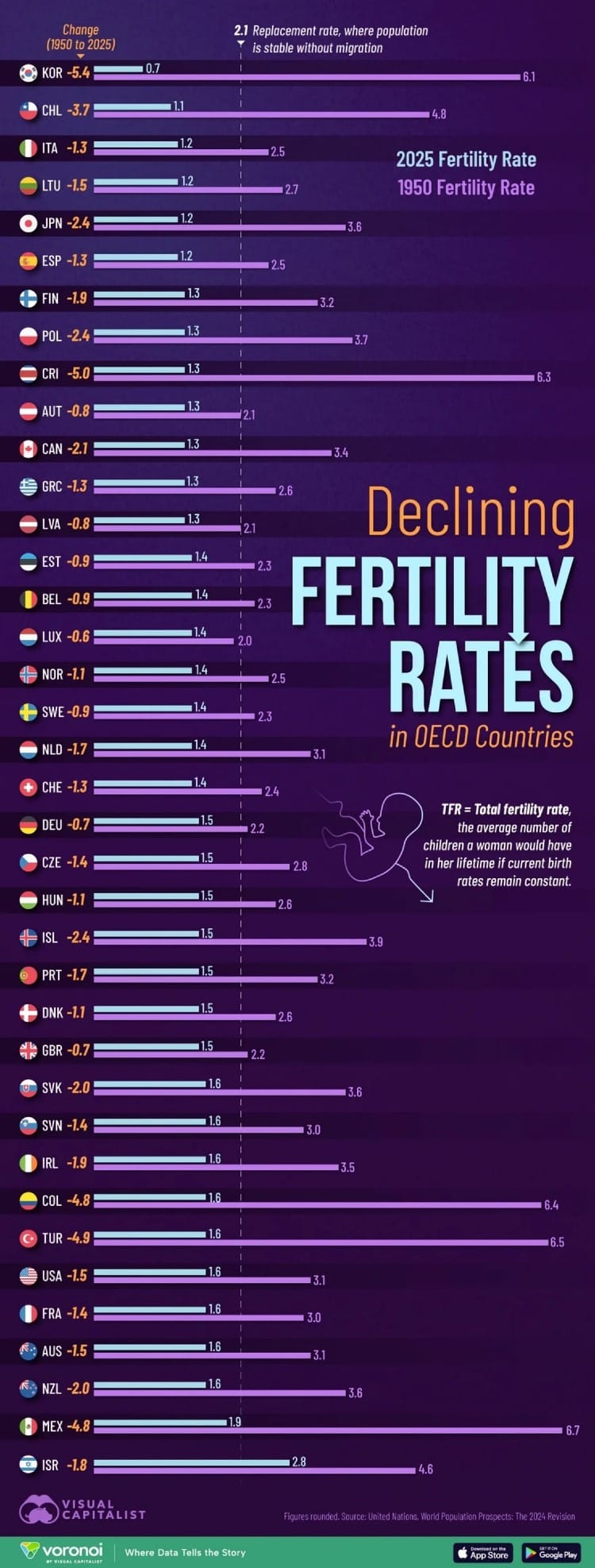
Why it matters: The OECD - the club of 38 rich countries like the U.S., Europe, Japan, Canada, Australia, and South Korea - has watched fertility rates collapse over the last 75 years, falling well below replacement almost everywhere. This could pose economic and political consequences as fewer people means fewer buyers, weaker growth, lower interest rates, and constant downward pressure on prices - the kind of long-term drag central banks hate and investors tend to ignore.
Now the Deep Dive: The recent data from Visual Capitalist on plunging birth rates across the developed world is exactly the kind of thing I think gets overlooked
Put simply, falling demographics are one of the most underappreciated deflationary forces out there.
Why?
Because fewer people means less demand. Fewer homes bought. Fewer cars sold. Fewer meals eaten. Fewer services consumed.
What makes this more troubling is that nearly every OECD countrynow sits well below the 2.1 replacement rate - the level economists say is needed to replace a population over time.
Japan is the textbook case for demographics gone wrong.
For decades, it’s lived with an aging, shrinking population - alongside weak growth, excessive debt, ultra-low interest rates, and long flirtations with deflation. Not because people stopped working hard (Japan still has one of the lowest unemployment rates in the developed world, around 2.6%)6, but because there simply weren’t enough new consumers to replace the old ones.
Here’s how the cycle feeds on itself:
Lower demand: Fewer people means less spending overall, dragging down sales, revenues, and hiring.
Weaker confidence: Population decline signals stagnation, discouraging investment and risk-taking. (Why build more if fewer people will buy?)
Aging and saving: Older populations consume less and save more, pushing money into financial assets instead of the real economy.
Shrinking labor force: Fewer workers cap growth (labor force × productivity = output). If demand falls faster than supply, excess capacity builds and prices - and margins - slide.
Fiscal strain: Governments must support more retirees with fewer workers, usually via higher taxes or debt - neither of which creates new long-term demand (Moving money from Worker A to Retiree B doesn’t grow the pie.)
Together, this pushes down the neutral interest rate, making it harder for central banks to stimulate growth without inflating asset bubbles. It’s one reason rates keep wanting to drift back toward zero - no matter how many times policymakers tell us this time is different even as inflation remains elevated.
And here’s the big issue - demographics don’t reverse on command. You can’t rate-cut your way to more babies. You can’t stimulus-check your way out of a shrinking population.
That’s why declining fertility isn’t just a cyclical issue - it’s a structural one. It helps explain why growth feels harder to generate, why inflation struggles to stay high outside temporary shocks like COVID, why governments run larger deficits for less growth, and why many economies keep drifting toward Japan-style outcomes - think China, South Korea, and parts of Europe today.
Sure, Japan’s inflation has ticked up since 2020 after decades below ~2%. But the evidence shows that’s been driven mostly by higher import costs from a weak yen, supply disruptions, global commodity spikes, and one-off issues like poor rice harvests - not a surge in consumer demand.
In other words, while markets obsess over the next CPI print or rate cut, demographics sit in the background - relentlessly playing the long game.
And yes, while fewer workers can push wages higher in theory, in practice the drag from fewer people being born, spending, and forming households usually overwhelms that effect.
As the saying goes - demographics are destiny.
Figure 3: VisualCapitalist, December 2025
Anyway, who knows how this will all play out?
This is just some food for thought as we watch how these trends develop.
We’ll be keeping a close eye on things. Enjoy the rest of your weekend.
This communication is general in nature and provided for educational and informational purposes only. It should not be considered or relied upon as legal, tax or investment advice or an investment recommendation, or as a substitute for legal or tax counsel. Any investment products or services named herein are for illustrative purposes only, and should not be considered an offer to buy or sell, or an investment recommendation for, any specific security, strategy or investment product or service. Always consult a qualified professional or your own independent financial professional for personalized advice or investment recommendations tailored to your specific goals, individual situation, and risk tolerance.
Information contained in the materials included is believed to be from reliable sources, but no representations or guarantees are made as to the accuracy or completeness of information.
Dunham & Associates Investment Counsel, Inc. is a Registered Investment Adviser and Broker/Dealer. Member FINRA/SIPC. Advisory services and securities offered through Dunham & Associates Investment Counsel, Inc.