Content Editor, Dunham | 2025 ThinkAdvisor Luminaries Award Winner | 2026 Wealthies Finalist, Thought Leader of the Year | Macroeconomics, markets, geopolitics & global trends
First published April 2025: The U.S. demographic problem is that fertility remains below replacement while the population keeps aging. That combination can shrink future workforce growth, strain Social Security and Medicare, increase reliance on immigration, and slow long-term economic momentum unless productivity, labor-force participation, or policy changes offset the decline.
Key Takeaways
The U.S. fertility rate remains well below the replacement rate of roughly 2.1 births per woman.
Final CDC data showed the U.S. general fertility rate fell to 53.8 births per 1,000 women ages 15-44 in 2024, and provisional 2025 data showed another decline to 53.1.
A smaller future workforce and larger retiree population may pressure economic growth, tax revenues, Social Security, Medicare, and caregiving systems.
Immigration has helped offset U.S. demographic weakness, but it also creates tradeoffs around housing, infrastructure, wages, and public services.
Falling birth rates are driven by urbanization, higher living costs, delayed family formation, lower child mortality, women’s workforce participation, and changing family preferences.
What Is the U.S. Demographic Problem?
There’s an old saying in economics: “Demographics are destiny.”
Why?
Because population structure shapes almost everything: the labor force, consumer spending, productivity, housing demand, tax revenue, healthcare costs, and the long-term sustainability of retirement programs.
A young and growing population can support economic expansion. More workers means more production, more income, more spending, and more people paying into systems like Social Security and Medicare.
But when birth rates fall and the population ages, the math gets harder.
The U.S. needs enough working-age people to support a growing number of retirees. If there are too few workers relative to dependents, the burden on the working population rises. That can strain government budgets, pressure entitlement programs, and weaken long-term economic growth.
This is the core demographic problem: fewer births today mean fewer workers tomorrow.
And unlike a recession or a rate cycle, demographics are not easy to reverse. The Federal Reserve can cut interest rates, but it cannot magically create more babies.
The U.S. Fertility Rate Is Still Below Replacement
The U.S. birth rate has been on a steady decline for more than 60 years.
1 - the U.S. general fertility rate was 122.9 births per 1,000 women in 1957. (by 2024, it had fallen to 53.8 births per 1,000 women ages 15-44. And provisional 2025 data showed another decline to 53.1).
And while this downtrend has been a multi-decade one – after the Second World War’s “baby boom” - things have gotten much worse since 2008 (no surprise after the housing market imploded).
For perspective, the general fertility rate has fallen by roughly 23% since 2007, leaving the U.S. well below the replacement rate of about 2.1 children per woman.
The average American woman now only bears around 1.6 children2, a notable decrease from the three births recorded in 1950.
And while this is not a good number, it’s better than other major economies.
Italy currently experiences 12 deaths for every seven births.
South Korea faces a declining birth rate of 0.81 children per woman.
China, having enforced a one-child policy for decades, now suffers from population decline for the first time since the 1960s.
And Taiwan's birth rate stands at 0.87.
Why Falling Birth Rates Matter for the Economy
Falling birth rates affect the economy through several channels.
First, they reduce future workforce growth. Fewer births today mean fewer young workers entering the labor force 20 years from now.
Second, they increase the old-age dependency burden. As more people retire, a smaller pool of workers must support a larger pool of retirees through taxes, payroll contributions, caregiving, and public spending.
Third, they can slow consumption growth. Younger households tend to form families, buy homes, spend on children, and drive demand for many goods and services. Fewer young families can eventually reshape housing, education, retail, and local economies.
Fourth, falling birth rates can pressure government finances. Programs like Social Security and Medicare depend on a balance between workers paying in and retirees receiving benefits. As the population ages, that balance becomes harder to maintain.
This is why demographics matter so much.
Keep in mind that an economy isn't just numbers on a spreadsheet. It's a social system. When the age structure changes, the entire system feels it.
This is becoming a serious problem for the U.S. (and the world) as policymakers are banging their heads trying to reverse these trends – especially when there is a tidal wave of people hitting retirement age in the coming decades.
As I’ve shared with you before – roughly 10,000 to 12,000 U.S. citizens are hitting retirement age per day3 until 2030. To put this into perspective, in 2020, about 1 in 6 people in the United States were age 65 and over. In 1920, this proportion was less than 1 in 20.
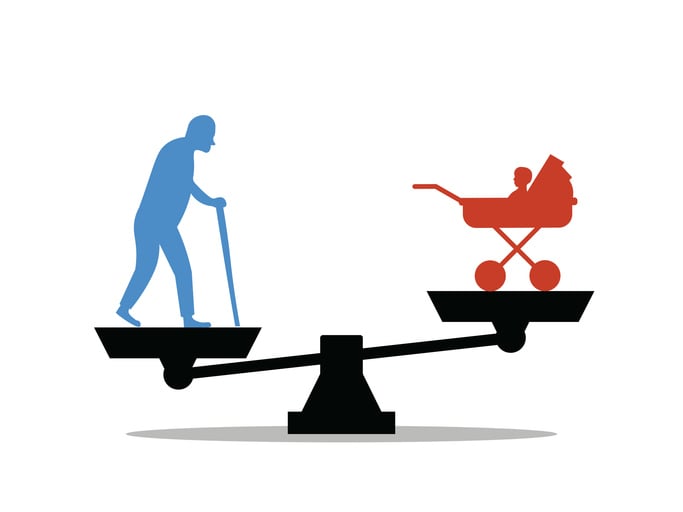
This is becoming very unbalanced as there are simply too many older people compared to younger ones.
In fact, according to Bloomberg4, the native-born US population ages 16 through 64 has been flat since 2016 and now declining - coinciding with the overall declining birth rates.
Actually, according to the same data, it’s immigration that’s carrying the working-age population. . .
Just take a look at the immigrant working-age population in the same 17-year period – it’s risen sharply.
Why Immigration Matters More as Birth Rates Fall
As shown above, the major advantage the U.S. has over many other developed countries is immigration.
Immigration helps offset low fertility by adding workers, taxpayers, consumers, entrepreneurs, and future families. It can support labor-force growth even when the native-born working-age population stagnates or declines.
This is important because the U.S. working-age population would look much weaker without immigrants.
That said, immigration is not a free lunch.
More people can also increase demand for housing, infrastructure, schools, healthcare, and public services. If housing supply is already tight, immigration can add pressure to rents and home prices. If local governments are underfunded, fast population growth can strain services.
Thus, the point is that in a low-birth-rate world, immigration becomes much more important to economic growth.
Countries that can attract and integrate workers have a demographic advantage. Countries that cannot may face sharper labor shortages and slower growth.
Why Are Birth Rates Declining?
Now, you may be wondering, “Why is the fertility rate sinking all over?”
There are various theories on this. But one I find the most compelling was from reading economist Robert J. Gordon’s book – “The Rise and Fall of American Growth (2016)” - which was an exhaustive 800-page tome on the history of the U.S. economy since the first industrial revolution (late-1700s).
The gist was that there were four major drivers for this change:
As the economy urbanized (moving from rural farmland to cities), families required fewer children to help maintain chores on the land.
The child mortality rate has declined steadily5 over the last 220-plus years – from 462 per 1000 births in 1800 to just 7 in 2020 - which indicates women needed to have fewer children without worry of some passing away.
The introduction of social safety nets sponsored by the state (such as Medicare or social security or pensions). These programs meant parents didn’t need to depend on having more kids to subsidize and care for them during their retirement.
The rising cost of living. This is probably one of the more important ones as families may find it easier to pay for one or two children than three or four. Simply put, having more kids is extremely expensive (according to the USDA6, the average cost of raising a child is $233,610 as of 2017, and this doesn’t include college).
Another factor to consider is the change in the family dynamic – specifically with women entering the workforce in droves post-World War Two.
Take a look at the following chart showing the labor force participation rate for women since the 1950s – rising from 33.4% to 56.7% as of September 2026.
As women began focusing more on careers, it essentially meant less time to focus on children (an opportunity cost).
Every individual and family may have their reasons for reducing the number of children they have. But the main points here worth highlighting are the structural issues – and these are not something that can be reversed easily (believe me, governments around the world have tried7 – from patriotic calls to duty and doling out cash to love cruises and investment into public daycare).
The Future of Demographics: What Lies Ahead?
Demographics are a problem plaguing the developed world – and while the U.S. isn’t in as bad a position as other major economies, it’s still suffering.
Lawmakers and commentators are alarmed by the decline, as headlines caution about an impending "demographic crisis" or "Great People Shortage” – because economies are facing a shortage of young workers to fill jobs and contribute taxes and social programs that subsidize the old.
And unfortunately, history suggests that regardless of governmental efforts to reverse this, global fertility rates continue to decline.
This will have big implications for global growth, immigration policies, government balance sheets, and the structure of the world economy.
Because if demographics are in fact destiny, things look pretty bleak. . .
This communication is general in nature and provided for educational and informational purposes only. It should not be considered or relied upon as legal, tax or investment advice or an investment recommendation, or as a substitute for legal or tax counsel. Any investment products or services named herein are for illustrative purposes only and should not be considered an offer to buy or sell, or an investment recommendation for, any specific security, strategy or investment product or service. Always consult a qualified professional or your own independent financial professional for personalized advice or investment recommendations tailored to your specific goals, individual situation, and risk tolerance. All examples are hypothetical and are for illustrative purposes only.
Information contained in the materials included is believed to be from reliable sources, but no representations or guarantees are made as to the accuracy or completeness of information. This document is provided for information purposes only and should not be considered as investment advice.
Dunham & Associates Investment Counsel, Inc. is a Registered Investment Adviser and Broker/Dealer. Member FINRA/SIPC. Advisory services and securities offered through Dunham & Associates Investment Counsel, Inc.
The U.S. Demographic Problem: Falling Birth Rates and an Aging Economy | Dunham




.png&w=3840&q=75)