Content Editor, Dunham | 2025 ThinkAdvisor Luminaries Award Winner | 2026 Wealthies Finalist, Thought Leader of the Year | Macroeconomics, markets, geopolitics & global trends
Updated June 2026:The current AI boom shows classic bubble traits. Valuations have exploded, corporate AI spending is increasingly financed with debt, and each new dollar buys less innovation than the last. At the same time, today’s shortages in power, chips, and data centers are setting up tomorrow’s overcapacity and margin crunch. The risk is that expectations, spending, and leverage outrun the revenue and productivity gains needed to support them.
Key Takeaways:
AI Mania: The excitement around artificial intelligence is starting to look a lot like past market bubbles.
Real Returns: Despite the hype, most companies aren’t seeing the profits they expected from AI adoption.
Big Spending: Tech giants are pouring trillions into AI, but more of it now comes increasingly from borrowed money (be wary of debt-fueled growth).
Supply Crunch: Shortages in power, chips, and materials today could turn into costly gluts tomorrow due to overcapacity and excess competition.
Market Reality: AI won’t collapse because it failed — it’ll cool off because success went too far, too fast (as most booms suffer from).
The AI Bubble Is Swelling: Debt-Fueled Growth and Hype Are Flashing Warning Signs
Since ChatGPT went public in late 2022, artificial intelligence (AI) has dominated every headline, every conversation, and every investment theme.
We’ve heard it all - “AI will take over the world,” “AI will reshape the economy,” and “Anyone not investing in AI is a fool."
So, let’s take a closer look at what’s really behind the boom - and why it may not last.
Is AI Market Hype Overbought — or Just Right?
We all know that emotions drive markets.
Greed lifts prices beyond reason
Fear brings them crashing back.
And right now, markets are drunk on optimism about AI.
Analysts, CEOs, investors, entrepreneurs – all convinced that AI will change everything and mint fortunes along the way.
And so far, they seem right.
But what if it doesn’t hold? What if the promised productivity revolution never quite materializes?
Well, if that happens, trillions in paper wealth could vanish – fast – as hype turns to fear.
And that risk is growing.
Back in August, the Massachusetts Institute of Technology (MIT) published a worrying paper showing that most companies aren’t seeing the revenue boom AI was supposed to deliver.
According to The GenAI Divide: State of AI in Business 20252, only 5% of AI pilot programs achieved meaningful revenue growth. The other 95% stalled, delivering little measurable impact on profit. The researchers found the problem isn’t exactly the models – but rather the execution (akacompanies are overspending on tools that don’t integrate, don’t learn from workflows, and don’t scale).
The result is an economy where AI adoption is soaring, but returns aren’t.
Even worse is that spending could start to backfire. If companies keep pouring money into underperforming systems, the payoff gap will grow wider - and valuations will have to adjust (more in the next section).
Still, falling hype doesn’t mean AI is useless (far from) - just that it might be overpriced right now.
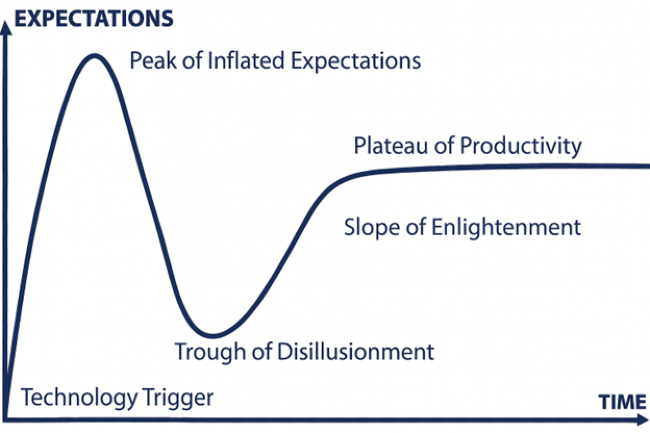
For example, as Gartner’s Five Phases of the Hype Cycle shows, technology booms often follow the same pattern:
Technology Trigger: A breakthrough sparks excitement - long on promise, short on proof.
Peak of Inflated Expectations: Hype completely outruns fundamentals.
Trough of Disillusionment: Projects start to fail, optimism fades, and only the strongest survive the culling.
Slope of Enlightenment: The survivors consolidate, learn, refine, and rebuild.
Plateau of Productivity: Real value emerges, albeit at a much slower and saner pace.
Figure 1: Gartner, Dunham, 2025
I’d estimate we’re around the peak of inflated expectations and sooner than later will plunge into the trough of disillusionment.
Hype seems surreal in this market. But that can quickly unwind.
Is the AI Boom Still Cash‑Funded — or Now Mostly Debt‑Fueled?
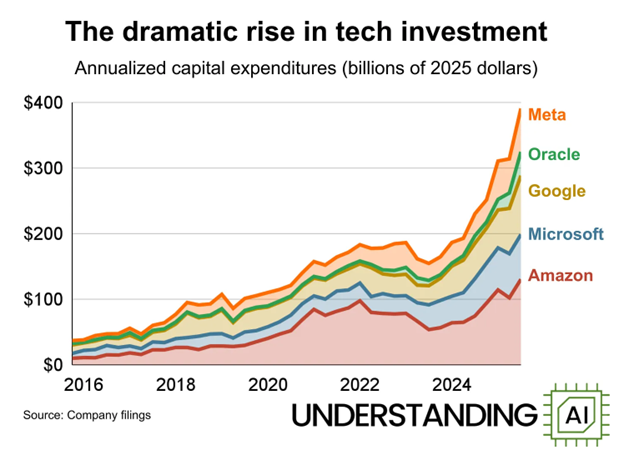
Big tech is spending fortunes in this AI arms race.
That’s more than the European Union’s entireannual defense budget.
And the spree isn’t even close to slowing. . .
Morgan Stanley estimates nearly $3 trillion in AI infrastructure spending from 2025–2028, enough to add about 0.5% to U.S. GDP growth this year and next.
Figure 2: UnderstandingAI, Substack, October 2025
Such massive investments are helping push companies’ profits (and their share prices) to records.
But this will – inevitably – lead to a significant squeeze in margins.
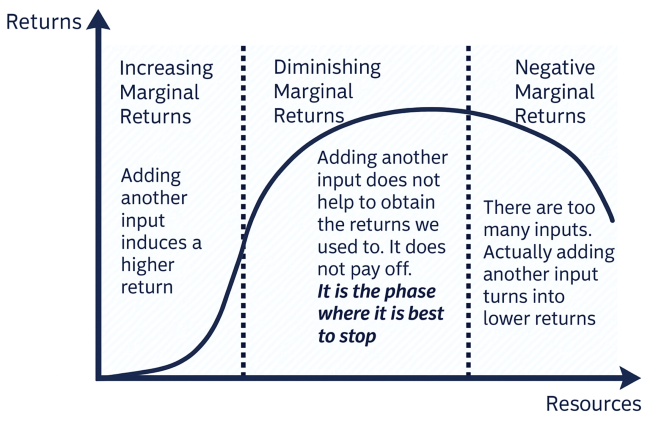
Why? Because of the law of diminishing returns.
Meaning every boom begins with productive spending - and ends with unproductive spending.
The early money spent in AI created breakthroughs - ChatGPT, copilots, image generation, and autonomous code. Each dollar then delivered exponential returns in capability.
But now? The spending curve has gone parabolic while the innovation curve is flattening – aka more spending for less innovation.
Said another way - the marginal gain from each new model or chip is shrinking - yet the cost of chasing it keeps drastically rising.
It’s like squeezing juice from an orange - the first press gives you everything, the next gives you less, and eventually, you’re just twisting the rind and hurting your hand for nothing.
Figure 3: Dunham, 2025
Simply put, the weight of this enormous AI spending will eventually collapse under its own mass.
Meanwhile, the top players in the AI space are increasingly engaging in sketchy circular financing deals - which is historically a fragile sign.
What’s circular financing? I wrote about this before, but in short - it’s when suppliers essentially fund their own sales. GPU makers, for example, are reportedly lending money to data-center firms so those firms can buy more chips - booking revenue up front while financing future buying. It’s a loop that looks like growth but risks turning into malinvestment - much like the late-1990s telecom boom when Cisco and Lucent extended credit to customers to sustain orders. And when the lending stopped, so did the buying.
The same risk now looms over AI.
Because subsidized momentum fueled by self-financed spending = more fragility.
What started as a cash-flow story is now entering its credit-driven chapter.
Keep in mind that most companies here remain financially strong, but the trend shows that AI spending is stretching even Big Tech’s balance sheets.
Thus, as credit replaces cash, the story of organic, self-funded growth is giving way to one of rising leverage, opaque financing loops, and uncertain payback - the classic signals of a boom nearing its peak.
Put simply, every boom runs on hype until it starts borrowing against it. Then it’s a recipe for disaster.
Will Today’s AI Power and Chip Shortages Become Tomorrow’s Glut?
A ripple effect from all this AI hype and spending has been the extreme shortage of supplies - from commodities, power, and space.
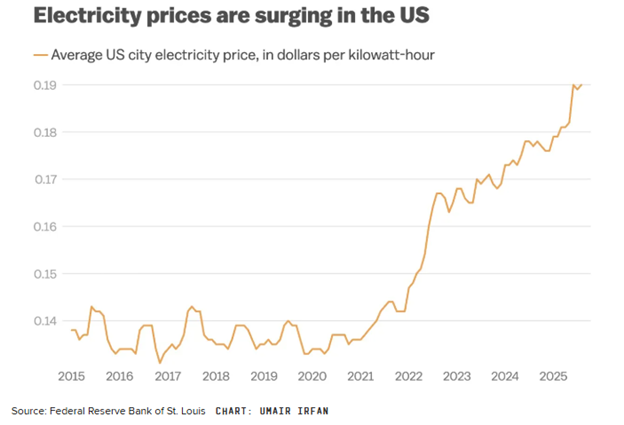
Because of this, prices for copper, aluminum, and energy have soared, and some regions are already rationing electricity for new projects.
Many Americans already dislike the idea of AI taking their jobs. And they’ll like it even less when it starts raising their power bills further.
Figure 4: WIRED.com, October 2025
Thus, what started as an AI revolution is now colliding headfirst with the limits of the physical world and rippling into something far bigger.
And when prices rise, entrepreneurs rush in to chase profits.
But – like every bubble before - we’re not seeing the true innovators anymore.
We’re seeing what I call “slop-preneurs” - the latecomers who pile in when the real opportunity’s already been picked clean.
They put AI in their name and expect markets to love it.
They build when materials are most expensive.
They borrow when credit is tightest.
And arrive just in time to catch the downslope.
Thus, they’re not creating efficiency - just chasing momentum.
And in every cycle, it’s the slop-preneurs who show up last - and leave first.
But - there’s upside when they do show up. . .
Because these slop-preneurs will bring on extra supply – helping ease shortages and push prices down.
Sure, many will likely go bust from excessive competition and falling prices that crush margins (from overcapacity). But the last firms standing will pick over their bones and grow stronger.
The only problem is that this may take a while to play out.
You can’t build a nuclear reactor, data center, or new copper mine overnight, right?
The point is, shortages always create gluts, and gluts always crush margins.
This boom has already planted seeds of its own destruction.
Am I saying AI isn’t important? No - it’s clearly revolutionary.
Am I saying it’s not worth watching? Absolutely not. It will reshape industries, workflows, and maybe even economies.
But is the hype worth the price being paid for it right now? That’s where I have doubts.
It’s like climbing a mountain long after the summit’s been reached - the view doesn’t get better, the air just gets thinner.
That’s where we are with AI. The technology isn’t the problem. The hype and valuations are.
History shows that cycles – booms and busts – are inevitable. And every great innovation eventually overshoots its value before crashing back down into reality.
The internet did.
Railroads did.
Electricity did.
And I believe AI will too.
And when it does, it won’t mean the end of AI - far from it. It’ll simply mark the end of the illusion that it could defy gravity at any cost.
Thus, AI won’t collapse from failure - it’ll stumble under the weight of its own success.
Because in markets, progress is never the real problem. Hype, valuations, and scarcity always are.
But as always, this is just some food for thought.
Frequently Asked Questions About AI Infrastructure Capital Cycles
What is circular financing in the AI chip supply chain? Circular financing is a closed loop where hardware suppliers fund their own buyers. Tech suppliers invest money or back credit lines for AI startups and cloud firms. Those buyers then use that capital to buy chips and servers from the same supplier. This moves cash off the balance sheet as an investment and returns it as sales revenue, echoing telecom vendor financing from the late 1990s.
Why did 95% of corporate generative AI pilots fail to generate revenue? Most corporate AI pilots failed to make money because companies struggled to fit the tools into daily work routines. An MIT report found that 95% of business pilots stalled without real revenue gains. Companies bought broad, off-the-shelf tools that did not link to internal databases or show a clear return on cash spent.
How do data center power constraints trigger the capital cycle? Power limits spark the capital cycle by pulling big money into long-term energy projects. Giant data centers need huge amounts of power, which strains utilities and pushes up local electric bills. That shortage draws cash to build new plants and lines. Because these big projects take three to seven years to finish, extra supply often hits the market after demand cools, cutting rents and profit margins.
How is debt replacing cash in hyperscale AI infrastructure spending? Tech giants are turning to bonds and private loans because yearly spending is nearing $400 billion. Instead of paying with pure cash, developers take on investment-grade debt and set up off-balance-sheet deals to build data centers. This debt brings fixed interest bills that companies must pay each month, even if software sales never cover the cost of the hardware.
This communication is general in nature and provided for educational and informational purposes only. It should not be considered or relied upon as legal, tax or investment advice or an investment recommendation, or as a substitute for legal or tax counsel. Any investment products or services named herein are for illustrative purposes only, and should not be considered an offer to buy or sell, or an investment recommendation for, any specific security, strategy or investment product or service. Always consult a qualified professional or your own independent financial professional for personalized advice or investment recommendations tailored to your specific goals, individual situation, and risk tolerance.
Information contained in the materials included is believed to be from reliable sources, but no representations or guarantees are made as to the accuracy or completeness of information.
Dunham & Associates Investment Counsel, Inc. is a Registered Investment Adviser and Broker/Dealer. Member FINRA/SIPC. Advisory services and securities offered through Dunham & Associates Investment Counsel, Inc.