Content Editor, Dunham | 2025 ThinkAdvisor Luminaries Award Winner | 2026 Wealthies Finalist, Thought Leader of the Year | Macroeconomics, markets, geopolitics & global trends
Copper prices are rising because demand from power grids, AI data centers, electric vehicles, and industrial electrification is growing faster than new mine supply. Since major copper mines can take 16 to 25 years to develop, today’s supply shortage may persist well into the 2030s and potentially toward 2040.
Key Takeaways
Copper prices are up over 100% since pre-COVID levels — but the primary driver is a structural supply deficit rather than a booming global economy.
According to Morgan Stanley, copper is entering its largest supply deficit in 22 years in 2026, with the gap forecast to deepen from there.
A major copper mine takes 16 to 25 years from discovery to first production — meaning today's price signals might not produce meaningful new supply until around 2040.
High copper prices feed producer inflation, inflation keeps rates elevated, and elevated rates make new mines harder to finance — a self-reinforcing loop that could keep the deficit open far longer than most models assume.
Dr. Copper's signal is still critical. But what it's diagnosing has changed — from economic expansion to decades of underinvestment arriving as a present-tense problem.
Listen to this blog here
11:35
When most people picture it, they imagine pennies, old pipes, wire spools sitting in a hardware store.
Unglamorous. Industrial. Boring, even.
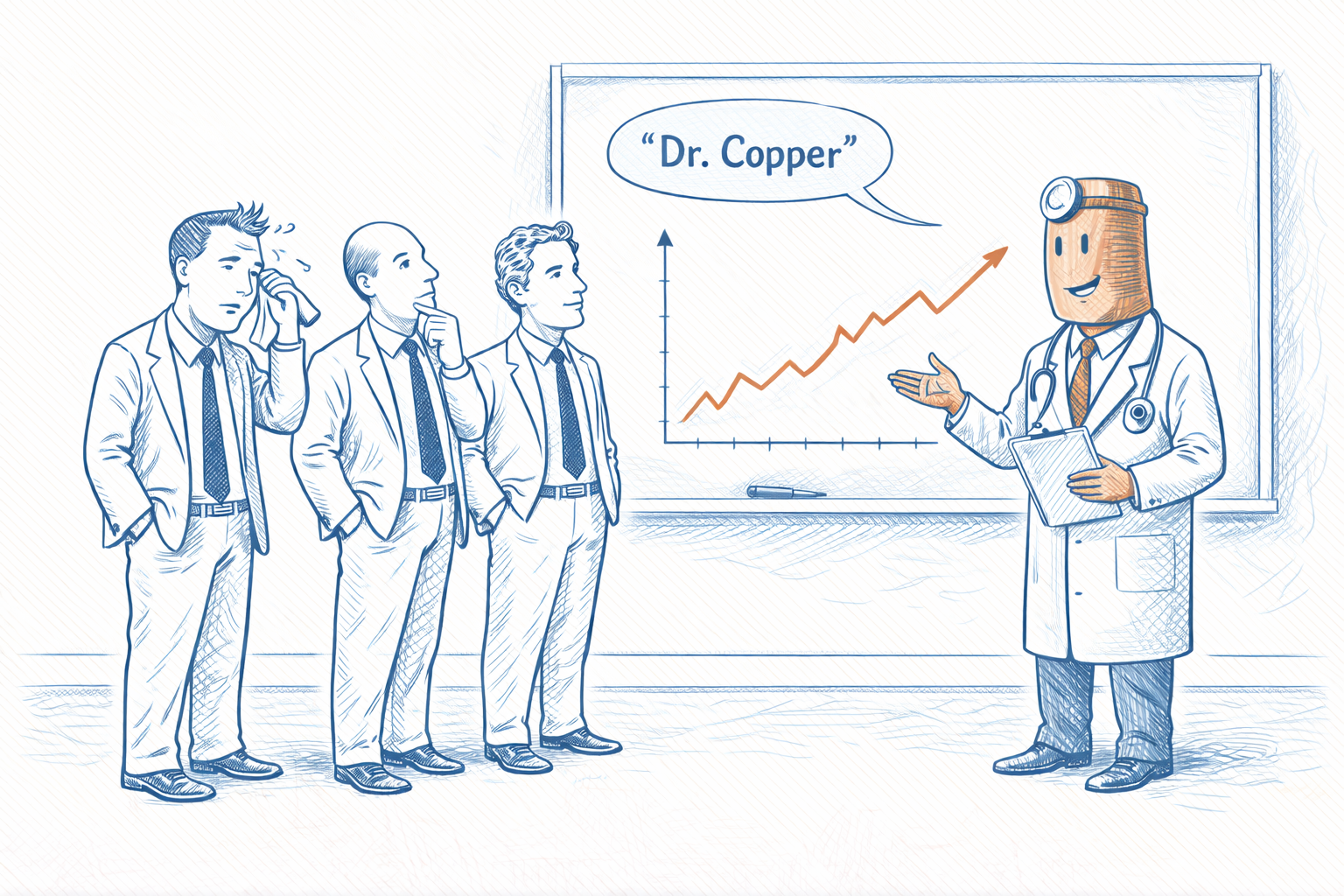
But on Wall Street, copper has a nickname - Dr. Copper.
It’s the metal with a PhD in economics. Why? Because copper is inside virtually everything - from buildings and vehicles to grid lines and consumer electronics - thus its price has historically told you something about the global economy.
And that is – when copper prices rise, global demand is probably expanding. And when prices fall, a slowdown is coming.
It’s a clean signal that’s been historically accurate.
And with copper prices up over ~100% since pre-COVID levels, you'd think the global economy was booming.
So - is it? Yes and no.
Copper prices are rising partly because grid buildouts, data centers, and electric vehicles are driving demand.
But the bigger driver is simpler - there just isn't enough copper being mined.
Let's look at why prices may stay much higher - even if global demand eventually declines.
Why the Copper Supply Deficit Could Last Until 2040
What's driving it is decades of underinvestment in new mine discovery, combined with demand that keeps accelerating. The mines that could have corrected this imbalance were never found - or were found too late to matter.
Meanwhile, the low-hanging fruit has been picked clean.
BHP's analysis with MinEx Consulting3 tracks major copper discoveries - those exceeding three million metric tons of copper-equivalent - going back to 1900. And the data is interesting.
The post-war decades through the 1970s produced a hefty cluster of major finds – mines like Escondida, Olympic Dam, Antamina. Large deposits. Relatively shallow. Discovered during an era of aggressive global exploration when the most accessible ore was still sitting undiscovered.
But since roughly 1990, the pipeline has thinned dramatically. . .
Fewer finds. Smaller deposits. And far deeper to get to.
For example, the Resolution deposit in Arizona - one of the more significant recent discoveries - sits at roughly 1,300 meters below surface. Most of the deposits that built today's global copper supply base were found within the top few hundred meters of the earth's crust.
Thus, the accessible ore has largely been found. And what remains is harder to reach, more expensive to develop, and further from production than anything that came before it.
In fact, BHP estimates that a quarter-trillion dollars in new investment is needed over the next decade just to close the supply gap – which is a substantial sum many miners may hesitate to raise.
Why Higher Copper Prices Can’t Quickly Fix the Supply Shortage
Supply constraint
What the evidence shows
Why higher prices aren’t a quick fix
New mines take decades to reach production
S&P Global estimates an average of 24.1 years from discovery to production for copper projects in its expanded analysis, which includes projects still in development.
Higher prices can encourage exploration today, but a new discovery may remain decades away from supplying copper.
U.S. projects face even longer timelines
The same analysis puts the U.S. copper average at 31.8 years, compared with 24.1 years globally.
Large domestic deposits offer potential supply, but permitting, studies, and development uncertainty can delay their contribution.
Some major deposits lie much deeper underground
BHP and MinEx data place Escondida’s main deposit at roughly 40 meters below the surface, versus 1,280 meters for Resolution.
A valuable discovery still needs an economically and technically workable path to extraction. Deeper deposits can make that path more costly and complex.
Closing the gap requires substantial investment
BHP’s analysis, presented by Visual Capitalist, estimated that the sector needed $250 billion of investment over the following decade.
A higher copper price is an incentive to invest—not a substitute for raising capital and developing projects.
Of course, there’s more to this. But the gist is there’s just not enough copper being discovered – or what is discovered is much more expensive to mine.
This is what will underpin the higher copper price thesis.
Not “booming demand” – but rather, not enough supply.
The Cobweb Model and Copper's Mine Development Lag
"This makes sense - but wouldn't higher prices justify the added risk and cost to explore deeper or bring on a marginal mine?"
Yes - they would. High prices invite more supply. That's how markets work.
But copper isn't farming. A farmer can rotate crops every couple of years. If soybean prices fall, he plants wheat next season. The adjustment cycle is one year.
In copper, the adjustment cycle is measured in decades - and that creates a problem most mainstream commentary never touches.
It's called the cobweb model4 – and it’s one of the most underrated concepts in economics.
The concept describes how prices can flow into disequilibrium and what happens when supply can't respond to price signals in real time.
When the gap between "prices are high, we should produce more" and when the new supply actually arrives is so long that markets overshoot in both directions - driving the multi-year boom-bust cycles that historically define metals, energy, and even housing.
The agricultural version is simple. Corn prices spike. Farmers plant more. By harvest, oversupply crashes the price. Planting drops the next season. Prices spike again. The cycle repeats - driven entirely by the lag between signal and response.
Copper has the same problem. The lag just isn't one growing season. It's decades.
Take a look at the chart:
Copper prices spike above equilibrium. Miners see the margins and greenlight new projects (the boom phase)
As I mentioned above, those mines take 16–25 years to build. Then, by the time supply arrives, it massively overshoots what the market needs (since multiple projects come online at once).
That oversupply crashes the price - sometimes lower than where it started (the bust phase).
At those depressed prices, investment stops entirely. Firms go bankrupt. And no new mines get built (consolidation phase).
Supply dries up. Scarcity pushes prices back up - higher than the previous spike.
The new high prices trigger another wave of mine investment. The cycle repeats.
Figure 3: Dunham, 2026
With this lens, the current copper boom makes complete sense.
The price collapse from 2011 to 2020 - when copper fell roughly 50% over nine years - stalled new mine development at exactly the moment when discoveries were getting harder to find and more expensive to reach. Thus, the supply deficit we're seeing today was years in the making.
This means that the price signal going out right now is scheduled for a supply response that may arrive around 2040 - at the earliest.
The point is - the boom-bust cycle in copper isn't a market failure. It's a market doing exactly what markets do - responding to price signals.
The problem is the clock. A 20-year lag between signal and response means the cure always arrives after the patient has already moved on. By the time new supply hits, the world has changed. And the next cycle has already started.
Will copper prices collapse eventually? Probably.
But the cobweb suggests it won't happen soon.
Energy Transition Demand Is Accelerating the Copper Deficit
So, if the supply deficit is the foundation of the copper thesis, demand is what's pouring concrete on top of it.
The International Energy Agency (IEA)7 estimates that global electricity grids will need to add or replace over 80 million kilometers of transmission and distribution lines by 2040 just to meet clean energy targets. And that grid investment needs to double to more than $600 billion a year by 2030.
80 million kilometers = enough wire to circle the earth more than 2,000 times.
Upgraded transmission lines, substations, transformer infrastructure - all of it requires copper at every layer.
Put simply, you can't power an AI economy on a grid built for 1965.
Meanwhile, electric vehicles add another sustained demand vector.
An EV can contain roughly two to four times the copper of a conventional internal combustion engine. As EV penetration climbs - S&P Global8 forecasts global plug-in electric vehicle uptake reaching 53% by 2035.
But even with conservative demand numbers, the copper market is being pulled from multiple directions simultaneously - at exactly the moment when new supply has the least capacity to respond.
How Copper's Supply Constraint Becomes an Inflation Input
Here’s the ironic part.
Copper doesn't show up on a grocery receipt directly. But it threads through the cost structure of almost everything built or powered - construction costs, manufacturing margins, utility infrastructure, EV sticker prices, data center buildouts.
When copper is structurally expensive for years, those input costs work through the production chain and surface in the price of finished goods and services. That feeds inflation. Inflation gives central banks less room to cut rates. And elevated rates create a direct problem for the one thing that could fix the copper deficit - new mine development.
Mining is a capital-intensive, long-horizon business with notoriously thin free cash flow. Returns are highly sensitive to financing costs. Marginal mines that looked viable at 2% don't get greenlit at 4%.
The loop closes on itself. High copper prices feed inflation. Inflation keeps rates higher. Higher rates make new mines harder to finance. Fewer mines means the deficit deepens. And the deficit keeps copper prices elevated.
Said another way, the cure and the disease are running on the same track.
What Rising Copper Prices Actually Signal in 2026
Dr. Copper hasn't lost his PhD. The price signal is still real.
But what it's diagnosing has changed.
For most of modern economic history, a copper price surge meant the global economy was expanding and supply would eventually respond. That read made sense when new mines were findable, financeable, and buildable within a reasonable timeframe.
But none of those conditions really hold today.
The ore that should have been found in the 2010s wasn't. The mines that would correct today's deficit are 15-plus years from production at best. The inflation copper is feeding is making those mines harder to finance. And the demand side - grids, data centers, EVs - isn't waiting around while the supply side catches up.
So if copper prices keep rising (I believe they will), the signal isn't "the economy is booming." It's forty years of underinvestment arriving as a present-tense problem.
Markets price what they can see. But what's driving copper right now is mostly underground, mostly unpermitted, and mostly two decades away.
That's a structural condition.
As always, time will tell.
Frequently Asked Questions About the Copper Supply Shortage
Why are copper prices rising in 2026? Copper prices are rising mainly because supply can't keep up with demand, not because the global economy is booming. Morgan Stanley expects copper to enter its largest structural deficit in 22 years starting in 2026. Decades of underinvestment in new mine discovery, combined with rising demand from power grids, AI data centers, and electric vehicles, are driving prices higher.
How long does it take to build a new copper mine? A major copper mine typically takes 16 to 25 years from first discovery to first production. In the U.S., where permitting alone can take a decade, that timeline skews closer to 25 years. This long lag means today's high prices won't likely trigger meaningful new supply until sometime around 2040.
What is the cobweb model and how does it explain copper cycles? The cobweb model describes what happens when supply can't respond to price signals quickly. High copper prices spark new mining investment, but because mines take 16 to 25 years to build, that new supply often overshoots demand once it finally arrives, crashing prices, followed by a bust that eventually feeds the next shortage-driven boom.
How is AI and the energy transition driving copper demand? AI data centers need extensive copper wiring for cabling and cooling, and the power grids feeding them, many built in the 1960s and 70s, need major upgrades to handle that load. The IEA estimates grids will need over 80 million kilometers of new transmission and distribution lines by 2040. Electric vehicles add more demand too, using two to four times the copper of a gas engine.
How could the copper shortage affect inflation and interest rates? Persistently expensive copper raises construction, manufacturing, and infrastructure costs, which feeds into inflation. That inflation gives central banks less room to cut interest rates, and higher rates make it harder to finance new mines, which are capital-intensive with thin cash flow. Fewer new mines mean the supply deficit lasts longer, keeping copper prices high in a self-reinforcing loop.
This communication is general in nature and provided for educational and informational purposes only. It should not be considered or relied upon as legal, tax or investment advice or an investment recommendation, or as a substitute for legal or tax counsel. Any investment products or services named herein are for illustrative purposes only and should not be considered an offer to buy or sell, or an investment recommendation for, any specific security, strategy or investment product or service. Always consult a qualified professional or your own independent financial professional for personalized advice or investment recommendations tailored to your specific goals, individual situation, and risk tolerance. All examples are hypothetical and are for illustrative purposes only.
Information contained in the materials included is believed to be from reliable sources, but no representations or guarantees are made as to the accuracy or completeness of information. This document is provided for information purposes only and should not be considered as investment advice.
Dunham & Associates Investment Counsel, Inc. is a Registered Investment Adviser and Broker/Dealer. Member FINRA/SIPC. Advisory services and securities offered through Dunham & Associates Investment Counsel, Inc.