Content Editor, Dunham | 2025 ThinkAdvisor Luminaries Award Winner | 2026 Wealthies Finalist, Thought Leader of the Year | Macroeconomics, markets, geopolitics & global trends
A BRICS currency would aim to reduce reliance on the U.S. dollar, but replacing its global role would require trusted institutions, liquid financial markets, and broad international acceptance. BRICS payment initiatives currently emphasize local currencies. Trade imbalances and China’s capital controls add challenges, while the dollar’s established role in reserves, borrowing, and trade supports its continuing dominance across global finance.
Key Takeaways:
De-dollarization has several forms: Countries can diversify reserves, settle trade in local currencies, and develop alternative payment systems.
BRICS members have different economic priorities: The expanded bloc brings together countries with varied interests, complicating coordinated financial initiatives.
Trade imbalances matter: Export-oriented economies depend on demand elsewhere, making domestic rebalancing an important part of the discussion.
Financial infrastructure is critical: A widely adopted reserve currency needs trusted, accessible markets and assets investors can readily buy and sell.
The dollar retains substantial advantages: Its established role in reserves, international banking, and payments creates a high barrier for alternatives.
Over the last few months, we’ve seen a wave of hysteria regarding ‘de-dollarization’ and the formation of a BRICS currency. And many investors and clients may be spooked about this.
Now, what do I mean by de-dollarization?
Well, de-dollarization is the theoretical process of countries reducing their reliance on the U.S. dollar for global trade, central bank reserves, and financial transactions.
Simply put, it’s the concept that the global economy is moving away from the dollar and U.S. bonds.
But let’s be clear – BRICS is simply:
A diminishing growth engine in China (the C).
A golden goose that’s never laid an egg - but has potential - in India (the I).
And three anemic commodity producers in Russia (R), Brazil (B), and South Africa (S).
Headlines like “Argentina Ditching Dollar” and “Saudi Arabia Moving Towards Chinese Yuan” and “Brazil Declares War On Dollar” have spread like a fire.
But I don’t buy the hype.
Why?
Because there are imbalances within the BRICS economies - such as they all essentially run current account surpluses (except India). Have extremely high domestic savings rates. And - I believe - would most likely depend on the Chinese economy and the yuan as the backbone of a currency bloc.
This may sound like a mouthful, but I’ll explain why these things truly matter when trying to envision a BRICS currency and economic union.
Now, it’s not impossible for a BRICS currency to happen. But it would require a hefty amount of pain that these countries likely don’t want to endure.
Or rather, it’s not as easy as many mainstream talking heads claim. It would completely upend their economies and trade flows to switch from dollar reserves to their own BRICS currency.
Now, keep in mind this is a complex macroeconomic topic (although grossly underrated). And I don’t plan on covering everything.
But these are important topics that not many seem to discuss regarding a BRICS currency.
So, let’s take a closer look at all this and why it matters. . .
Why Are Current Account Surpluses a Problem for a BRICS Currency?
A current account surplus means a country receives more from trade, income, and current transfers than it pays abroad. It also reflects national saving exceeding domestic investment. Surpluses and deficits balance across the world, subject to measurement discrepancies. imf
In economics, it’s generally taught that a country running a current account surplus is a ‘good’ thing - and that a deficit is ‘bad’.
But I don’t look at things so black and white - especially in economics and markets.
Instead, it’s just a balancingact – neither good nor bad.
A better way to think of it is that balance of payments (BOPs – global deficits and surplus measures) are basically accounting for countries - meaning a surplus in country A is a deficit in countries B or C or D, etc. (and vice versa).
So – for example – if China runs a surplus, that necessarily means some other country ran a deficit.
Now, why does this matter?
Because currently, almost all BRICS run chronic current account surpluses (with India potentially moving towards one1).
Why Do BRICS Nations Depend on Western Deficits?
Meanwhile, the U.S. and U.K. run large current account deficits to match these (remember, it must balance).
For perspective, the International Monetary Fund (IMF) recently noted2 in 2022 the evolution of global current accounts (as a percentage of world GDP) after the Russia-Ukraine war began.
And as you can see, not only do they balance. But has actually widened since 2020 (but is expected to narrow in the coming years according to the IMF).
Figure 1: IMF. 2023
Seems ‘good’ for BRICS, right?
Well, not so fast.
These current account surpluses also indicate that BRICS (and Germany, Saudi Arabia, and Japan) have unbalanced economies.
What I mean is, they aren’t consuming what they produce, thus needing to export the rest abroad (hence the surplus).
Another way to put this is that these current account surpluses show us that BRICS have low domestic demand. And thus, depend on the Western economies to import their glut of goods and savings for growth.
In fact, according to Investopedia3, a current account surplus indicates, “low domestic demand, or may be the result of a drop in imports due to a recession.”
These chronic BRICS surpluses indicate two things:
High Savings, Low Consumption: The Achilles’ Heel of BRICS
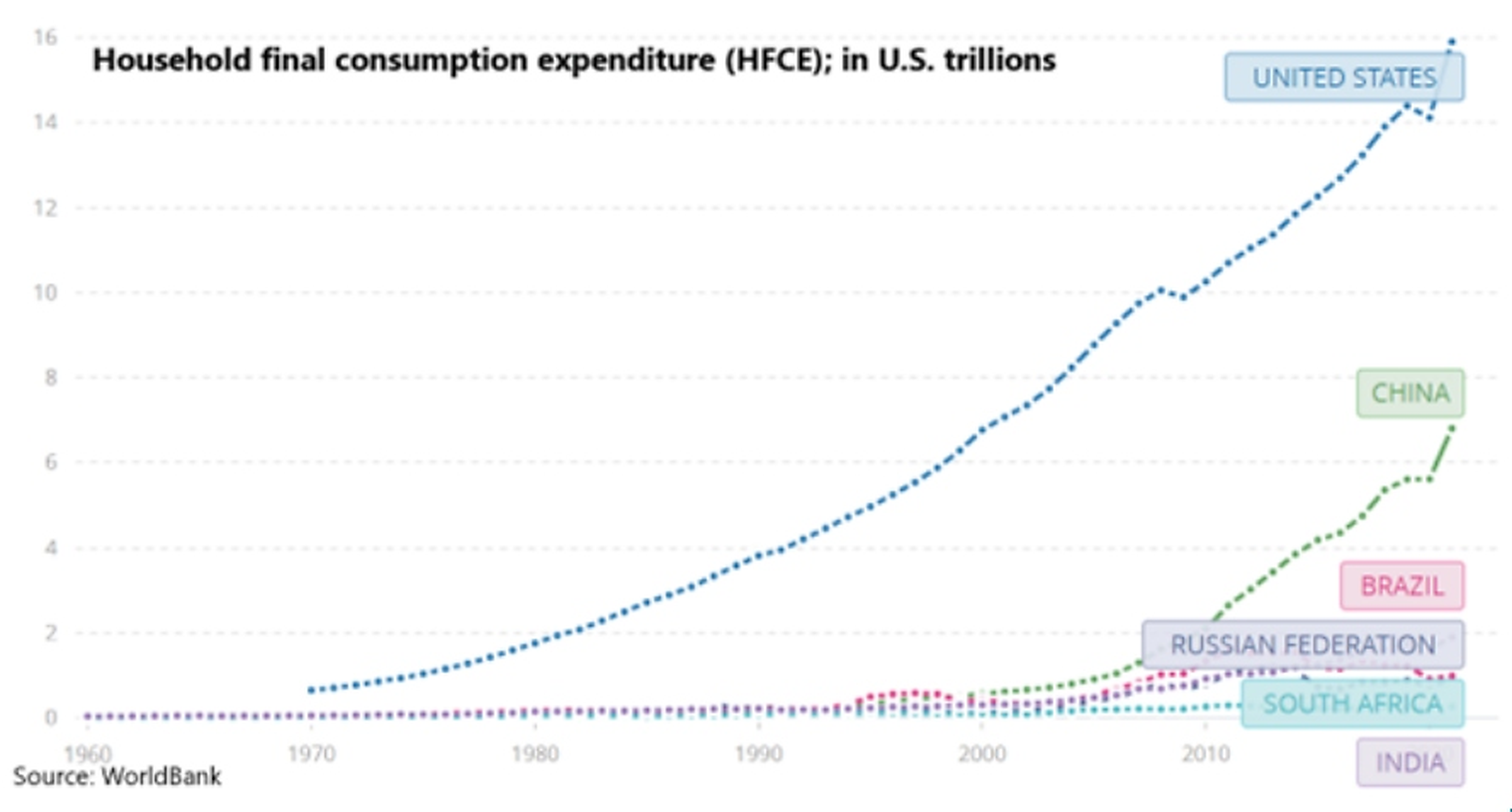
Just look at the World Bank’s household financial consumption expenditures (HFCE – aka consumer spending) as of the end of 2021.
There’s a thick gap between consumer spending in the BRICS compared to the U.S.
Figure 2: World Bank, 2023
To put this into context, U.S. consumer spending is nearly $16 trillion – which is 50% more than allof BRICS put together ($10.8 trillion).
The consumer classes in BRICS just don’t have enough purchasing power to absorb all of what they produce and therefore depend on exports.
Thus, if it wasn’t for the deficits (excess buying) in the West, these economies would likely drown in deflation and unemployment as all their unconsumed goods sit idle (which is what we’ve seen happen in China over the last 10 months).
Or – putting it plainly – they depend on their exports to the West for growth and foreign reserves at the expense of their own anemic consumers.
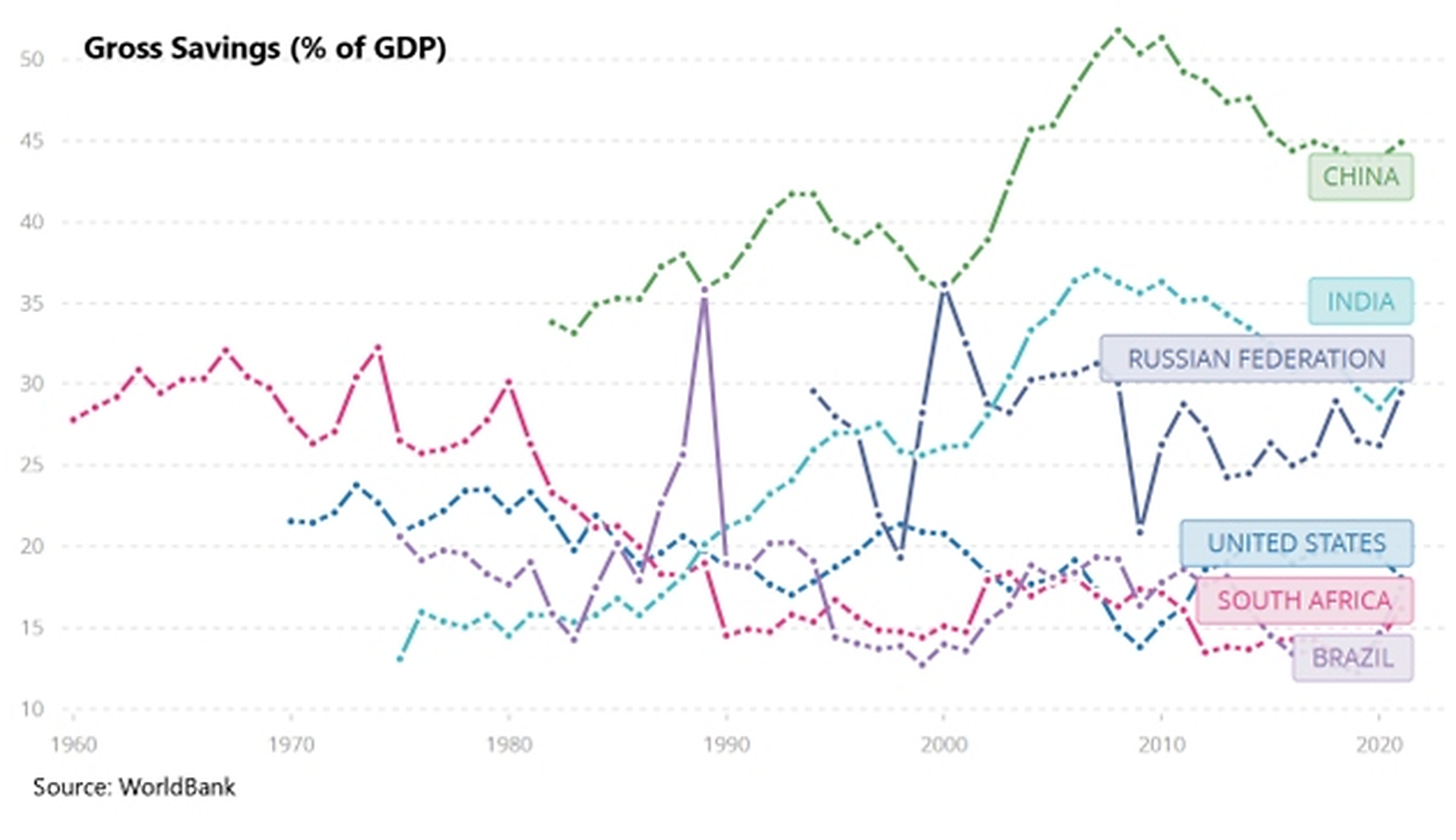
Figure 3: World Bank, 2023
Note that other major current account surplus nations4 – such as Germany, Japan, South Korea, and Saudi Arabia – also have very high savings rates.
Germany is at 26%. Japan is at 25%. South Korea is at 35%. And Saudi Arabia is at 29%.
These numbers dwarf the U.S.’s 17% and U.K.’s 15% savings rates.
Keep in mind that households can only do two things with income – dissave (consume) or save (not consume).
And when there are more domestic savings on a national level, it means less consumption.
In fact, many of these BRICS and emerging economies depend on high savings (low consumption) policies to fuel export growth.
This is known as the Gerschenkron growth model5 – named after classical economist Alexander Gerschenkron.
The Gerschenkron growth model is an economic strategy where developing nations suppress domestic consumption to channel high national savings into state-backed export and industrial growth.
He essentially wrote that the more backward an economy is at the outset of development, the more likely certain conditions will occur - such as:
Government-controlled banks that channel physical and human capital into specific industries (such as oil or manufacturing).
A focus on producer goods rather than consumer goods.
An emphasis on agricultural/commodity sectors, as the market for new domestic industries will be small.
More capital-intensive production rather than labor-intensive production (focus on capital for returns rather than labor efficiency).
Do all sound familiar?
This is what China, Russia, Brazil, South Africa - and even Japan, Saudi Arabia, and Germany - have done to some extent.
Thus, the high savings turn into less domestic consumption, which creates a larger current account surplus (lower imports to consumer while exporting more) – translating into more dollar reserves in state coffers.
Why Is a BRICS Currency Unlikely to Replace the U.S. Dollar?
And what do they do with these dollar reserves? They buy U.S. bonds as collateral (yield) and often use it to keep their currencies weak against the dollar – making sure export growth continues.
I know this may sound technical, but the gist is that BRICS depend on others to absorb their excess exports – mostly the Western countries (such as the U.S.).
Or rather, if U.S. import demand weakened, export-oriented economies could face pressure to find other buyers or strengthen demand at home. Thus, the impact would depend on each country’s trading relationships and ability to adjust.
Breaking from the dollar would completely force these nations to rebalance their economies. Something they don't seem willing to do thus far. . .
What Does the Future Hold for the U.S. Dollar?
Now, the appeal of a BRICS currency is understandable. It promises autonomy, leverage, and insulation from U.S. policy.
But currencies don’t run on promises. They run on imbalances.
It’s just far more disruptive - and far less politically convenient - than most are willing to admit.
Frequently Asked Questions About BRICS Currency and De-Dollarization
What is a BRICS currency? A BRICS currency is a proposed shared currency or settlement unit that would support payments among member countries and reduce reliance on the U.S. dollar. Official efforts have focused on financing in local currencies and cooperation on cross-border payments. Key questions include who would issue it, how its value would be set, and what assets would back it.
Can a BRICS currency replace the U.S. dollar? A BRICS currency would need broad acceptance and deep, trusted financial markets to replace the U.S. dollar. The dollar’s widespread use in reserves, banking, and payments gives it a strong advantage. BRICS efforts currently focus on local-currency payments and payment cooperation. Progress in those areas is separate from matching the dollar’s much larger role in global finance.
Why is de-dollarization difficult? De-dollarization is difficult because countries and businesses use the dollar across trade, borrowing, banking, and reserves. Changing those habits requires trusted alternatives and coordination among users. Deep U.S. financial markets support dollar use, while China’s capital controls and concerns about investor protections limit the yuan’s appeal. More local-currency payments can reduce dollar reliance without replacing its wider role.
Can China’s yuan become a global reserve currency? China’s yuan is already a reserve currency, making up 1.99% of global foreign-exchange reserves in the first quarter of 2026. The dollar’s share was 57.13%. Expanding the yuan’s role faces barriers, including capital controls, limits on financial access, and concerns about investor protections. Using the yuan more often for payments doesn’t necessarily mean central banks will hold more of it.
This communication is general in nature and provided for educational and informational purposes only. It should not be considered or relied upon as legal, tax or investment advice or an investment recommendation, or as a substitute for legal or tax counsel. Any investment products or services named herein are for illustrative purposes only and should not be considered an offer to buy or sell, or an investment recommendation for, any specific security, strategy or investment product or service. Always consult a qualified professional or your own independent financial professional for personalized advice or investment recommendations tailored to your specific goals, individual situation, and risk tolerance. All examples are hypothetical and are for illustrative purposes only.
Information contained in the materials included is believed to be from reliable sources, but no representations or guarantees are made as to the accuracy or completeness of information. This document is provided for information purposes only and should not be considered as investment advice.
Dunham & Associates Investment Counsel, Inc. is a Registered Investment Adviser and Broker/Dealer. Member FINRA/SIPC. Advisory services and securities offered through Dunham & Associates Investment Counsel, Inc.
The Flaws of a BRICS Currency: Why Replacing the Dollar Is Difficult (For Now) | Dunham