Salvatore M. Capizzi, CEPA, CBDA, is Dunham’s Chief Sales & Marketing Officer with 45 years of financial-services experience. His commentary has appeared on Bloomberg Radio and Yahoo Finance and in Kiplinger, Financial Advisor magazine, and ThinkAdvisor. A 2026 ThinkAdvisor Luminaries and Wealthies finalist, he writes about retirement planning and advanced tax, trust, and estate strategies.
An Intermediated Installment Sale is a tax deferral strategy that allows sellers of highly appreciated businesses or real estate to defer capital gains taxes under IRC §453. By routing the sale through an independent trust, sellers preserve full pre-tax proceeds, eliminate buyer credit risk, and keep significantly more capital compounding over time.
Key Takeaways
Intermediated Installment Sales allow clients to defer capital gains taxes for up to 20 years under IRC §453 instead of paying them all at sale.
Deferring taxes preserves more investable capital, which can potentially increase income and long-term economic value.
Unlike carrying a buyer note, the structure removes buyer credit risk by using an independent trust.
Financial advisors may gain the opportunity to manage significantly larger asset pools compared to an outright sale.
If your client or prospect is selling a highly appreciated business or real estate, it can provide them with a wonderful and satisfying experience. They are seeing the seeds they planted grow into the valuable enterprise that it is today.
Our experience tells us that considering a planning tool known as an Intermediated Installment Sale could provide a number of overlooked benefits, which could be helpful while selling highly appreciated assets.
What Is an Intermediated Installment Sale?
An Intermediated Installment Sale is an alternative to an outright sale which uses IRS Code §453 as its foundation. Known as an Installment Sale, it provides a number of benefits when compared to an outright sale.
Eliminates the risk associated with “carrying a note” for a buyer
Can provide asset protection against creditors and lawsuits
Replaces income lost when selling a business or real estate
Provides capital gains deferral for up to 20 years
Allows you to use inflation to your advantage
This planning tool can potentially provide more investable cash and more income
At its core, an Intermediated Installment Sale spreads the income from the sale over the life of the installment note. In some circumstances, spreading the capital gains over multiple years can provide financial benefits compared to reporting the entire gain in one year.
How It Works: A Step-by-Step Breakdown
Step-by-step overview:
The asset owner negotiates a sale with a buyer
A trust is established, administered by an independent trustee
The trust purchases the asset from the seller in exchange for a promissory note
The trust sells the asset to the end buyer under the original terms
Proceeds from the sale are invested and administered per the terms of the trust
The seller receives payments per the note terms; financial professionals may provide investment guidance within the trust structure
By the Numbers: A $5M Sale, Two Very Different Outcomes
Let us explore a hypothetical case study and assume the following:
Your client or prospect intends to sell an asset in California.
They own 100% of the asset.
The asset is valued at $5,000,000.
Their cost basis is $500,000.
There is no third party debt, such as a mortgage or business loan.
For this hypothetical illustration, the applicable capital gains tax rates are:
- Federal tax rate of 20%.
- State effective tax rate of 12.93%.
- Medicare tax rate of 3.8%.[1]
*Note that there may be other state or local sale or transfer taxes that apply at the time of sale; these are not itemized here for purposes of this hypothetical example.
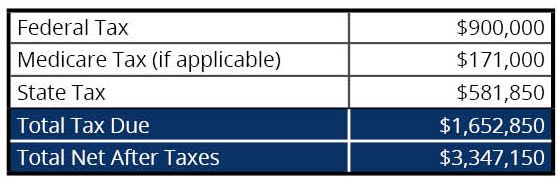
Based on our hypothetical case study, if you sell the business outright for $5 million and your cost basis is $500,000, your taxable gain is $4.5 million. Therefore, at sale, estimated capital gains taxes due will be:
Instead of an outright sale, you can sell the asset in a carefully constructed Intermediated Installment Sale. Since you defer taxes in the Intermediated Installment Sale, you would begin with the full $5 million invested as opposed to the after-tax amount of $3,347,333 in the outright sale.
The money in the trust from the completion of the Intermediated Installment Sale allows the trust to enjoy the "earning power" of the $1,652,567 that would have been immediately paid in taxes under the outright sale.
This can potentially provide more investable cash and more income.
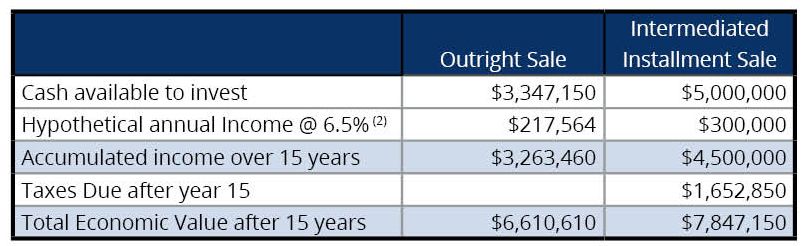
Below is a hypothetical illustration comparing an Intermediated Installment Sale to an outright sale of the asset. In the calculations, we assume a sale price of $5,000,000 with a cost basis of $500,000, as per the above hypothetical case study.
This illustration assumes the same post sales income tax on the investment income and same advisory fees but provides the net return on the trust after trust administration fees. We are assuming a 10-year note with an option taken for an additional five years for a total of 15 years. We are assuming this note is interest only with a balloon at the end of the 15 years, at which point, the tax on the sale of the asset is due.
In this hypothetical case study, the Intermediated Installment Sales potentially provides a total of $1,228,091 of additional income and economic value during the 15-year period.
In addition, if we assume a 2% rate of inflation, the present value of the tax due today of $1,652,850 paid 15 years from now, would be $1,228,091 or 74.3 cents on the dollar, thereby putting inflation to work for your client!
In our view, the Intermediated Installment Sale provides significant advantages to an outright sale – advantages many times over looked when transitioning ownership of a business or real estate.
At the same time, it creates a large pool of assets for you to manage.
The Bottom Line
An Intermediated Installment Sale can help clients defer capital gains taxes for up to 20 years, preserve investable capital, and benefit from inflation — while giving financial advisors the opportunity to manage significantly larger asset pools.
Also, please feel free to forward this to other financial advisors you feel may benefit from this strategy.
Sources
[1] The Medicare tax may not be applicable depending on the sale structure. For this illustration, it is included.
[2] Net return on the Intermediated Instalment sales is 6% due to trust’s 50 bps annual administration fee.
Disclosures
This communication is general in nature and provided for educational and informational purposes only. It should not be considered or relied upon as legal, tax or investment advice or an investment recommendation, or as a substitute for legal or tax counsel. Any examples are hypothetical and are for illustrative purposes only.
Information contained in the materials included is believed to be from reliable sources, but no representations or guarantees are made as to the accuracy or completeness of information.
IRS Circular 230 Disclosure: To ensure compliance with requirements imposed by the IRS, we inform you that any U.S. federal tax advice contained in this communication (including any attachments) is not intended or written to be used, and cannot be used, for the purpose of (i) avoiding penalties under the Internal revenue Code or (ii) promoting, marketing or recommending to another party any transaction or matter addressed herein.
Dunham & Associates Investment Counsel, Inc. is a Registered Investment Adviser and Broker/Dealer. Member FINRA / SIPC. Advisory services and securities offered through Dunham & Associates Investment Counsel, Inc.
Intermediated Installment Sale: Capital Gains Deferral for Up to 20 Years | Dunham